

A proprietary blend lists its ingredients but hides how much of each one you’re actually getting, showing only the combined weight of the whole mix. The core rule: choose products with transparent, per-ingredient dosing whenever you can. U.S. law permits blends, and a strong Certificate of Analysis or clinical backing on the finished formula can make one worth trusting anyway.
TL;DR:
- Proprietary blends list the total weight and ingredients but do not disclose individual ingredient amounts, making effective dosing difficult to verify.
- U.S. law requires disclosure of ingredient order and total weight but allows hiding specific doses, which can mask underdosing or undisclosed stimulants.
- Companies may use blends for trade-secret protection or marketing reasons, but hiding doses can also conceal weak or unsafe formulas.
- Consumers should scrutinize blends with small total weights, no testing data, or undisclosed key actives, especially if dosing appears lower than clinical standards.
- Transparency is best ensured through brands providing certificates of analysis, third-party testing, and clear disclosure of key ingredient amounts.
Table of Contents
- What a Proprietary Blend Looks Like on a Supplement Facts Label
- How Does U.S. Law Regulate Proprietary Blends?
- Why Do Companies Use Proprietary Blends?
- When Should a Proprietary Blend Worry You?
- Are Proprietary Blends Ever Acceptable?
- A Practical Checklist Before You Buy a Blended Supplement
- How Organicufuel Approaches Ingredient Transparency
- The Bottom Line on Proprietary Blends
- Why Most Advice on This Topic Misses the Point
- See the testing behind a natural stamina and vitality bundle
- Sources
What a Proprietary Blend Looks Like on a Supplement Facts Label
Look at the Supplement Facts panel on a pre-workout or testosterone support product and you’ll often see something like “Focus Matrix: 800 mg” followed by six or seven ingredient names underneath. That’s a proprietary blend. The label gives you the blend’s name, the total combined weight, and the ingredients ranked in descending order by how much of each is present. What it does not give you is the milligram amount of any single ingredient inside that matrix.
Ingredients that carry an established Reference Daily Intake or Daily Reference Value, known on the label as (b)(2) dietary ingredients, still typically get their own line with a specific amount even when a blend is present elsewhere on the panel. Everything else can disappear into the matrix.
Here’s the practical difference:
- Transparent labeling: “Ashwagandha extract” with a precise milligram amount tells you exactly what you’re taking and lets you compare it to clinical research.
- Proprietary blend labeling: “Vitality Matrix” with a total blend weight and a list of ingredients tells you the matrix totals a certain amount, but the amount of each ingredient inside is unknown.
That gap is the entire issue consumers run into, and it’s why regulators built specific rules around how blends can be labeled in the first place.
How Does U.S. Law Regulate Proprietary Blends?
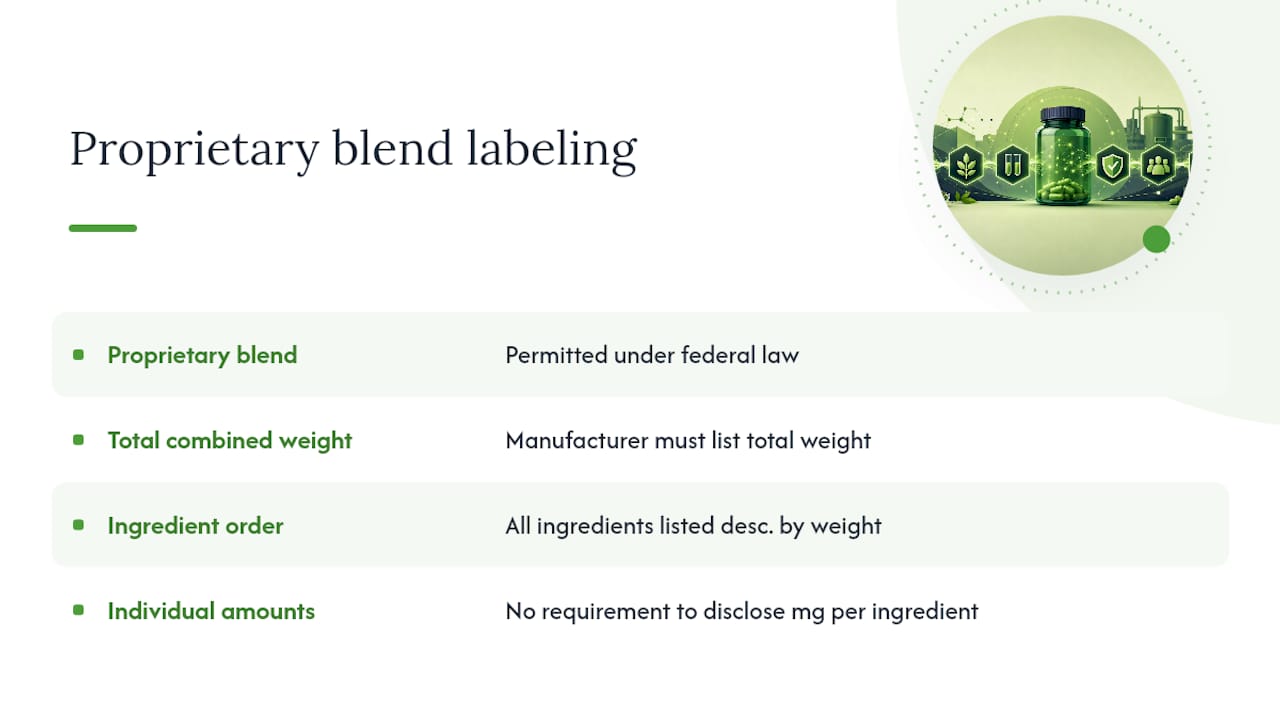
Federal law allows proprietary blends outright. Under 21 CFR 101.36, manufacturers must list the blend’s total weight and name every ingredient inside it in descending order by weight, but they are not required to break out the specific amount of each one. The Dietary Supplement Health and Education Act set up this framework decades ago, and it still governs how blends reach store shelves today.
The FDA doesn’t pre-approve supplement labels or formulas before they launch. Manufacturers are responsible for making sure their products are safe, their claims are truthful and substantiated, and their facilities follow Good Manufacturing Practices, according to the agency’s own consumer guidance on dietary supplements. There’s no government checkpoint verifying that a “Stamina Complex” actually contains an effective dose of anything.
That regulatory gap is exactly what researchers flag as a problem. A 2023 NIH/PMC perspective paper on proprietary blends points out that hidden dosing makes it difficult to calculate real-world exposure, assess safety, or replicate a product’s effects in clinical research. If scientists can’t determine how much of an ingredient a consumer actually consumed, they can’t reliably study whether that ingredient caused a benefit or a side effect.
By the numbers: Blends must disclose total weight and ingredient order under 21 CFR 101.36, but individual ingredient amounts inside the blend are not required to be disclosed.
Consumer-safety guidance from the Operation Supplement Safety program reinforces the same point: legal doesn’t mean fully informative. The law sets a floor, not a transparency standard.
Why Do Companies Use Proprietary Blends?
Not every company hiding a formula is trying to cheat you. Some legitimate reasons hold up:
- Trade-secret protection. A company that spent years dialing in ratios of six botanicals doesn’t want a competitor buying one bottle, reverse-engineering the label, and launching a clone next quarter.
- Marketing flexibility. Branding a “matrix” or “complex” lets a company sell the story of a formula rather than a list of commodity ingredients that any competitor could copy line for line.
- Formula control. Blends let manufacturers tweak ratios between production runs without redesigning the entire label each time.
Those motives are real, but they’re also the exact cover a less scrupulous brand needs to hide underdosing. If the actual amount of an ingredient never appears anywhere, nobody outside the company can tell whether you’re getting a clinically meaningful dose or a token sprinkle added mostly for the ingredient list. That practice has a name in the industry: fairy dusting.
When Should a Proprietary Blend Worry You?
Some blends deserve real scrutiny. Here’s what to watch for, in order of how much it should concern you:
- Underdosing you can’t verify. If a blend’s total weight appears smaller than typical clinical doses of some listed ingredients, the formula may be underdosed.
- Hidden stimulants. Botanical stimulants, and occasionally undisclosed synthetic ones, can sit inside a matrix without a visible milligram count, according to supplement safety guidance from OPSS. That matters for anyone managing blood pressure, anxiety, or medication interactions.
- Drug interaction risk. Without knowing the actual dose of an active compound, your doctor or pharmacist can’t accurately assess how it might interact with a prescription you’re already taking.
- Long ingredient lists paired with small total weights. A blend listing many botanicals with a low total weight may indicate potential underdosing.
- Vague matrix names with no accessible testing data. “Proprietary Energy Blend” with no Certificate of Analysis available on request is a brand asking you to trust it on faith alone.
Pro Tip: Search the product name plus “Certificate of Analysis” before you buy. If a brand has nothing indexed and won’t email you one on request, treat that silence as an answer.
Are Proprietary Blends Ever Acceptable?
Yes, in narrower circumstances than most marketing implies. A few scenarios hold up to scrutiny:
- The finished blend itself was clinically tested, rather than just its individual ingredients. If researchers studied the exact combination and ratio you’re buying, the blend format doesn’t erase that evidence.
- Traditional formulas with long-established ratios, where the combination itself, not any single herb, is the basis for historical use.
- Formulas that disclose the key active ingredients separately and blend only minor, supportive botanicals into a smaller matrix. That structure gives you the dosing information that actually matters while still protecting a secondary formula detail.
The distinction that matters: a blend built around real evidence for the combination is a different animal than a blend built to obscure weak individual doses.
A Practical Checklist Before You Buy a Blended Supplement
Run through this before any blended product goes in your cart:
- Do the math first. Compare the total blend weight to typical clinical doses of listed botanicals to assess if effective dosing for each ingredient is plausible.
- Look for a Certificate of Analysis. A COA can confirm ingredient identity and the blend’s total mass, but it usually can’t verify that each individual botanical hit a therapeutic dose when amounts aren’t disclosed on the label.
- Prefer third-party certification when it’s available, such as testing referenced by organizations like NSF or USP, even knowing its limits with undisclosed blends.
- Contact the manufacturer directly. A company confident in its formula will usually tell you approximate ranges for key actives, even if the label can’t legally itemize them.
- Scan for stimulant-containing botanicals hiding inside the matrix, especially in pre-workout or energy products.
- Talk to a clinician before use if you’re pregnant, managing a chronic condition, or taking medications that could interact with unknown-dose botanical actives.
Pro Tip: If two products claim similar benefits and one lists exact milligrams while the other hides everything behind a matrix name, the transparent one is the easier one to actually evaluate, not necessarily the only one that works.
How Organicufuel Approaches Ingredient Transparency
Organicufuel builds its formulas, including BioSync-XT and its Alpha Cactus formulation, around ingredients tested in U.S. labs rather than matrices designed to obscure amounts. Good manufacturer practice looks like this in real terms:
- Accessible testing documentation or a COA available to customers who ask.
- Manufacturing under Good Manufacturing Practices in FDA-registered facilities.
- A policy that allows customers to seek a refund if a formula doesn’t work for them.
- Ingredient explainers, like this breakdown of Alpha Cactus’s formulation, that show the reasoning behind a formula rather than just naming it.
By the numbers: Third-party testing can confirm a blend’s total mass and ingredient identity, but without disclosed per-ingredient amounts, it can’t certify that every listed botanical hit a therapeutic dose.
These are the baseline signals worth demanding from any brand, not just the ones you already trust.
The Bottom Line on Proprietary Blends
Default to transparent, per-ingredient dosing. Make an exception only when a brand backs its blend with real testing access, disclosed key actives, or evidence that the specific combination was clinically studied as a whole. Run the checklist above before buying anything with a matrix name on the label, and loop in a clinician if you’re pregnant, on medication, or managing a chronic condition. Transparency, not marketing language, is what actually protects you.
Why Most Advice on This Topic Misses the Point
Most guides treat proprietary blends as a binary: good brands disclose everything, and bad brands hide behind matrices. That’s too clean. The real split is between brands whose secrecy is defensible, backed by finished-formula research or genuine trade-secret protection, and brands whose secrecy exists purely to disguise a formula too weak to survive full disclosure.
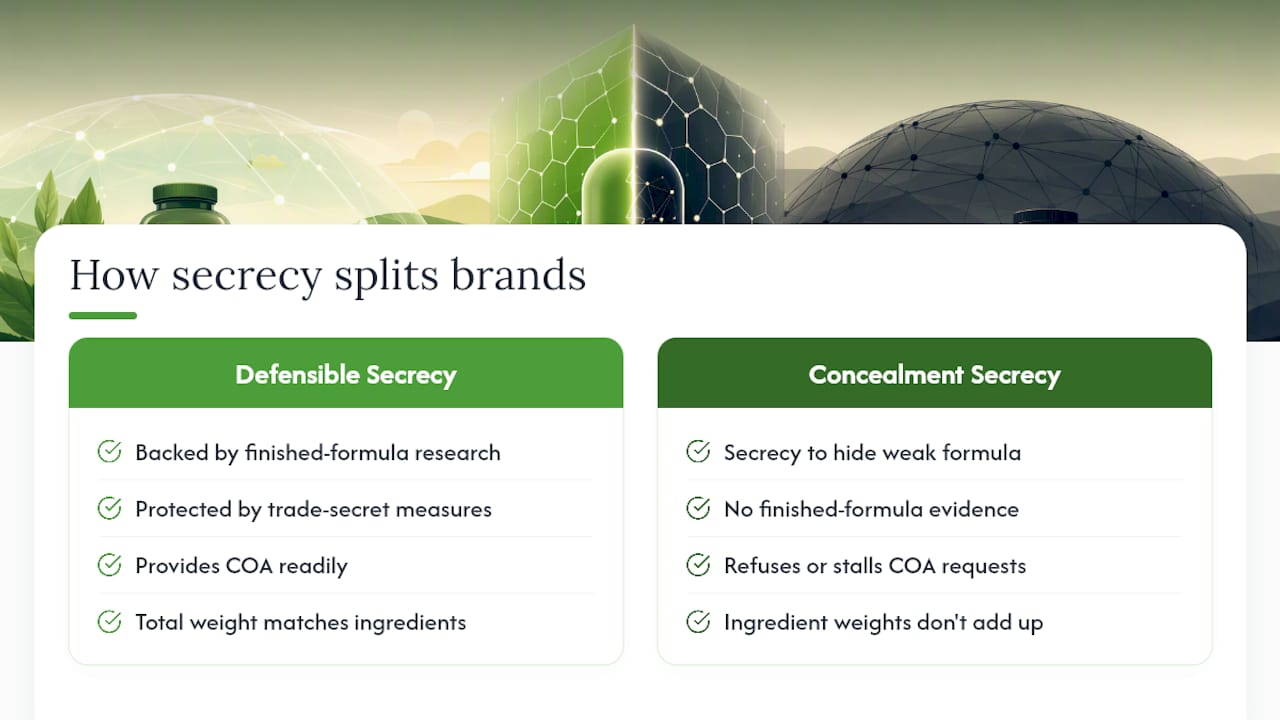
The conventional advice to “avoid all proprietary blends” oversimplifies a legal reality: the law never required full transparency in the first place, so blends aren’t a loophole some companies found. They’re a built-in option every company has. The real signal isn’t whether a blend exists. It’s whether the company acts like it has nothing to hide once you ask questions.
What consumers should prioritize first isn’t ingredient purity or brand reputation. It’s math and access. Can you estimate whether the total weight makes sense for the ingredients listed? Can you get a COA without a fight? Those two questions filter out most of the products worth walking away from, long before you need to evaluate a single botanical’s research.
— Organic
See the testing behind a natural stamina and vitality bundle
If you’ve made it this far, you already know what to look for: disclosed testing, a formula built on more than marketing language, and a company willing to back what it sells. The Bad Boy Bundle from Organicufuel pairs Alpha Cactus and BioSync-XT into one organic herbal stack, formulated and tested in U.S. labs rather than hidden behind a vague matrix name.
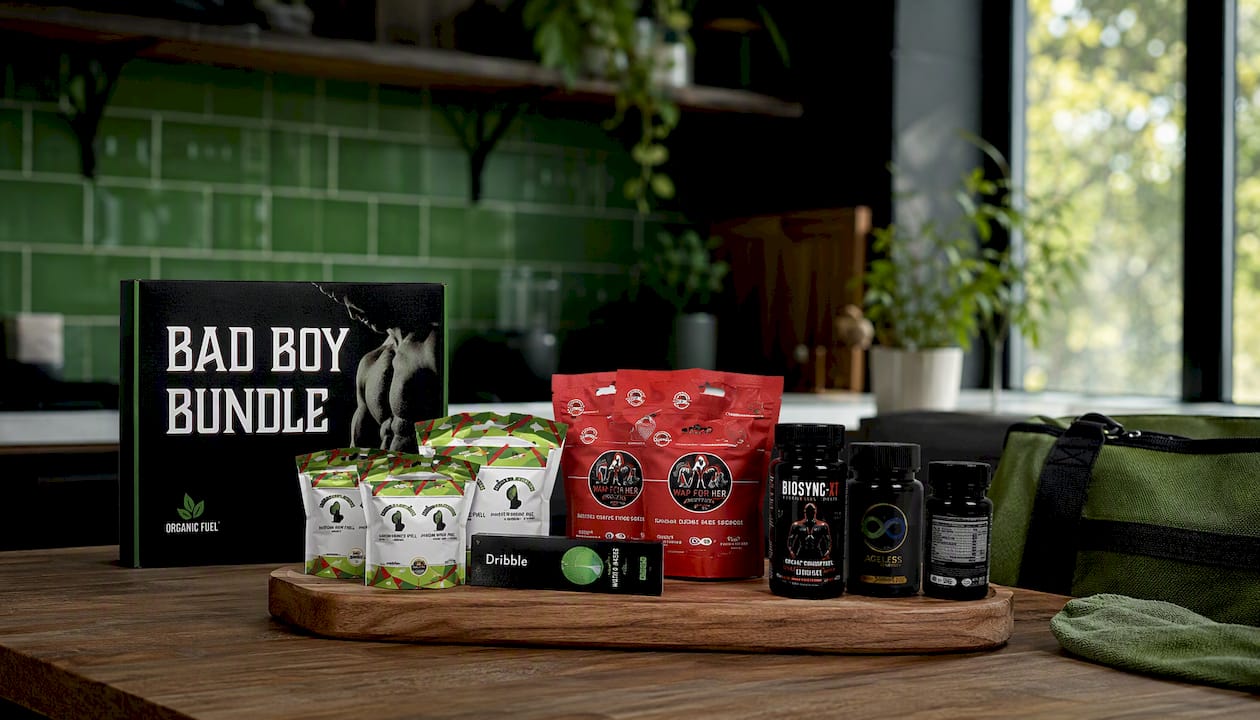
That’s a lower-risk way to try a natural stamina and vitality stack than committing to a product where you can’t verify a single dose. Check the Bad Boy Bundle product page for current ingredient details and order information before your next supplement decision.
This article is general information, not a substitute for advice from a qualified doctor. Consult a qualified healthcare professional about your own circumstances before acting on anything here.
Sources
- Perspectives on the Use of Proprietary Blends in Dietary Supplements
- Proprietary blends: What does this mean?
- Questions and answers: Dietary supplements (FDA)


Comments (0)
There are no comments for this article. Be the first one to leave a message!