

Saffron and ashwagandha carry the strongest human trial evidence among herbal aphrodisiacs, with measurable improvements in sexual function scores in controlled studies. Maca, red ginseng, tribulus terrestris, ginkgo, and fenugreek show mixed but sometimes promising results, often from smaller or shorter trials. None of these herbs are risk-free. Anyone on blood thinners, blood pressure medication, or antidepressants should talk to a doctor before adding any of them.
TL;DR:
- Saffron and ashwagandha have the strongest human trial evidence, with saffron showing consistent improvements in female sexual function scores.
- Many other herbs like maca, tribulus, and ginseng show mixed results, often from small or short-term studies, and carry potential side effects.
- Herbal supplements can interact with common medications such as blood thinners, blood pressure drugs, or antidepressants, making medical consultation essential.
- Dosing should match clinical trial protocols, using standardized extracts at studied doses over at least 6 to 12 weeks to gauge effectiveness reliably.
- Choosing brands with transparent lab testing and guarantees reduces risk, as many herbal products lack rigorous quality control.
Table of Contents
- What’s on the Herbal Aphrodisiacs List That Actually Has Data Behind It
- How Strong Is the Clinical Evidence, Really?
- Drug Interactions and Contraindications to Check Before You Buy
- Choosing and Dosing Herbal Remedies for Sex Drive the Right Way
- Why Organicufuel Talks About Lab Testing and Guarantees
- Herbal Aphrodisiacs Have a Longer History Than the Supplement Aisle Suggests
- The Side Effects Nobody Puts on the Marketing Page
- Working Herbal Aphrodisiacs Into Daily Life Without Overdoing It
- Our Take: Most Aphrodisiac Advice Skips the One Question That Matters
- Where Herbal Aphrodisiacs Fit Into Organicufuel’s Product Line
- Sources
What’s on the Herbal Aphrodisiacs List That Actually Has Data Behind It
Most articles calling themselves an aphrodisiac herbs list are really just folklore roundups with a citation or two bolted on for credibility. This one sorts by evidence quality first, because that’s the only thing that should determine whether you spend money on a bottle.
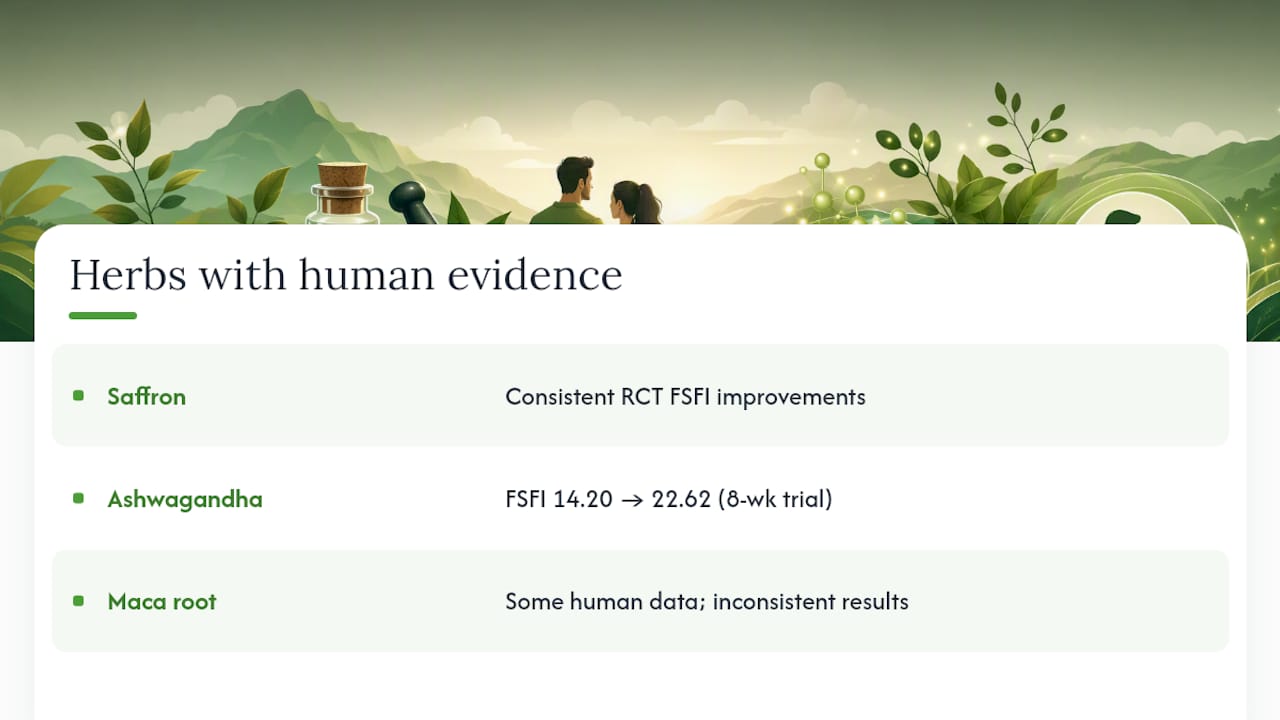
Saffron (Crocus sativus) Saffron shows up in more rigorous female sexual dysfunction trials than almost any other herb on this list. A systematic review of clinical trials found saffron improved desire, lubrication, and satisfaction scores compared to placebo across several RCTs. It’s typically taken as a standardized extract capsule, though saffron threads themselves are edible and sometimes brewed as tea.
Statistic Callout: Multiple RCTs reviewed in the saffron systematic review reported consistent improvements across several domains of the Female Sexual Function Index, one of the more reproducible findings on this entire list.
Side effects at supplement doses are generally mild (nausea, dry mouth, dizziness) but saffron in large amounts can act as a uterine stimulant, so pregnant women should avoid it. Evidence confidence: consistent for female sexual dysfunction specifically.
Ashwagandha (Withania somnifera) Ashwagandha’s reputation as a stress adaptogen is well earned, and stress reduction may be exactly why it shows up on aphrodisiac herbs lists. A 2022 randomized trial gave healthy women 300 mg of standardized ashwagandha root extract twice daily for 8 weeks.
Statistic Callout: Female Sexual Function Index scores rose from 14.20 to 22.62 over the 8 week ashwagandha trial, a jump large enough to be statistically significant, not just a placebo drift.
It’s sold as capsules, powder, or tinctures, usually standardized to withanolide content. Common side effects include drowsiness and mild stomach upset. People with autoimmune thyroid conditions or those on sedatives should check with a clinician first, since ashwagandha can affect thyroid hormone levels and amplify sedation. Evidence confidence: consistent for the specific trial population, though the sample size was modest.
Maca (Lepidium meyenii) Maca root, grown at high altitude in Peru, is one of the most searched natural aphrodisiacs for men, largely on reputation rather than a deep trial base. It’s available as powder, capsules, or extract, often black, red, or yellow maca depending on the marketing angle. A broader review of pharmacologically tested aphrodisiac plants includes maca among herbs with some human data, though results across studies are inconsistent regarding libido versus general energy effects. Side effects are minimal at food-level doses; excess intake has been linked to digestive discomfort. Evidence confidence: limited.
Tribulus Terrestris Tribulus is where the gap between marketing claims and trial data widens the most. Animal studies show testosterone-like effects, but human evidence is inconsistent. A PubMed-indexed body of tribulus research found positive results in animal models but no reliable androgen boost in healthy human men. The effect, where it appears at all, seems more likely in men with specific erectile dysfunction causes than in young, healthy users. It’s sold mostly as capsules standardized to protodioscin content. Side effects can include stomach cramps and, rarely, gynecomastia at high doses. Evidence confidence: contradictory.
Ginkgo Biloba Ginkgo’s aphrodisiac reputation comes largely from its role as a vasodilator, improving blood flow, which is the same mechanism behind many prescription erectile dysfunction drugs. WebMD’s review of aphrodisiac herbs notes some evidence for ginkgo supporting sexual function, but the data is thinner than for saffron or ashwagandha. Extracts are typically standardized to 24% flavone glycosides. The major safety concern: ginkgo thins blood, so combining it with anticoagulants or before surgery is a real risk. Evidence confidence: limited.
Red Ginseng (Panax ginseng) Red ginseng has one of the longer traditional-use histories on this list and a reasonable, though not huge, body of human trial data on erectile function and sexual satisfaction. It’s usually standardized to ginsenoside content and sold as capsules or extract. Side effects include insomnia, headache, and elevated blood pressure in sensitive individuals. It can also interact with blood thinners and diabetes medications. Evidence confidence: limited to moderate, depending on the outcome measured.
Fenugreek Fenugreek seed extract shows up in some small trials tied to libido and testosterone markers in men, though the studies tend to be short and industry-funded. It’s sold as capsules, powder, or seeds used in cooking. Side effects include a maple-syrup body odor (a known and harmless quirk of fenugreek metabolites) and mild digestive upset. People with peanut or chickpea allergies should be cautious, since fenugreek is a legume. Evidence confidence: limited.
Food-Related Aphrodisiacs: Pistachios, Pomegranate, and Dark Chocolate These don’t belong in the same evidence tier as the herbs above, but they consistently show up on any aphrodisiac foods list because of cardiovascular and sensory contributions. Healthline’s roundup of aphrodisiac foods points out that pistachios and pomegranate support blood flow and vascular health, which indirectly supports sexual function, rather than acting on desire directly. Dark chocolate’s contribution is likely more sensory and psychological than pharmacological.
How Strong Is the Clinical Evidence, Really?
Here’s the honest state of the research: most herbal aphrodisiacs have decent animal data and thin human data. The 2013 review of scientifically tested aphrodisiac plants makes this pattern clear across nearly every herb it catalogs, from tribulus to nutmeg to maca. Rodent studies show a compound increases mounting behavior or testosterone; then a handful of small human trials try to replicate that in people, with far messier results.
Saffron and ashwagandha stand out because they have actual randomized, placebo-controlled human trials behind them, not just animal extrapolation. The ashwagandha trial and the saffron systematic review both measured outcomes using the Female Sexual Function Index, a validated clinical tool, rather than self-reported “did you feel frisky” surveys.
Placebo and context effects are a major, underappreciated driver of perceived benefit in complementary therapies. A person who believes a supplement will help their sex life often experiences some improvement regardless of what’s in the capsule, according to research summarized by the National Center for Complementary and Integrative Health.
That doesn’t mean the trials are worthless. It means a modest, statistically significant result in an 8 week study should be read as encouraging, not as proof the herb works for everyone, in every form, at every dose.
“May help” in practical terms means: in a controlled study, a defined group of people taking a defined dose showed a measurable, statistically real improvement over a placebo group. It doesn’t mean the same bottle from a different brand, at a different dose, will do the same thing for you. If a herb produces no change after a full trial window, or if you develop new symptoms, that’s a signal to talk to a doctor rather than switch to a higher dose on your own.
Drug Interactions and Contraindications to Check Before You Buy
Herbal doesn’t mean harmless, and the interaction list for common libido herbs is longer than most product labels admit. Clinical guidance on natural aphrodisiacs is blunt about this: natural compounds can interact with prescription drugs in ways that are just as serious as synthetic drug interactions.
- Anticoagulants (warfarin, aspirin): ginkgo and high-dose ginseng can increase bleeding risk.
- Antihypertensives: red ginseng and licorice-containing blends can raise or destabilize blood pressure.
- SSRIs and MAOIs: ginseng and yohimbe both carry a risk of serotonin-related interactions and blood pressure spikes.
- Pregnancy and nursing: saffron in high amounts, fenugreek, and tribulus are generally advised against without medical clearance.
Yohimbe deserves a specific warning. It’s often marketed under a natural aphrodisiac for men label, but it carries real cardiovascular risk, including rapid heartbeat, anxiety, and dangerous blood pressure swings, especially when combined with stimulants or MAOIs. Treat it as a supervised-use-only herb, not a casual one.
Stop any herbal supplement and seek care immediately if you notice chest pain, irregular heartbeat, severe headache, or fainting.
Pro Tip: Check for third-party testing seals (NSF, USP, or a certificate of analysis from an independent lab) before buying any herbal aphrodisiac. A supplement with no batch testing is a black box, no matter how clean the label copy sounds.
Choosing and Dosing Herbal Remedies for Sex Drive the Right Way
A supplement is only as good as its match to the trial that proved it works. Here’s how to evaluate one before it hits your cart.
- Match the dose to the trial. If a study used 300 mg of standardized ashwagandha extract twice daily, a product with 50 mg of unstandardized root powder isn’t the same product, even if it lists the same herb.
- Look for standardized extracts, not just “proprietary blends” that hide actual milligram amounts behind vague percentages.
- Start low and go slow. Begin at the lower end of a trial-supported dose range and give it a full 6 to 12 weeks, mirroring the duration used in most of the trials cited above, before deciding whether it’s working.
- Track specific outcomes, not vague impressions: note desire frequency, physical response, and any side effects in a simple log.
- Bring a short list of questions to your clinician: does this herb interact with my current medications, is my dose appropriate for my health history, and how long should I try it before reassessing?
Why Organicufuel Talks About Lab Testing and Guarantees
Anyone shopping a herbal aphrodisiacs list eventually runs into the same problem: labels are easy to print and hard to verify. That’s the real value of a brand that talks openly about testing.
- Ingredients formulated for products like Alpha Cactus and BioSync-XT are lab-tested for safety and efficacy in US facilities before they reach a bottle.
- Organicufuel backs its formulas with a 100% money-back guarantee, which puts financial risk on the brand rather than the customer.
- Ingredient breakdowns are published rather than hidden, including detail on what’s actually inside Alpha Cactus.
- Broader safety context, including how to read supplement labels and spot red flags, is covered in Organicufuel’s guide to herbal enhancement safety.
These signals matter because the supplement industry has minimal pre-market oversight. A lab test result and a guarantee are two of the only concrete things a buyer can check before paying.
Herbal Aphrodisiacs Have a Longer History Than the Supplement Aisle Suggests
Long before capsules and extract percentages, cultures across the world were already building elaborate traditions around specific plants for desire and fertility. Ancient Greek texts referenced satyrion root. Ayurvedic medicine in India built entire formulations around ashwagandha and related roots centuries before a 2022 trial put a number on it. Traditional Chinese medicine has used red ginseng for vitality and reproductive health for over a thousand years, long predating any ginsenoside assay.
Saffron’s association with desire dates back to ancient Persia and the Mediterranean, where it was prized as much for cost and rarity as for any measured effect, a reminder that scarcity and ritual have always shaped which plants got the aphrodisiac label. Maca has similar cultural roots in the Andes, where Peruvian communities used it for stamina and fertility at high altitude long before it reached Western wellness shelves.
What’s changed isn’t the plants. It’s the tools available to test whether folklore holds up under controlled conditions. Some traditions, like saffron and ashwagandha, are now backed by real trial data. Others, like tribulus, remain more myth than mechanism. The 2013 review of aphrodisiac plants captures this exact tension: centuries of use, decades of modern testing, and still a wide range of confidence levels depending on the herb.
The Side Effects Nobody Puts on the Marketing Page
Interaction warnings get most of the attention, but everyday side effects deserve equal billing. Saffron in high doses can cause nausea, dry mouth, and anxiety-like jitteriness. Ashwagandha commonly causes drowsiness, which is a problem if you’re taking it before driving or operating machinery rather than before bed.
Ginseng can trigger insomnia and headaches, particularly when taken later in the day, since its stimulating effect resembles caffeine for some people. Fenugreek’s most reported quirk isn’t dangerous, just unexpected: a maple-syrup smell in sweat and urine caused by a natural compound in the seed. Tribulus has been linked to gastrointestinal cramping and, in rare high-dose cases, breast tissue changes in men.
None of these are reasons to avoid herbal remedies for sex drive outright. They’re reasons to start at a lower dose, watch your body’s response for the first week or two, and adjust before assuming a herb “doesn’t work” when it might just need a smaller starting amount. Anyone with an existing liver or kidney condition should be more cautious across the board, since most of these herbs are metabolized through those organs and human safety data at high doses over long periods remains thin.
Working Herbal Aphrodisiacs Into Daily Life Without Overdoing It
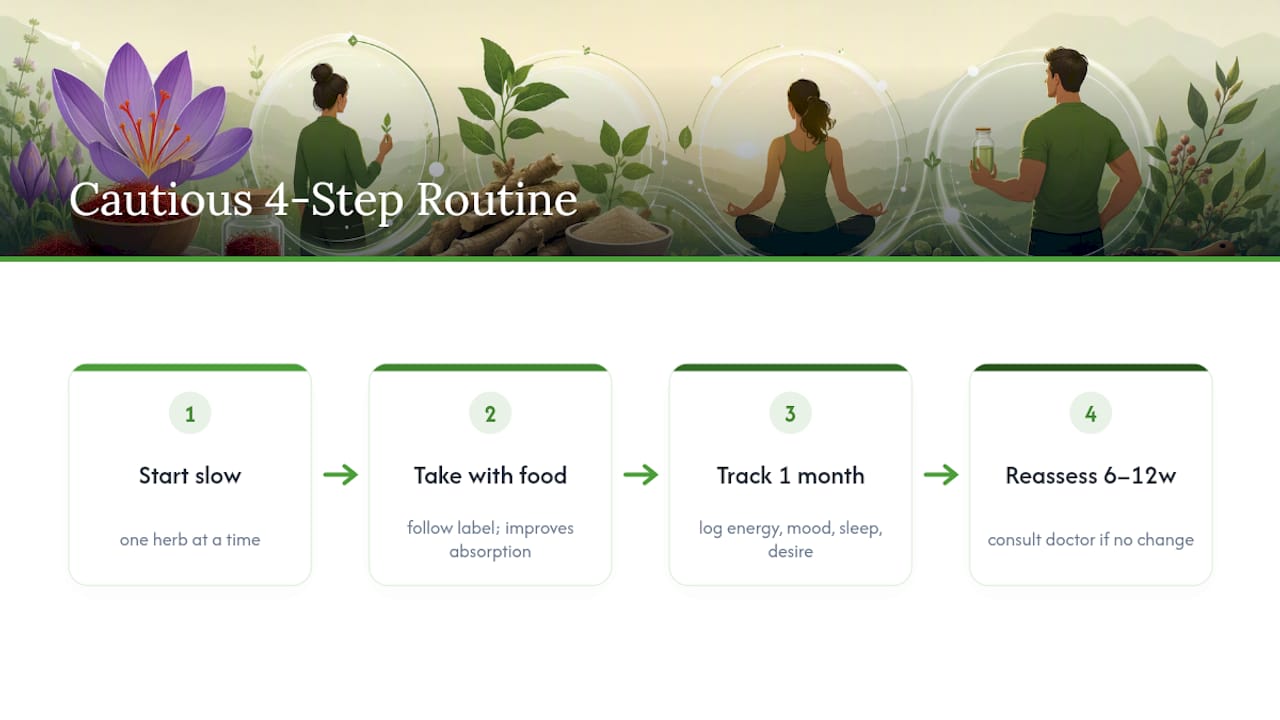
The safest approach treats herbal aphrodisiacs as a slow addition to your routine, not a swap for medical care. Start with one herb at a time, never a stack of five new supplements at once, so you can actually tell what’s causing an effect or a side effect.
Take herbs with food when the label suggests it, particularly fat-soluble ones like saffron extract, to improve absorption and reduce stomach upset. Keep a simple log for the first month, noting energy, mood, sleep quality, and any changes in desire or response, since sexual function is tied closely to stress, sleep, and general health, not just biochemistry. Pair the herb with the context that actually amplifies its effect: a calmer evening, a shared meal, less screen time before bed. Sensory and psychological context genuinely shape how these compounds feel in practice, a point WebMD’s aphrodisiac coverage makes clear.
Revisit your choice at the 6 to 12 week mark. If nothing has shifted, that’s useful information, not a failure, and it’s a good moment to loop in a doctor rather than double the dose on your own.
Our Take: Most Aphrodisiac Advice Skips the One Question That Matters
The conventional advice on herbal aphrodisiacs treats every herb on the list as roughly equal, a grab bag of options with a shared “natural” halo. That’s backwards. Saffron and ashwagandha have real randomized trial data behind them. Tribulus mostly has folklore and rodent studies. Treating those as interchangeable choices is where most buyers waste money.
The bigger gap isn’t in the herbs themselves. It’s in dosing discipline. A trial-matched dose of a standardized extract, taken consistently for a full 8 to 12 week window, gives you a fair test. A random amount from an unstandardized blend, abandoned after ten days because nothing happened, tells you nothing at all.
If you take one thing from this list, make it this: pick the herb with the best evidence for your specific goal, match the dose to what was actually studied, and give it the time the research itself used before judging results. That’s a more useful filter than any ranking of “top” herbs could ever be.
— Organic
Where Herbal Aphrodisiacs Fit Into Organicufuel’s Product Line
If the evidence above has you thinking about trying a supplement rather than piecing together loose herbs yourself, Organicufuel’s formulas apply that same trial dose logic to finished products, so you’re not guessing at milligrams on your own.

WAP FOR HER ONLY! is built for women looking for a women-targeted formula addressing desire and drive, rather than a men’s product relabeled with different packaging. Alpha Cactus is formulated for men dealing with erectile function or stamina concerns, using organic ingredients tested for safety and effect rather than synthetic actives. For anyone who wants to try more than one formula without committing to full price on each, the Holiday Fire Deal 4 in 1 Premium Collection bundles multiple products at a lower combined cost, a practical starting point if you’re still figuring out which formula fits your goals.
Every Organicufuel product carries a 100% money-back guarantee, so testing one against your own body’s response carries no financial risk. Check ingredient details on the Alpha Cactus product page and pick the formula that matches what you actually need this month.
This article is general information, not a substitute for advice from a qualified doctor. Consult a qualified healthcare professional about your own circumstances before acting on anything here.
Sources
- Study: Ashwagandha improves sexual function in healthy women — PubMed
- Effects of saffron (Crocus sativus) on sexual dysfunction — systematic review and clinical trials (PMC)
- Aphrodisiacs: Foods and Herbs to grow your Sex Life — WebMD
- The placebo effect — NCCIH


Comments (0)
There are no comments for this article. Be the first one to leave a message!