
Non-GMO supplements are products formulated without ingredients derived from genetically engineered organisms, verified through documentation rather than a single blanket law. Choosing them is a reasonable filter if you care about traceable sourcing and clean-label ingredients, but the label alone guarantees less than most shoppers assume. What actually matters is whether the brand backs the claim with third-party certification, supplier paperwork, and lab testing, not just a green leaf on the front of the bottle.
TL;DR:
- A non-GMO label alone does not guarantee ingredient safety or sourcing unless backed by third-party certification or detailed documentation.
- Most GMO-related contamination in supplements occurs through shared supply chains involving soy, corn, canola oil, and fermentation media without specific testing.
- USDA Organic certification offers broader safety and environmental guarantees compared to non-GMO claims, which focus solely on genetic engineering.
- Verifying non-GMO claims requires checking for certified labels, supplier documentation, and sourcing statements, not just marketing claims.
- Non-GMO ingredients mainly improve sourcing transparency and align with environmental values rather than offering proven health benefits.
Table of Contents
- What “Non-GMO” Actually Means for Dietary Supplements
- How GMO-Derived Material Ends Up in Supplements
- Non-GMO vs. Organic vs. Non-GMO Project Verified: What Each Label Covers
- A Shopper’s Checklist for Verifying Non-GMO Claims
- Do Non-GMO Supplements Actually Improve Health Outcomes?
- High-Risk Ingredients and What Safer Sourcing Looks Like
- How Organicufuel Documents Non-GMO Assurance
- Why Verification Beats Marketing on This Topic
- Where to Find Non-GMO Herbal Supplements Backed by Real Documentation
- Sources
What “Non-GMO” Actually Means for Dietary Supplements
Genetic engineering means altering an organism’s DNA directly in a lab, using tools that snip, insert, or silence specific genes. That’s fundamentally different from traditional cross-breeding, where farmers have selected plants and animals with desirable traits over generations through natural reproduction. A non-GMO supplement, by definition, avoids ingredients that came from crops or organisms modified this way.
The United States doesn’t have one single “non-GMO law” the way many people assume. Instead, the USDA Agricultural Marketing Service’s bioengineered food disclosure standard requires food and supplement makers to disclose when a product contains detectable modified genetic material above certain thresholds. The FDA also plays a role, overseeing safety assessments for bioengineered crops and ingredients that enter the food and supplement supply, as outlined in its background on GMO regulation.
Here’s the part that trips people up:
- A “non-GMO” claim on a label is a statement of avoidance, not a government-verified absolute guarantee, unless it’s backed by a specific certification program.
- Disclosure rules apply to detectable bioengineered material, so highly refined ingredients (some oils, some sugars) may fall outside disclosure requirements even when derived from a GMO crop.
- No U.S. law requires blanket non-GMO testing of every supplement batch, which is why the paperwork behind a claim matters as much as the claim itself.
That last point is the one worth remembering before you trust any label. A brand can say “non-GMO” honestly and still mean something narrower than you’d expect, which is exactly why verification systems exist.
How GMO-Derived Material Ends Up in Supplements
Contamination rarely happens on purpose. It happens because supplement supply chains run through the same crops, mills, and equipment that feed the entire packaged food industry, and a handful of ingredients carry most of the risk.
- Soy and soy lecithin. Soy is one of the most widely genetically engineered crops grown in the U.S., and soy lecithin shows up as a binder or emulsifier in capsules, gummies, and softgels.
- Corn-derived fillers and carriers. Corn starch, dextrose, and some encapsulation materials trace back to corn, another heavily engineered crop.
- Canola and rapeseed oil. Used as a carrier oil in softgel formulas, canola is frequently genetically engineered unless specifically sourced otherwise.
- Vitamin E and other nutrient carriers. Some synthetic vitamin E is produced using processes that start with GMO-derived feedstocks.
- Probiotic fermentation media. The bacteria itself isn’t genetically modified, but the growth medium used to culture it sometimes is, which is a detail few labels disclose.
- Shared manufacturing equipment. A facility that processes both GMO and non-GMO ingredients on the same lines risks trace cross-contact even with good cleaning protocols.
Most reputable brands don’t DNA-test every finished capsule. It’s not practical at scale. Instead, they lean on supplier Certificates of Analysis (COAs) and documented sourcing agreements that trace an ingredient back to its origin before it ever reaches the manufacturing floor.
Pro Tip: If a probiotic supplement doesn’t disclose what its bacteria were fermented on, email the company and ask. A brand with a real non-GMO program will have that answer ready.
Non-GMO vs. Organic vs. Non-GMO Project Verified: What Each Label Covers
These three labels get used almost interchangeably in casual conversation, and that’s a mistake, because they guarantee genuinely different things.
USDA Organic covers far more ground than genetics alone. It restricts synthetic pesticides, regulates soil management, and sets rules for processing methods, in addition to prohibiting genetically engineered ingredients outright. As USDA’s own explainer puts it, organic certification is a full production-system standard, not a single-issue claim.
Non-GMO Project Verified is narrower and more targeted. This third-party program specifically tests and audits for genetically engineered content, and it’s currently the most recognized independent seal for that one issue in North America, according to The Non-GMO Project.
A brand’s own “non-GMO” claim, without either certification, relies entirely on that company’s internal sourcing standards and documentation.
- Choose USDA Organic when you want assurance about farming practices and processing, not just genetics.
- Choose Non-GMO Project Verified when genetic engineering specifically is your priority and you want independent audit trail behind the claim.
- Accept an uncertified brand claim only when the company backs it with visible supplier documentation, as NSF’s consumer explainer on organic versus non-GMO labeling recommends checking for.
Neither label ranks universally “better.” They answer different questions, and the right one depends on what you’re actually trying to avoid.
A Shopper’s Checklist for Verifying Non-GMO Claims
Verification takes about two minutes once you know what to look for, and it beats trusting a marketing headline every time.
- Scan for a real seal. Look for the Non-GMO Project Verified butterfly logo or the USDA Organic seal directly on the packaging or product photos, not just text claiming “non-GMO.”
- Read the “Other Ingredients” list, not just the actives. This is where soy lecithin, corn-derived starches, and canola-based carriers hide, often unnoticed while shoppers focus on the vitamin or herb front and center.
- Look for published documentation. Reputable brands post Certificates of Analysis and third-party lab testing summaries on their product pages or a dedicated certifications page.
- Check for a sourcing statement. Does the brand say where key ingredients come from, or just that the product is “made with quality ingredients”? Vague language is a warning sign.
- Contact customer support if documentation is missing. Ask directly: “Can you send me the COA for this batch?” or “What growth medium is used for your probiotic strains?” A brand with real sourcing controls answers quickly.
Pro Tip: Bookmark the certifications or lab-testing page of any brand you buy from regularly. Companies update COAs by batch, and a stale link is often the first sign a program has slipped.
Do Non-GMO Supplements Actually Improve Health Outcomes?
Here’s the honest answer: choosing non-GMO ingredients is mostly about sourcing transparency and personal values, not a documented clinical safety upgrade. There isn’t strong evidence that a genetically engineered source of a given nutrient behaves differently in your body than a non-GMO source once it’s isolated and purified. The nutrient itself, say vitamin D3, has a well-documented biological role regardless of the crop or process behind the raw material, as the NIH Office of Dietary Supplements details for that nutrient specifically.
What non-GMO status actually buys you:
- Supply-chain traceability. You know more about where the ingredient came from and how it was processed.
- Reduced exposure to certain herbicide-tolerant crop systems, a concern tied to farming practices rather than the nutrient’s own chemistry.
- Alignment with environmental or ethical preferences, which is a legitimate reason on its own, even without a health claim attached.
- A cleaner label overall, since brands running non-GMO programs often apply the same scrutiny to other excipients.
Non-GMO products sometimes cost more and offer a smaller selection than conventional alternatives, a real trade-off worth weighing against how much traceability matters to you.
High-Risk Ingredients and What Safer Sourcing Looks Like
A handful of ingredient categories account for most non-GMO concerns in the supplement aisle, and knowing the substitutes makes label-reading much faster.
- Soy lecithin → look for sunflower lecithin, a common and effective non-GMO substitute for capsule and softgel binding.
- Corn-derived starches and dextrose → look for tapioca-based or certified non-GMO corn alternatives, explicitly labeled as such.
- Canola/rapeseed oil carriers → look for non-GMO sunflower or olive oil carriers in softgel formulas.
- Synthetic vitamin E from GMO feedstock → look for natural-source vitamin E (d-alpha-tocopherol) with disclosed sourcing.
- Probiotics fermented on undisclosed media → look for brands that specify non-GMO fermentation media directly on the label or product page.
Language to trust: “sourced from non-GMO sunflower,” “verified non-GMO corn,” or a listed certification number. Language to question: “natural ingredients” or “clean formula” with no ingredient-level detail behind it.
How Organicufuel Documents Non-GMO Assurance
Trust in a supplement claim comes down to whether the brand shows its work. Organicufuel publishes ingredient testing and certification details rather than asking customers to take sourcing on faith, formulating its herbal supplements with U.S. lab-tested ingredients and backing every purchase with a money-back guarantee.
A high-integrity brand, at minimum, gives you:
- A visible certifications page explaining what seals apply and what they cover.
- Access to Certificates of Analysis for key ingredients, either published directly or available on request.
- A clear guarantee policy that lets you return a product if it doesn’t meet expectations, without hoops to jump through.
- Sourcing statements specific enough to name the ingredient form, not just the ingredient category.
Pro Tip: If a brand’s certification page is vague or missing entirely, email and ask for the specific COA of the product you’re considering. A company with nothing to hide will send it without pushback.
For deeper documentation, batch-specific lab reports and formulation summaries are best requested directly through customer support, since testing detail can vary by production run.
Why Verification Beats Marketing on This Topic
The conventional advice on non-GMO supplements stops at “look for the seal,” and that’s incomplete advice. A seal tells you a program exists. It doesn’t tell you whether the excipients, carrier oils, or fermentation media in your specific bottle were covered by that same scrutiny. The research here supports a sharper conclusion: non-GMO status is a proxy for traceability, and traceability only means something when the paperwork behind it is actually available to you.
Where most guides get it backward is treating non-GMO as a health claim first and a sourcing claim second. It’s the reverse. Nobody has strong evidence that a genetically engineered source of an isolated nutrient behaves differently in the body once purified. What differs is what you can verify about how it got to your shelf.
If you take one thing from this, prioritize documentation over labeling. Ask for the COA. Read the “Other Ingredients” line. A brand that answers those questions without hesitation is telling you more than any front-of-package claim ever could.
— Organic
Where to Find Non-GMO Herbal Supplements Backed by Real Documentation
Most shoppers land here after realizing that “non-GMO” printed on a box isn’t the same as verified sourcing, and that’s exactly the gap Organicufuel built its catalog to close. Every formula runs through U.S. lab testing, and the brand backs each purchase with a money-back guarantee, so checking the box on sourcing doesn’t mean gambling on results.
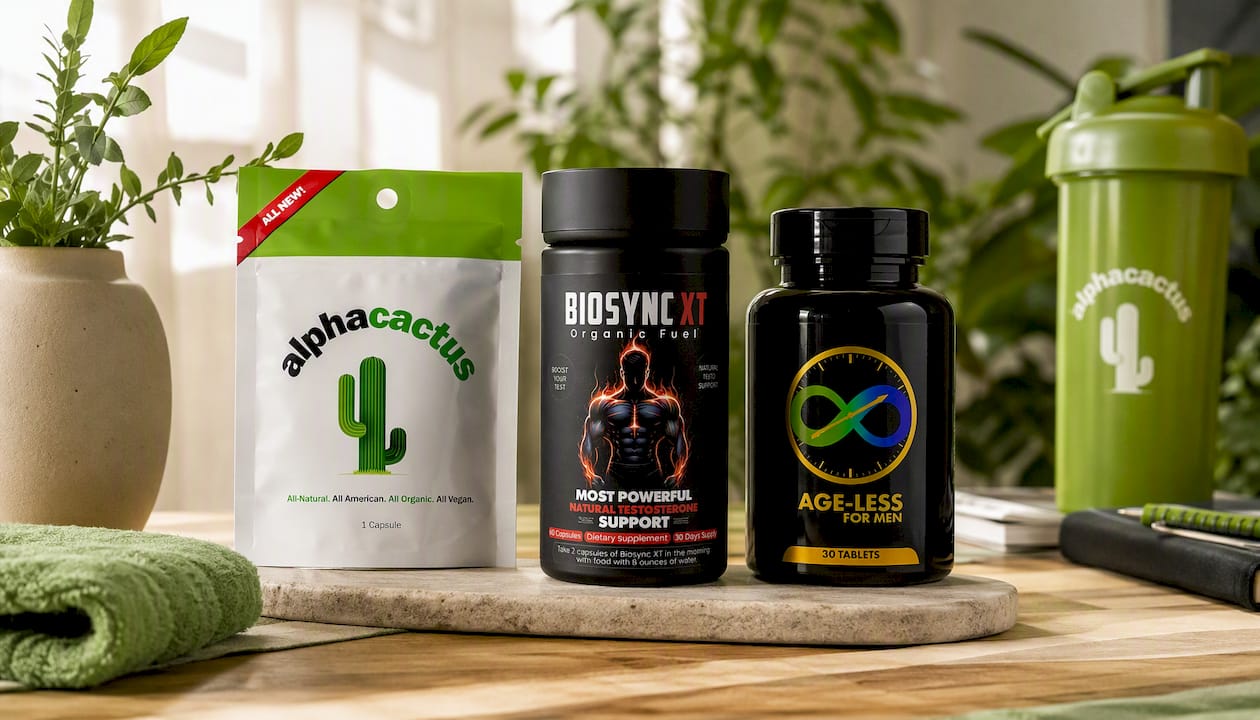
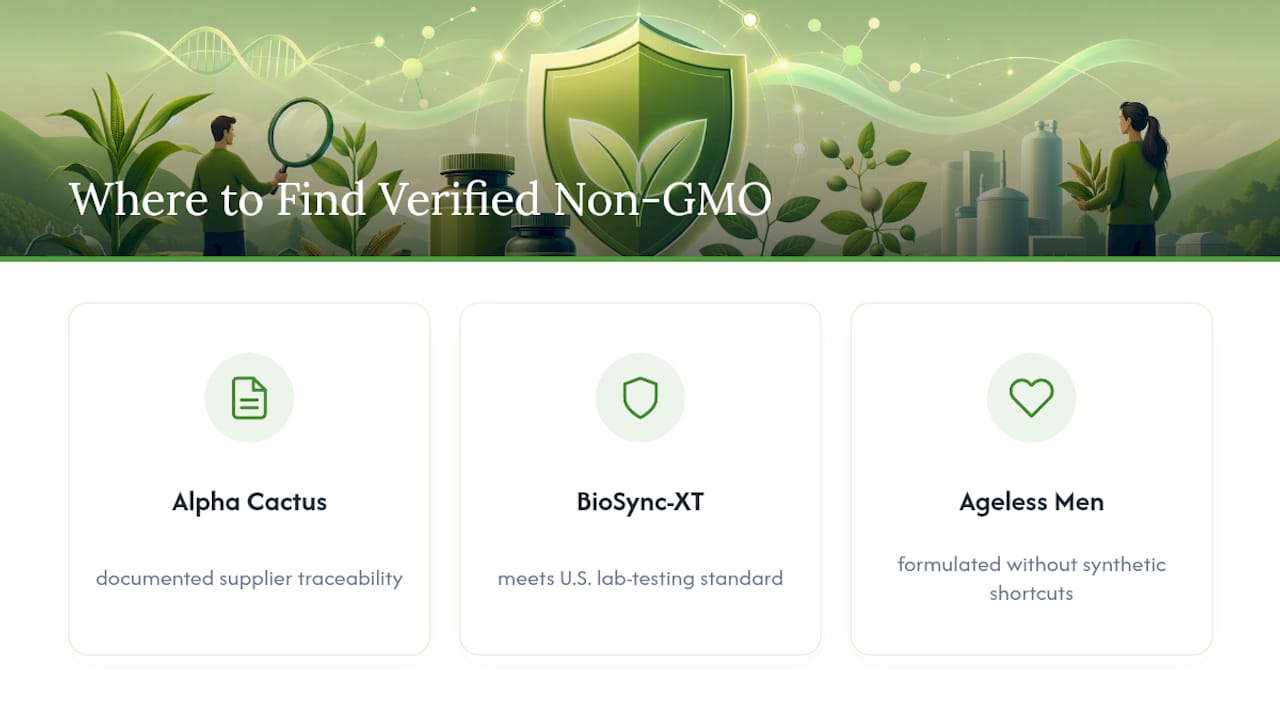
Alpha Cactus is formulated for natural performance support using ingredients sourced and tested to meet the sourcing checklist covered above, including documented supplier traceability. BioSync-XT Natural Testosterone Support & Booster targets natural testosterone support with the same lab-testing standard applied across the Organicufuel lineup. Ageless For Men rounds out the collection for men focused on vitality and stamina, formulated without synthetic shortcuts.
If you want to see how sourcing and testing details are presented for a specific product, the certifications page breaks down what each label means before you buy. Browse the full product collection and pick the formula that matches your goal. Some brands offer money-back guarantees to reduce risk if a product doesn’t meet expectations.
This article is general information, not a substitute for advice from a qualified doctor. Consult a qualified healthcare professional about your own circumstances before acting on anything here.
Sources
- The Non-GMO Project
- USDA — Organic 101: What the USDA organic label means
- NIH Office of Dietary Supplements — Vitamin D (Health Professional Fact Sheet)


Comments (0)
There are no comments for this article. Be the first one to leave a message!