

“GMP certified” means an independent auditor has verified that a manufacturing facility, not the bottle on the shelf, follows Good Manufacturing Practice standards for sanitation, equipment, staff training, and recordkeeping. In the U.S., the legal floor for this comes from the FDA under 21 CFR Part 111 for dietary supplements. Third-party certification on top of that is voluntary.
TL;DR:
- Most “GMP certified” claims are based on voluntary third-party verification, not the FDA’s inspection or approval process.
- Certification details, including scope, issuer, certificate number, and renewal dates, should be provided and cross-checked for validity.
- FDA inspections are unannounced and generate internal violation reports, but the agency does not issue a GMP certification badge or maintain a public certification registry.
- Meeting GMP standards ensures process consistency but does not guarantee a supplement’s safety, efficacy, or FDA approval of health claims.
- Organicufuel openly displays its GMP certification and lab testing details online, emphasizing transparency and ease of verification for consumers.
Table of Contents
- What GMP and cGMP Mean, and Why “Current” Matters
- How the FDA Enforces GMP Rules in the United States
- Compliance vs. Certification: The Distinction Nobody Explains Clearly
- What a GMP Audit Actually Looks Like, Start to Finish
- What Certification Guarantees, and Where It Stops
- Where Organicufuel Fits Into the GMP Picture
- Verify Before You Buy: Organicufuel’s Approach to GMP
- The Gap Between What Certification Promises and What Buyers Assume
- Sources
What GMP and cGMP Mean, and Why “Current” Matters
Good Manufacturing Practice is the set of rules governing how something gets made, not what it claims to do. The FDA’s version, cGMP, adds one letter that carries real weight: the “c” stands for “current,” and it exists because regulatory standards are dynamic rather than fixed. A facility running 2005-era equipment and paperwork isn’t automatically noncompliant, but it has to prove its systems still reflect modern science and practice, not just whatever passed inspection a decade ago.
GMP rules apply across drugs, dietary supplements, cosmetics, and medical devices, each under its own regulatory framework. For supplements specifically, the FDA’s requirements sit in 21 CFR Part 111, and they’re detailed enough to cover the entire life of a product, not just the finished capsule.
A compliant supplement facility generally has to demonstrate:
- Clean, controlled production and storage environments to prevent contamination
- Equipment that’s maintained, calibrated, and inspected on a documented schedule
- Personnel trained specifically for their role in production, not just generally “trained”
- Batch records and testing documentation that trace every lot back to its raw materials
- A quality control unit with actual authority to reject a batch, not just flag it
Pro Tip: If a brand’s website only says “GMP compliant” with no mention of a specific standard or certifying body, that’s a compliance claim, not proof of independent verification. The two aren’t interchangeable.
The ISPE’s definition of GMP frames it as the quality assurance layer that keeps production “defined, validated, and documented,” with personnel and facilities suitable for the product’s intended use. That’s the technical backbone. In plain terms: cGMP is the difference between a supplement made in a facility that can prove consistency batch after batch, and one made wherever there was space and a blender.
How the FDA Enforces GMP Rules in the United States
The FDA doesn’t hand out gold stars. It enforces a legal minimum, and the tools it uses look very different from a certification badge.
Dietary supplements fall under 21 CFR Part 111, while conventional drugs are governed by 21 CFR Parts 210 and 211, a stricter set of rules given the higher risk profile of pharmaceuticals. Both frameworks require documented, validated processes, but the drug rules go further on things like stability testing and batch release criteria.
Enforcement happens through unannounced inspections. When an investigator finds a problem, the agency issues what’s known internally as a Form 483, a list of observed violations. Serious or repeated issues escalate to a warning letter, and in rare cases to seizures, injunctions, or criminal referral.
Here’s the part that trips people up: the FDA inspects and can shut a facility down, but it does not issue a “GMP certified” seal, and there’s no central government database where consumers can look up which brands are certified. Any certificate a brand shows you comes from a private, third-party body, not the FDA itself. Confusing the two is one of the most common mistakes in this space.
- FDA inspections are unannounced and legally mandatory for regulated facilities
- A 483 lists violations found during inspection; it isn’t automatically public knowledge unless requested
- Warning letters are public and searchable, and often the first sign a brand cut corners
- “FDA approved” and “GMP compliant” are not the same claim, and neither implies third-party certification
Compliance vs. Certification: The Distinction Nobody Explains Clearly
Legal compliance and voluntary certification solve different problems, and mixing them up is where most confusion about “GMP certified” starts.
Compliance means a facility meets the FDA’s mandatory baseline under 21 CFR 111. It’s the law, not a choice. Certification is a separate, opt-in step: a facility pays an accredited third party, such as a program built around NSF/ANSI 455, to independently verify that compliance and issue documentation proving it. Certification also cuts down on redundant audits across a supply chain, since retailers and distributors can accept one accredited certificate instead of running their own inspection.
If a brand tells you it’s certified, four things should show up on the actual document:
- The certifying body’s name and accreditation status (ANSI/ANAB accreditation is the recognized benchmark)
- A scope statement specifying exactly what the certificate covers, whether that’s manufacturing, packaging, or labeling
- A unique certificate number tied to that specific facility and audit cycle
- Issue and expiration dates, since certification lapses without renewal
Pro Tip: Ask the brand for the certificate itself, not just a logo. A real one will have a certificate number you can cross-check with the issuing body’s registry.
What a GMP Audit Actually Looks Like, Start to Finish
Getting certified isn’t a one-time inspection. It’s a lifecycle with several distinct stages, and skipping ahead usually backfires.
Most facilities start with a gap assessment, an internal or consultant-led review comparing current practices against the target standard. Whatever falls short goes into a corrective action plan: rewriting SOPs, retraining staff, fixing equipment calibration logs. Only after that does the formal third-party audit happen, where an accredited auditor physically inspects the facility and reviews documentation before recommending certification. Once issued, the certificate isn’t permanent; it’s maintained through periodic surveillance audits, typically unannounced or lightly scheduled, to confirm nothing has slipped.
Timelines vary widely depending on how much remediation a facility needs going in. Industry guidance commonly cites a 3 to 9 month window for facilities that already have some quality systems in place; a facility starting from near zero can take considerably longer. Costs scale with facility size, scope, and how many corrective actions are needed, so any number quoted without those qualifiers should be treated as a rough estimate, not a quote.
Auditors dig into specifics, not impressions:
- Batch and lot records tracing raw materials through to finished product
- Sanitation logs and pest control documentation
- Equipment calibration and maintenance schedules
- Staff training records tied to specific job functions
- Traceability systems that can isolate and recall a bad lot quickly
What Certification Guarantees, and Where It Stops
A certificate confirms that a facility’s manufacturing controls are consistent, documented, and independently verified. That’s real value, but it has clear edges.
Certification says nothing about whether a supplement’s health claims hold up, whether it’s clinically effective, or whether the FDA has pre-approved it, because the FDA doesn’t pre-approve dietary supplements the way it does drugs. It’s also facility-specific, not product-specific: supplements themselves aren’t GMP certified, the plant that makes them is.
Before trusting a “GMP certified” label, verify a few things yourself:
- Ask for the actual certificate, not a badge image on a website
- Check the scope statement to see exactly what’s covered
- Confirm the surveillance audit schedule hasn’t lapsed
Pro Tip: A certificate with no visible expiration or renewal date is worth a second look. Certification isn’t a one-time achievement; it requires ongoing surveillance to stay valid.
Where Organicufuel Fits Into the GMP Picture
Organicufuel manufactures its formulas, including BioSync-XT, Alpha Cactus, the Bad Boy Bundle, Ageless For Men, and WAP FOR HER ONLY!, in facilities documented on its certifications and labs pages. Those pages exist so readers don’t have to take a label’s word for it.
Verify Before You Buy: Organicufuel’s Approach to GMP
Reading about certificate numbers and audit cycles is one thing. Actually checking them is another, and most supplement shoppers never do because most brands make it hard. Organicufuel is built around the opposite idea: certification and lab testing details live on public pages, not buried behind a customer service email.

That transparency matters most for men and women dealing with issues like low energy, low drive, or performance concerns who’ve been burned before by synthetic products with vague sourcing. Organicufuel’s formulas, from BioSync-XT for testosterone support to Alpha Cactus and the women’s-focused WAP FOR HER ONLY!, are made in U.S. facilities with documented lab testing behind them, backed by a 100% money-back guarantee if a product doesn’t deliver. If you’ve read this far because you wanted to know what “GMP certified” should actually guarantee, the next logical step is checking it against a real example: browse Organicufuel’s full product line and pull up the certification details for yourself before you decide what goes in your body.
The Gap Between What Certification Promises and What Buyers Assume
Most people treat “GMP certified” as a stand-in for “this works” or “this is safe to take with anything.” Neither follows from the certification itself, and that’s not a flaw in the standard, it’s a misunderstanding of what the standard was ever designed to measure.
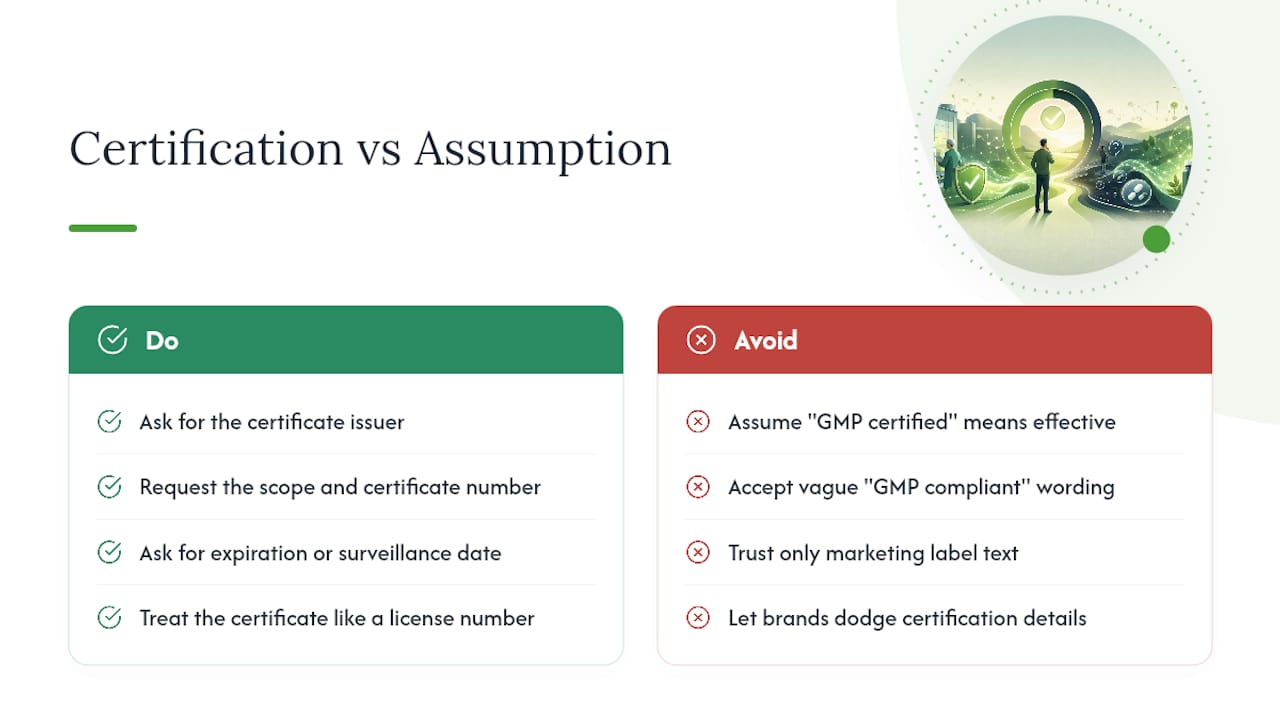
Where the industry undersells the point is on the compliance-versus-certification gap. A facility can be fully legal, inspected, and never once written up by the FDA, and still not carry an independent certificate. That doesn’t make it shady. But when a brand leans hard on “GMP compliant” language while dodging any mention of who certified them, how, or when the last surveillance audit happened, that’s usually not an oversight. It’s a choice to keep the claim vague enough to sound reassuring without being checkable.
The fix isn’t skepticism toward every supplement brand. It’s asking for specifics the way you’d ask a contractor for a license number. A real certificate has an issuer, a scope, a number, and an expiration. If a brand can’t produce one, or gets vague when you ask, that tells you more than any marketing copy on the label.
— Organic

Comments (0)
There are no comments for this article. Be the first one to leave a message!