

Pomegranate has shown a measurable, short-term boost to testosterone in small human trials, with one controlled study reporting a roughly 24% jump in salivary testosterone after just two weeks. That number sounds impressive, and it’s real. But the catch matters just as much as the headline: the strongest results come from saliva testing, not blood work, and saliva readings swing with hydration, time of day, and lab technique.
Serum testosterone, the blood measurement doctors actually use for diagnosis, moves too, but usually in smaller, slower increments tied to standardized rind extracts taken over eight to twelve weeks rather than a glass of juice sipped for a fortnight. So the honest answer sits in the middle: pomegranate looks like a real, modest lever on testosterone and related markers, not a switch you flip overnight.
Here’s the quick breakdown of what the evidence actually supports:
- Salivary testosterone: Up about 24% after 1 to 2 weeks of daily pomegranate juice in a 60-person trial.
- Serum (blood) testosterone: Rises measured in a proprietary rind extract at 200 to 400 mg daily over 56 to 84 days.
- Sperm motility: A 62% increase in total motile sperm count after three months, using a pomegranate-galangal combination.
- Form matters: Juice, whole fruit, rind extract, and standardized blends do not behave the same way in the body.
The rest of this guide walks through the actual trials, the biology behind them, how forms and doses compare, where the evidence gets shaky, and what a sensible person does with all of this information.
Key Takeaways
Pomegranate shows a real but modest link to testosterone in small human trials, with results depending heavily on the form used and whether testosterone was measured in saliva or blood.
| Point | Details |
|---|---|
| Salivary trials show fast, large shifts | A 60-person trial found roughly 24% higher salivary testosterone after two weeks of daily juice. |
| Serum trials show slower, verified shifts | A 120-person randomized trial found significant free testosterone increases using 200 to 400 mg of rind extract over 56 days. |
| Sperm motility responds to combinations | A pomegranate-galangal blend raised total motile sperm count 62% over three months in men with reduced semen quality. |
| Rind extracts concentrate the active compounds | Punicalagins and ellagic acid sit at much higher levels in rind extracts than in juice, driving more consistent results. |
| Organicufuel offers a standardized alternative | Products like BioSync-XT and Alpha Cactus deliver consistent, lab-tested dosing for men who want reproducible results beyond variable juice. |
Table of Contents
- Pomegranate and Testosterone: What the Human Studies Show
- How Might Pomegranate Affect Testosterone Biologically?
- Juice vs. Rind Extract vs. Standardized Blend: Which Form Works Best?
- How Strong Is the Evidence, Really?
- How to Use Pomegranate Sensibly for Testosterone and Reproductive Health
- Where Organicufuel’s Products Fit This Evidence
- What the Evidence Actually Tells Us
- A Standardized Path Forward With Organicufuel
- Sources
Pomegranate and Testosterone: What the Human Studies Show
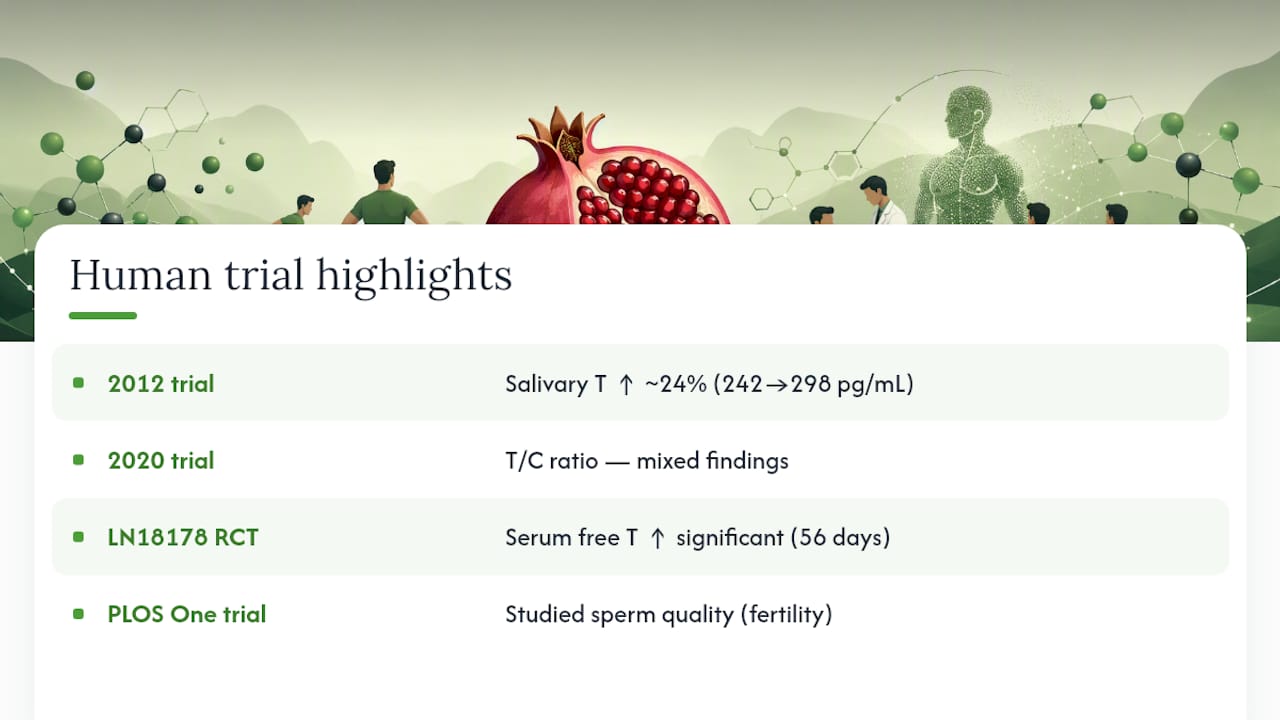
Four human trials anchor almost everything written about pomegranate and testosterone, and each one measured something slightly different. That matters more than most articles admit.
The most-cited study is a 2012 controlled trial presented at the Society for Endocrinology’s annual conference, involving 60 healthy men and women. Participants drank pomegranate juice daily for two weeks while researchers collected saliva samples three times a day, morning, noon, and evening, to smooth out natural hormonal swings. The result: average salivary testosterone in men rose from 242.1 pg/mL at baseline to 296.1 pg/mL after one week, and settled around 298.4 pg/mL by week two, a sustained increase of roughly 24%. Participants also reported improved mood, and researchers noted drops in both systolic and diastolic blood pressure. That’s a meaningful cluster of effects from one piece of fruit, but it’s still one trial, with a two-week window and a saliva-only measurement method that leaves plenty of room for debate.
A different picture emerges from a 2020 double-blind, placebo-controlled trial involving weightlifters who drank polyphenol-rich pomegranate juice around intense training sessions. This one tracked the testosterone-to-cortisol ratio, a marker strength athletes care about because it reflects recovery capacity, not just raw hormone levels. The findings were more complicated than a simple “testosterone went up” story. This weightlifting study is a useful reality check: pomegranate’s endocrine effects aren’t uniformly upward, and exercise timing changes the picture entirely.
The most rigorous testosterone data comes from trials using LN18178, a proprietary blend combining Punica granatum rind extract with Theobroma cacao seed extract, marketed under the name Tesnor. In a randomized, double-blind, placebo-controlled study of 120 healthy young men, daily doses of 200 mg or 400 mg over 56 days produced statistically significant increases in free testosterone compared to baseline (p < 0.0001), and the higher dose group also showed meaningful increases in total testosterone and luteinizing hormone versus placebo. This is the closest thing the pomegranate research world has to a gold-standard result: a randomized trial using serum measurement, a real placebo arm, and a sample large enough to detect statistical significance. A related, more recent trial using a similar combination over a longer window reported improvements in sexual function among aging men, adding functional outcomes like grip strength and libido scores to the hormone data.
Finally, a trial published in PLOS One looked past testosterone entirely and asked a more practical question for men trying to conceive: does pomegranate affect sperm quality? Researchers gave 70 men with reduced semen quality a combination of pomegranate fruit extract and greater galangal rhizome powder for three months. That’s a real, statistically significant difference, and it comes from a double-blind, controlled design rather than an open-label experiment where expectation bias could skew results.
The pattern across all four studies: saliva-based trials show the fastest, largest percentage changes; serum-based trials using standardized extracts show smaller but statistically verified changes over longer timeframes; and sperm-motility outcomes seem to respond best to multi-ingredient combinations rather than pomegranate alone.
How Might Pomegranate Affect Testosterone Biologically?
The plausibility behind these numbers comes down to a handful of plant compounds concentrated in pomegranate, particularly in the rind.
Punicalagins and ellagic acid are the two heavyweight polyphenols responsible for most of pomegranate’s biological activity. The rind, not the juicy arils most people eat, contains far higher concentrations of these compounds. That’s a detail worth remembering, because it explains why a glass of juice and a standardized rind extract can produce noticeably different effects even though both come from the same fruit.
Here’s roughly how researchers think these compounds interact with testosterone production and related pathways:
- Antioxidant protection of Leydig cells. Leydig cells in the testes manufacture testosterone, and they’re vulnerable to oxidative stress. Punicalagins and ellagic acid neutralize free radicals that would otherwise damage these cells, theoretically preserving their hormone-producing capacity.
- Anti-inflammatory activity. Chronic low-grade inflammation is linked to lower testosterone in men, and pomegranate polyphenols appear to blunt inflammatory signaling, which may indirectly support healthier hormone output.
- Nitric oxide and cGMP pathway support. Nitric oxide relaxes blood vessels and supports blood flow, a mechanism tied more directly to erectile function than to testosterone synthesis itself, but relevant to the broader “pomegranate for men” conversation.
- Gene-expression modulation. Some preclinical work suggests pomegranate compounds influence expression of genes involved in androgen synthesis, though this evidence sits mostly in cell and animal models rather than confirmed human data.
A clinical review covering pomegranate’s role in urologic health lays out much of this preclinical groundwork, including in vitro evidence of antiproliferative activity in prostate cancer cells and reductions in oxidative damage markers in clinical contexts. The review is careful to separate what’s shown in petri dishes and animal models from what’s confirmed in people, and that distinction matters here. Antioxidant activity in a lab dish is well established. Its precise contribution to the testosterone increases seen in human trials is inferred, not directly measured, because none of the human studies biopsied testicular tissue to confirm the mechanism in action.
Pro Tip: If you’re trying to understand why “pomegranate extract” and “pomegranate juice” get talked about so differently in research, remember it usually comes down to rind concentration. Extracts are formulated to capture the compounds juice mostly leaves behind.
Some of this same antioxidant logic shows up in broader discussions of oxidative stress and immune resilience, where polyphenol-rich foods are credited with supporting cellular defense systems well beyond reproductive health. The overlap isn’t coincidental. Oxidative stress touches nearly every organ system, and testosterone-producing tissue is no exception.
Juice vs. Rind Extract vs. Standardized Blend: Which Form Works Best?
Not all pomegranate products are created equal, and the form you choose changes both the dose you’re actually getting and how consistent that dose is from one bottle to the next.
| Form | Evidence strength | Dose used in studies | Reported outcome |
|---|---|---|---|
| Pure juice | One controlled trial, saliva-measured | Daily servings for 1 to 2 weeks | ~24% salivary testosterone increase, improved mood, lower blood pressure |
| Polyphenol-rich juice (athletic context) | One double-blind trial, plasma-measured | Consumed around exercise sessions | Timing-dependent testosterone/cortisol shifts, no lasting difference over days |
| Rind and cocoa extract (LN18178/Tesnor) | Randomized, double-blind, placebo-controlled, serum-measured | 200 to 400 mg daily for 56 to 84 days | Significant free testosterone increase; total testosterone and LH increases at higher dose |
| Pomegranate plus galangal combination | Randomized, double-blind, controlled | Daily combination for 3 months | 62% increase in total motile sperm count |
The reason rind extracts and standardized blends tend to outperform plain juice in serum-testosterone trials comes down to concentration and consistency. Juice contains diluted amounts of punicalagins because the rind, where these compounds live in the highest concentration, isn’t part of what gets pressed into a typical bottle. An extract manufactured specifically to capture rind compounds delivers a far more concentrated, and more consistent, dose from batch to batch.
There’s no clean, universally agreed conversion between “ounces of juice” and “milligrams of extract,” and any comparison offered online should be treated as a rough approximation rather than a pharmacological equivalence. Juice concentration varies by fruit source, processing method, and how much of the fruit (including any rind residue) ends up in the final product. That variability is exactly why researchers running serious trials switch to standardized extracts once they want repeatable, verifiable dosing over months rather than weeks.
If you’re evaluating a supplement rather than a bottle of juice, a few checks help separate a serious product from a vague one:
- Look for stated ellagitannin or punicalagin content, not just “pomegranate extract” with no number attached.
- Check for third-party lab testing confirming potency and purity.
- Match the dose to what trials actually used (200 to 400 mg daily ranges show up repeatedly in the serum-testosterone research).
- Favor products with a defined study duration reference (56 to 84 days) rather than vague “results may vary” language.
How Strong Is the Evidence, Really?
Here’s the part most articles gloss over: every trial discussed above is small, and small trials deserve real skepticism even when the results look exciting.
The 60-person salivary trial, the 120-person serum trial, and the 70-person sperm-motility trial are all reasonably sized for early human research, but none of them approaches the scale needed for a public health recommendation. Compare that to trials for statins or blood pressure medications, which routinely enroll thousands of participants across multiple countries. A sample size in the dozens or low hundreds means results can shift meaningfully with a different population, a different season, or a different lab’s saliva-collection protocol.
Measurement method is the other major variable working against a clean, one-line verdict. Salivary testosterone is convenient to collect, but it’s sensitive to hydration, timing, and even how a sample is stored before analysis. The 2012 trial handled this reasonably well by averaging morning, noon, and evening samples across two weeks, which reduces noise from natural diurnal rhythm, the daily rise-and-fall pattern testosterone follows regardless of diet. But a single saliva sample, the kind a curious reader might collect at home with an over-the-counter kit, tells you far less than a properly averaged, multi-timepoint protocol. If you’re curious about baseline hormone levels before trying anything, a reliable home test kit paired with a doctor’s blood panel gives a more trustworthy starting point than saliva alone.
A few more caveats worth flagging plainly:
- Duration is short across the board. Even the longest trial ran 84 days; nobody has published data on what happens after a year of consistent use.
- Populations differ. Healthy young men, competitive weightlifters, and men with fertility concerns are not interchangeable groups, and effects seen in one population may not generalize to another.
- Proprietary blends are not the same as homemade juice. The strongest serum results come from a specific manufactured extract combination, not something you can replicate by juicing pomegranates at home.
- Publication patterns favor positive results. Smaller studies with null findings are less likely to get published or widely cited, which can make the overall evidence base look more consistently favorable than it is.
None of this means the findings are wrong. It means the honest label for pomegranate’s effect on testosterone right now is “a real, small-to-moderate signal that needs larger, longer confirmatory trials,” not “proven.”
How to Use Pomegranate Sensibly for Testosterone and Reproductive Health
If you want to actually try this rather than just read about it, here’s a realistic way to structure it.
- Start with a short juice trial if you’re curious about quick, subjective effects. Roughly 8 ounces of pure pomegranate juice daily for 2 to 4 weeks mirrors the protocol from the salivary trial. Track mood and general energy rather than expecting a lab-verified hormone jump, since you won’t be running saliva panels at home.
- Consider a standardized rind extract if you want a longer, more measurable protocol. Products dosed in the 200 to 400 mg range, taken daily for at least 8 weeks, align with the trial showing serum testosterone changes.
- Pair pomegranate with the strategies that move testosterone more reliably. Resistance training, adequate sleep, and correcting deficiencies in zinc or vitamin D have stronger, more consistent evidence behind them than any single fruit or extract. Pomegranate works best as an addition to those habits, not a replacement for them.
- Watch the sugar and calorie load if you’re drinking juice daily. Pomegranate arils carry natural sugars, and juicing concentrates that sugar without the fiber that would normally slow absorption, a detail confirmed in standard USDA nutrient data. If you’re managing blood sugar, an extract avoids this trade-off entirely.
- Flag any medications before starting, especially blood thinners or blood pressure drugs. Pomegranate has documented interactions with certain anticoagulants and can compound the blood-pressure-lowering effect seen in the 2012 trial, which is a benefit for some people and a risk for others already on medication.
- Get a prostate check if you have a family history or existing prostate concerns. Some preclinical research on pomegranate compounds and prostate tissue is genuinely promising, but it’s not a substitute for standard urologic monitoring.
Pro Tip: If you’re already taking a multi-ingredient male performance supplement, check its label before adding a separate pomegranate product. Ingredient overlap is common, and doubling up on the same polyphenols doesn’t necessarily double the benefit; it just risks pushing your total intake higher than any trial has tested.
Where Organicufuel’s Products Fit This Evidence
Home juice trials are genuinely interesting, but they’re also inherently inconsistent. Pomegranate sugar content, punicalagin concentration, and even freshness vary from one bottle to the next, which makes it hard to replicate what a controlled trial actually measured. That inconsistency is exactly the gap a standardized supplement is designed to close.
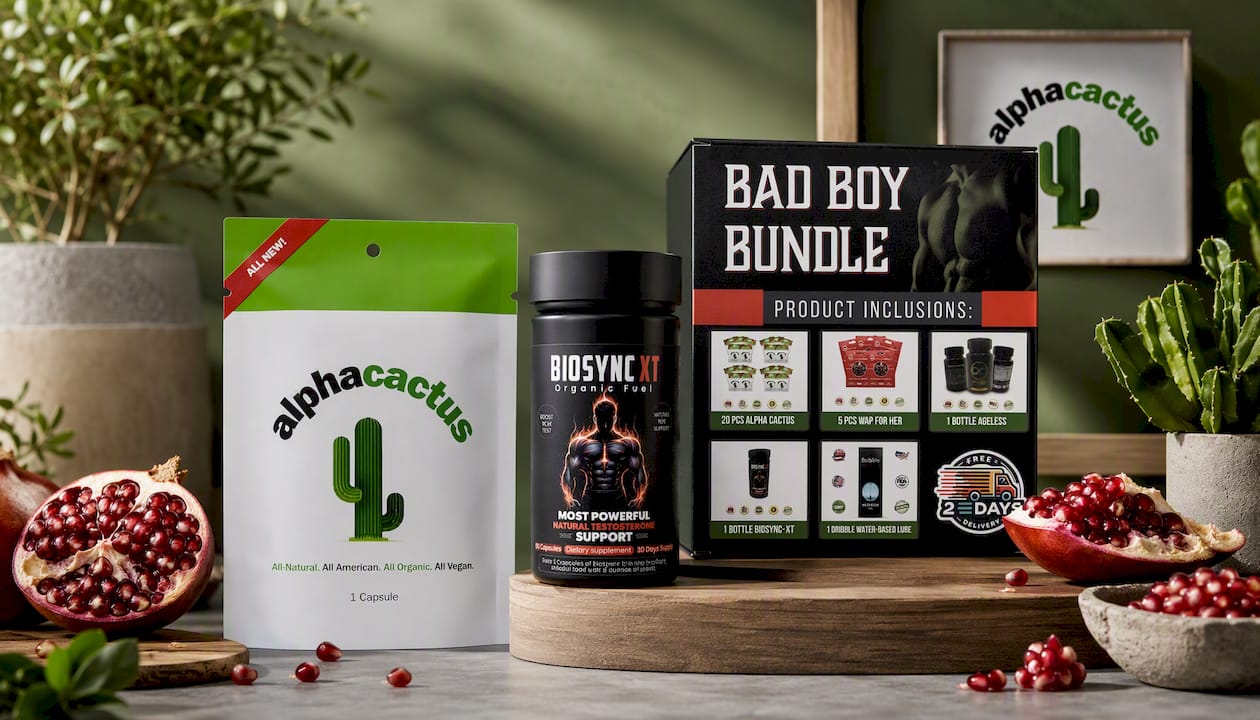
Organicufuel formulates its products with lab-tested, consistent dosing rather than the batch-to-batch variability you get from produce aisle juice. Alpha Cactus is built for men focused on natural performance and vitality support, drawing on botanical ingredients researched for their role in male sexual function, a category closely tied to the same nitric oxide and antioxidant pathways discussed earlier in this guide. Readers wanting a deeper look at how these botanical mechanisms connect to male enhancement can review the research behind organic male enhancement ingredients.
For men specifically interested in hormone support, BioSync-XT Natural Testosterone Support & Booster is formulated around the same principle the strongest serum-testosterone trial demonstrated: consistent, repeatable dosing matters more than an occasional glass of juice. You can review the full BioSync-XT formula directly on the product page. Men who want a broader approach, combining testosterone support with general performance ingredients, often look at the Bad Boy Bundle, which pairs multiple Organicufuel formulas for a more complete routine.
A standardized supplement makes the most sense for readers who’ve already discussed hormone goals with a doctor and want reproducible dosing over a period of months, mirroring the 56 to 84-day windows used in the serum trials. Readers who prefer a food-first approach, or who are still early in exploring diet changes, may reasonably start with dietary pomegranate and revisit supplementation later. Either path benefits from the same baseline habit: talk to a clinician before starting anything if you’re on medication or managing a prostate condition.
What the Evidence Actually Tells Us
The conventional wisdom on pomegranate splits into two unhelpful camps: it either gets dismissed as folk remedy nonsense, or oversold as a natural testosterone miracle. Neither holds up. The trials are small, but they’re real, controlled, and in some cases statistically significant enough to take seriously, particularly the serum-testosterone data from standardized rind extracts.
What gets underestimated is how much the form changes the story. Juice earns the flashiest headline numbers because saliva testing amplifies short-term swings, but rind extracts and combination formulas produce the evidence a clinician would actually trust. If you’re chasing a quick mood lift and modest hormonal nudge, juice is a reasonable, low-risk experiment. If you want something closer to what the serum trials measured, a standardized extract taken consistently over two to three months is the more defensible bet, and it’s the approach worth prioritizing first.
A Standardized Path Forward With Organicufuel
Home juicing and grocery-store pomegranate bottles get you inconsistent doses of the compounds that actually mattered in the trials above. Organicufuel exists for the reader who wants what those studies measured, not a rough approximation of it: a formulated, lab-tested dose you can repeat every single day without guessing how much punicalagin actually made it into your glass.
If your goal lines up with the hormone-support research in this guide, BioSync-XT Natural Testosterone Support & Booster is built around consistent daily dosing rather than variable fruit concentration. For men who want a wider performance and vitality formula alongside hormone support, Alpha Cactus draws on botanical research tied to the same nitric oxide pathways discussed earlier, and the Bad Boy Bundle combines both approaches for a more complete routine. Check the BioSync-XT product page or explore the Alpha Cactus formula to see which fits your routine, and place your first order today.
Sources
- Pomegranate juice intake enhances salivary testosterone levels and improves mood and well being in healthy men and women | SFEBES2012 | Endocrine Abstracts
- Effects of natural polyphenol-rich pomegranate juice on the acute and delayed response of Homocysteine and steroidal hormones following weightlifting exercises: a double-blind, placebo-controlled trial
- A Proprietary Herbal Blend Containing Extracts of Punica granatum Fruit Rind and Theobroma cocoa Seeds Increases Serum Testosterone Level in Healthy Young Males: A Randomized, Double-Blind Placebo-Controlled Study
- An Extract of Pomegranate Fruit and Galangal Rhizome Increases the Numbers of Motile Sperm: A Prospective, Randomised, Controlled, Double-Blinded Trial | PLOS One
Recommended
- Unleashing the Power of Nature: The Surprising Benefits of Organic Mal – Organic Fuel
- Elevate Your Sexual Performance Naturally with AlphaCactus Organic Mal – Organic Fuel
- 5 Surprising Benefits of Boosting Your Sexual Performance – Organic Fuel
- "Boost Your Confidence and Satisfaction with AlphaCactus - The Natural – Organic Fuel


Comments (0)
There are no comments for this article. Be the first one to leave a message!