

B vitamins don’t give you energy in the way a candy bar or a cup of coffee does. They have no calories and burn no fuel. What they do is act as cofactors, small helper molecules that let your cells’ enzymes convert carbohydrates, fats, and proteins into usable energy in the form of ATP. That distinction, cofactor versus fuel, is the whole story behind why “B vitamins for energy” is both true and widely misunderstood.
If your diet already supplies enough B1, B2, B3, B5, B6, B9, and B12, taking more in pill form usually does nothing measurable for your energy levels. The enzymes involved are already fully staffed. Adding more B vitamins on top of adequate status is a bit like hiring a second cashier for a store with no customers. The research backing this is consistent: supplemental B vitamins usually don’t increase energy levels in people who aren’t deficient.
There are real exceptions, though, and they matter:
- Confirmed deficiency on a blood test (low B12, folate, or others)
- Absorption problems, including celiac disease, Crohn’s disease, or prior gastric surgery
- Long-term metformin use, which is linked to reduced B12 absorption
- Strict vegans, who get little or no B12 from plant foods alone
- Older adults, whose stomachs often produce less of the acid needed to absorb B12 from food
Statistic to know: roughly 6% of adults 60 and older are outright B12 deficient, with milder insufficiency even more common in that age group.
Key Takeaways
B vitamins enable your cells to convert food into ATP, but they only measurably improve energy in people who start out deficient, not in people with adequate nutrient status.
| Point | Details |
|---|---|
| Cofactors, not fuel | B vitamins power enzymes that make ATP; they carry no calories of their own. |
| Deficiency drives benefit | Supplements help fatigue mainly when a real deficiency, like low B12, is confirmed by testing. |
| Know your risk group | Older adults, vegans, long-term metformin users, and people with malabsorption face higher deficiency odds. |
| Watch the upper limits | High-dose B6 above 100 mg/day carries neuropathy risk; niacin above 35 mg can cause flushing. |
| Food first, then testing | Whole foods cover most B-vitamin needs; blood work should guide any supplement decision. |
| Quality matters if you supplement | Organicufuel’s Alpha Cactus, BioSync-XT, and Bad Boy Bundle are lab-tested formulations for vitality and drive once diet and testing are addressed. |
Table of Contents
- How B Vitamins Support Energy at the Cellular Level
- What Do B1, B2, B3, B5, B6, B7, B9, and B12 Each Do?
- Do B-Complex Supplements Actually Reduce Fatigue?
- Who Should Get Tested for a B Vitamin Deficiency?
- How Much B Vitamin Should You Take, and Is It Safe?
- Which Foods Give You B Vitamins Naturally?
- When Fatigue Isn’t About B Vitamins at All
- What to Look for in a B-Vitamin Supplement
- Where Organicufuel Fits Into a Realistic Energy Strategy
- Frequently Asked Questions
- Sources
How B Vitamins Support Energy at the Cellular Level
The B-complex is a group of eight water-soluble vitamins: B1 (thiamine), B2 (riboflavin), B3 (niacin), B5 (pantothenic acid), B6 (pyridoxine), B7 (biotin), B9 (folate), and B12 (cobalamin). None of them provide calories. Instead, each one, in some form, becomes part of an enzyme system your mitochondria rely on to turn food into ATP, the molecule your muscles and brain actually run on.
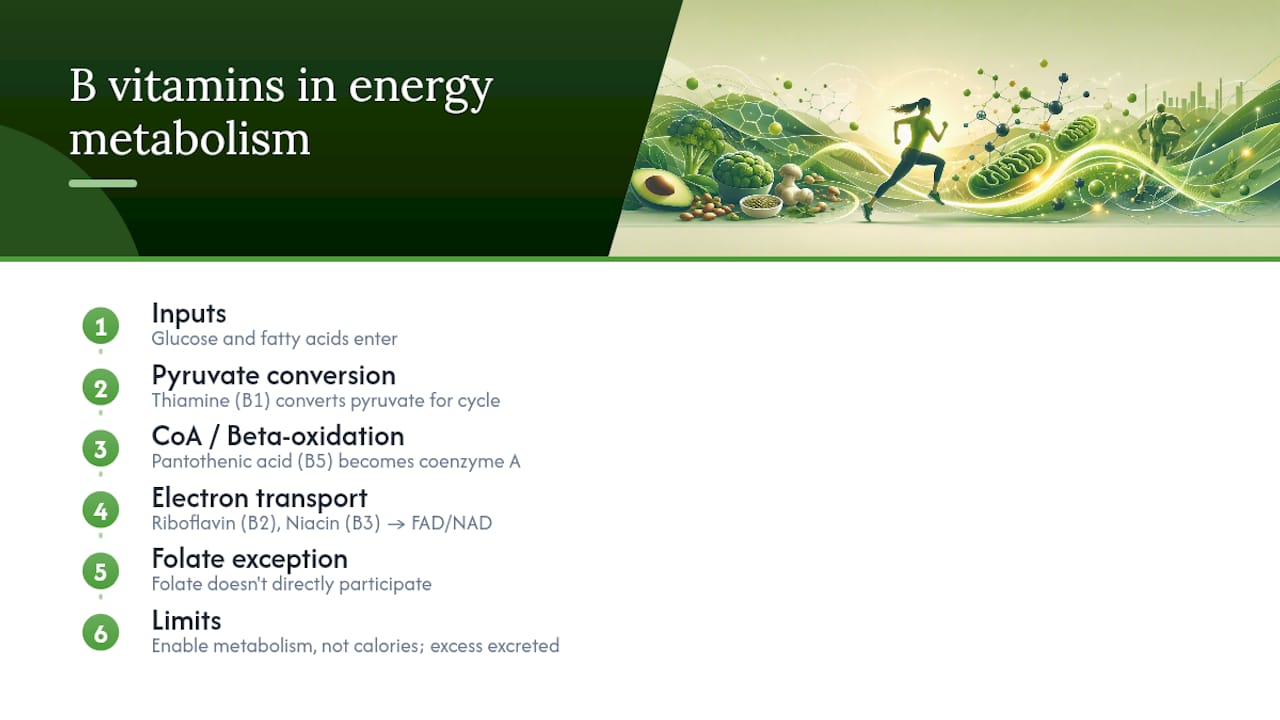
Picture your metabolism as an assembly line. Glucose and fatty acids come in one end; ATP comes out the other. B vitamins staff the checkpoints along that line. Thiamine helps convert pyruvate (a product of glucose breakdown) into a form the citric acid cycle can use. Riboflavin and niacin become FAD and NAD, the electron carriers that shuttle energy through the electron transport chain, the final and largest ATP-producing step. Pantothenic acid becomes coenzyme A, essential for feeding fats into that same cycle through beta-oxidation. Nearly every B vitamin has a specific job somewhere in this chain, and a narrative review of B vitamins and fatigue confirms that all of them except folate participate directly in at least one energy-producing step.
That’s the mechanistic case for “B vitamins boost energy,” and it’s real. What it doesn’t mean is that piling on extra B vitamins speeds up an assembly line that’s already fully staffed. As the NHS explains, these vitamins enable energy metabolism; they aren’t a source of it.
Because B vitamins are water-soluble, your body doesn’t store most of them long-term the way it stores vitamin A or D. Excess amounts, beyond what your enzymes can use, get filtered out and excreted in urine rather than banked for later. That’s part of why a “boost” from high-dose B supplements, when nutrient status is already fine, is often short-lived or purely anecdotal.
As one Cleveland Clinic summary puts it, B vitamins act like a switch that activates the enzymes responsible for metabolizing food. Flip the switch on and the process runs. Flip it on twice doesn’t make the process run twice as fast.
What Do B1, B2, B3, B5, B6, B7, B9, and B12 Each Do?
Each B vitamin has a distinct job, distinct food sources, and a distinct deficiency picture. Knowing which one is which helps you figure out where a diet gap, or a real medical risk, might be hiding.
Vitamin B1 (thiamine) helps convert carbohydrates into usable energy by supporting the enzyme that feeds pyruvate into the citric acid cycle. Good sources include pork, whole grains, legumes, and sunflower seeds. Deficiency is rare in the US outside of alcohol use disorder, but when it happens it causes profound fatigue, irritability, and in severe cases beriberi or Wernicke-Korsakoff syndrome.
Vitamin B2 (riboflavin) becomes FAD, one of the two major electron carriers your mitochondria used to generate ATP. It’s found in dairy, eggs, lean meats, and leafy greens. Deficiency shows up as cracked lips, a sore tongue, and skin irritation around the nose, alongside general fatigue.
Vitamin B3 (niacin) becomes NAD and NADP, arguably the most heavily used electron carriers in the entire energy system. Meat, fish, peanuts, and fortified grains are reliable sources. Severe deficiency causes pellagra, marked by dermatitis, diarrhea, and dementia, though mild shortfalls just produce fatigue and poor appetite.
Vitamin B5 (pantothenic acid) forms coenzyme A, the molecule that lets fats and carbohydrates both enter the citric acid cycle. It’s in nearly every food group, meat, avocado, broccoli, and whole grains among them, which is why true deficiency is almost unheard of.
Vitamin B6 (pyridoxine) supports amino acid metabolism and helps make hemoglobin, the oxygen-carrying protein in red blood cells. Poultry, fish, potatoes, and chickpeas are strong sources. Low B6 can cause a specific type of anemia along with irritability and confusion.
Vitamin B7 (biotin) assists enzymes involved in fat and glucose synthesis. Eggs, nuts, and salmon supply it well. True biotin deficiency is uncommon, but it can appear with hair thinning, brittle nails, and skin rashes, sometimes triggered by eating large amounts of raw egg whites over time.
Vitamin B9 (folate) is essential for DNA synthesis and red blood cell production, which indirectly affects oxygen delivery and energy. Leafy greens, legumes, and fortified cereals are top sources. Deficiency causes megaloblastic anemia with fatigue, weakness, and shortness of breath.
Vitamin B12 (cobalamin) is required for both nerve function and red blood cell formation, and works closely with folate in DNA synthesis. It’s found almost exclusively in animal products: meat, fish, eggs, and dairy, which is why vegans need a fortified source or supplement. Deficiency produces fatigue, numbness or tingling in the hands and feet, memory problems, and, if severe, irreversible nerve damage.
Supplement labels typically list B12 as either cyanocobalamin (synthetic, converted by the body) or methylcobalamin (the active form some people prefer for absorption reasons), and B9 as folic acid versus methylfolate for the same reason.
Do B-Complex Supplements Actually Reduce Fatigue?
The clinical evidence on this splits cleanly along one line: deficiency status. In people who are already deficient, correcting a B12, folate, or B6 shortfall reliably improves energy and reverses the associated anemia. In people whose diet already supplies adequate B vitamins, adding a B-complex supplement generally does not move the needle on fatigue, mood, or exercise performance. That’s the core takeaway from Harvard Health’s guidance on vitamins and energy, and it lines up with what the broader research on B vitamins and fatigue shows: benefit tracks with baseline status, not with dose.
This is where marketing claims and clinical reality tend to diverge. Ads for energy supplements often imply that exercise or daily stress “burns through” B vitamins fast enough that anyone active needs extra. There’s no solid trial evidence backing that as a general claim. Perceived energy boosts after taking a B-complex pill in a well-nourished person are more plausibly explained by expectation and the placebo response than by any measurable biochemical shift.
Where the subgroup data does hold up:
- Documented B12 deficiency, especially with megaloblastic anemia, shows consistent improvement in fatigue and cognitive symptoms once treated.
- Folate-deficiency anemia responds similarly to folate repletion.
- Older adults with confirmed low B12, roughly 6% of those 60 and older, often report meaningful symptom relief after correction, whether through oral high-dose B12 or injections.
- Well-nourished younger adults without deficiency show little to no measurable change in energy or performance from B-complex supplementation in most controlled comparisons.
Trial quality across this literature is uneven. Many studies use small samples, run for just a few weeks, and rely on subjective fatigue scales rather than objective performance measures. That’s a real limitation, and it’s part of why sweeping claims like “B vitamins cure fatigue” don’t hold up to scrutiny even as the narrower claim, “correcting a deficiency helps,” does. A partner analysis of supplement evidence for low energy reaches a similar conclusion: the strongest, most consistent effects appear in people starting from a measurable shortfall, not in the general population.
Risk versus benefit here is fairly one-sided. A basic B-complex at RDA-level doses carries low risk for most adults, so trying one isn’t dangerous even if the odds of a noticeable effect are low absent deficiency. High-dose, “mega-B” formulations have different risk considerations covered in the dosage section below.
Who Should Get Tested for a B Vitamin Deficiency?
Some people have a meaningfully higher chance of running low on one or more B vitamins, and for them, testing before supplementing makes more sense than guessing.
Higher-risk groups include:
- Adults 60 and older, due to reduced stomach acid production, which impairs B12 absorption from food
- Strict vegans and vegetarians, since B12 occurs almost exclusively in animal products
- People with malabsorption conditions: inflammatory bowel disease, celiac disease, or a history of gastric bypass or bariatric surgery
- Long-term metformin users, since metformin use beyond about four months is strongly associated with lower B12 levels
- People with chronic heavy alcohol use, which impairs absorption of thiamine, folate, and B6
- People on long-term acid-reducing medications (PPIs or H2 blockers) or certain anticonvulsants
If you fall into one of these categories and you’re dealing with persistent fatigue, ask your clinician about a targeted panel rather than starting a supplement blind. A reasonable testing checklist includes serum B12, methylmalonic acid (a more sensitive marker for B12 status than serum levels alone), RBC or serum folate, homocysteine, and a complete blood count to check for anemia. B6 testing is less standardized but worth requesting if symptoms point that direction.
Red flag: severe or rapidly progressing fatigue, numbness or tingling, memory changes, or visible signs of anemia (pale skin, shortness of breath, rapid heartbeat) warrant a medical evaluation, not a trip to the supplement aisle.
How Much B Vitamin Should You Take, and Is It Safe?
For most healthy adults, hitting the RDA through diet or a standard multivitamin covers the bases: roughly 1.1 to 1.2 mg of thiamine, 1.1 to 1.3 mg of riboflavin, 14 to 16 mg of niacin, 1.3 to 1.7 mg of B6, 400 mcg of folate, and 2.4 mcg of B12 daily. Therapeutic dosing looks very different and is meant for confirmed deficiency, not general wellness. B12 injections or high-dose oral B12 (often 1,000 mcg or more) are standard treatment once deficiency is confirmed. Folate repletion typically uses higher doses under medical supervision, particularly in pregnancy or diagnosed anemia.
Not every B vitamin is risk-free at high doses. Niacin above supplement doses of roughly 35 mg can cause flushing, and much higher doses used for cholesterol management require medical supervision due to liver risk. Vitamin B6 has a well-documented downside: chronic intake above 100 mg per day has been linked to peripheral neuropathy, nerve damage causing numbness or tingling, in some cases even at doses found in “mega-dose” energy supplements. B12 and B5 don’t have established upper limits because excess is efficiently excreted, but that doesn’t mean unlimited doses are useful.
Medication interactions deserve real attention. Long-term metformin use lowers B12 absorption. Acid-suppressing drugs (PPIs, H2 blockers) reduce the stomach acid needed to release B12 from food. Certain anticonvulsants interfere with folate metabolism. If you’re on any of these long-term, mention it at your next checkup rather than assuming a multivitamin covers the gap.
| Vitamin | RDA (adults) | Upper limit | Therapeutic use context |
|---|---|---|---|
| B1 (thiamine) | 1.1–1.2 mg/day | None established | High-dose IV in severe deficiency (alcohol use disorder) |
| B3 (niacin) | 14–16 mg/day | 35 mg/day (supplements) | Higher doses used medically for cholesterol, under supervision |
| B6 (pyridoxine) | 1.3–1.7 mg/day | 100 mg/day | Neuropathy risk above the upper limit with chronic use |
| B9 (folate) | 400 mcg/day | 1,000 mcg/day (folic acid) | Higher doses used for diagnosed folate deficiency, pregnancy |
| B12 (cobalamin) | 2.4 mcg/day | None established | 1,000 mcg+ oral or injection for confirmed deficiency |
One more caution worth stating plainly: dietary supplements aren’t pre-approved by the FDA for efficacy the way prescription drugs are. Label accuracy and dosing consistency depend heavily on the manufacturer, which is exactly why third-party testing matters when you’re choosing a product.
Which Foods Give You B Vitamins Naturally?
A food-first approach covers nearly every B vitamin without needing a pill, and it comes with the added benefit of fiber, protein, and other nutrients supplements don’t provide.
Reliable whole-food sources by vitamin:
- B1 and B3: whole grains, pork, legumes, fortified cereals
- B2: dairy, eggs, almonds, leafy greens
- B5: nearly everything, meat, avocado, mushrooms, sweet potatoes
- B6: poultry, fish, bananas, chickpeas
- B7: eggs, salmon, sunflower seeds
- B9: spinach, lentils, asparagus, fortified grains
- B12: meat, fish, eggs, dairy, or fortified plant milk and nutritional yeast for vegans
A simple one-day menu built around these looks like this: eggs with spinach and whole-grain toast for breakfast, a lentil and chicken salad with leafy greens for lunch, and salmon with sweet potato and broccoli for dinner, with almonds or sunflower seeds as a snack. That single day covers most of the B-complex without a single supplement.
Cooking method matters, too. B vitamins are water-soluble and heat-sensitive, so boiling vegetables leaches them into the cooking water; steaming or roasting preserves more. Store leafy greens properly and use them within a few days, since nutrient content drops the longer produce sits.
For vegans, fortified plant milks, nutritional yeast, and fortified cereals are the practical way to close the B12 gap, since it isn’t naturally present in plant foods.
Pro Tip: If you fall into a higher-risk group, pair dietary changes with periodic blood testing rather than assuming diet alone has fixed the problem. Absorption issues don’t always resolve just because your intake improves.
When Fatigue Isn’t About B Vitamins at All
Persistent fatigue sends plenty of people straight to the supplement aisle when the actual cause has nothing to do with vitamin status. Watch for red flags that point toward something else entirely:
- Unexplained weight loss or persistent fever
- Cognitive changes that are new or worsening
- Focal neurological symptoms: weakness on one side, vision changes, slurred speech
- Fatigue that’s rapidly progressing rather than gradual
- Chest pain, shortness of breath, or other cardiopulmonary symptoms
Any of these warrant a primary care visit, not a supplement trial. A reasonable next step includes targeted labs (thyroid panel, complete blood count, B12/folate, iron studies), a mental health screening for depression or anxiety, and a sleep assessment, since undiagnosed sleep apnea is a common, overlooked driver of daytime fatigue.
It’s also worth naming a specific trap directly: the Endocrine Society explicitly states that “adrenal fatigue” is not a recognized medical diagnosis, and warns that supplements marketed under that label can delay diagnosis of real, treatable conditions like anemia, hypothyroidism, or clinical depression. If a product’s marketing leans heavily on “adrenal support” language, treat that as a reason for more scrutiny, not less.
What to Look for in a B-Vitamin Supplement
If testing confirms a real gap, or your clinician recommends supplementing, quality control matters more than most people realize, given the labeling gaps mentioned earlier.
Run through this checklist before buying:
- Third-party testing from an independent body (USP, NSF, or ConsumerLab) rather than just the manufacturer’s own claims
- Clear, specific dosing on the label, not vague “proprietary blend” language that hides actual amounts
- Batch or lot numbers and a listed expiration date
- Transparent sourcing of ingredients, including the exact form (methylcobalamin versus cyanocobalamin, methylfolate versus folic acid)
- A certificate of analysis (COA) available on request, confirming the product contains what the label states
- A money-back guarantee, which signals a manufacturer willing to stand behind its formulation
If you have a known absorption issue, ask specifically whether the B12 and folate are in their methylated forms, since some people process these more efficiently than the synthetic versions. Also ask whether the doses align with standard RDAs or with therapeutic-level dosing, since those serve very different purposes.
Pro Tip: A red flag on any supplement label is a long list of additives or fillers with no clear function, alongside vitamin doses given only as a percentage of “Daily Value” with no milligram or microgram figure to check against known upper limits. Organicufuel’s approach to herbal supplement safety centers on lab testing and transparent labeling, the same standard worth applying to any B-vitamin product you’re considering.
How clinicians actually counsel patients on B vitamins and fatigue
Clinicians who take fatigue seriously tend to start with the same question: is this a diet problem or a diagnosis problem? Testing comes before high-dose supplementation, and food sources come before pills when diet alone can close the gap. A composite case that comes up often: an older adult reporting months of low energy turns out to have mildly low B12 on testing. After treatment, whether injections or high-dose oral B12, energy and mental clarity both improve within weeks. That pattern, test first, treat the actual deficiency, holds up far better than starting with a supplement and hoping.
Where Organicufuel Fits Into a Realistic Energy Strategy
Once testing and diet have done their part, some people still want a well-formulated supplement to round out their routine, particularly around stamina, drive, and hormonal support rather than B vitamins alone. That’s the lane Organicufuel works in.

Every Organicufuel formulation is tested in US labs and produced under FDA-registered, GMP-certified conditions, the same transparency standard covered in the supplement checklist above. The Bad Boy Bundle combines multiple formulations for men looking for a broader vitality stack rather than a single product. Alpha Cactus is built around natural stamina and drive support for men seeking a plant-based alternative to synthetic options. BioSync-XT targets natural testosterone support, relevant for men whose fatigue and low drive trace back to hormonal status rather than a vitamin shortfall.
None of these replace a blood test if you suspect a real deficiency; food and targeted correction still come first. But if you’ve covered that ground and want a natural formulation backed by lab testing and a money-back guarantee, visit Organicufuel’s product lineup and see which formulation matches what you’re actually trying to fix.
Frequently Asked Questions
Do B vitamins for energy actually work if you’re not deficient? Not reliably. Clinical guidance consistently finds that supplemental B vitamins don’t raise energy levels in people whose nutrient status is already adequate. The benefit shows up almost exclusively in people correcting a real deficiency.
Which B vitamin is most linked to fatigue? Vitamin B12 has the strongest documented link, since deficiency causes a specific type of anemia along with neurological symptoms like numbness and memory changes. Folate deficiency produces a similar anemia-driven fatigue.
Can B vitamins help with what people call adrenal fatigue? “Adrenal fatigue” isn’t a recognized medical diagnosis, and the Endocrine Society specifically warns against using unproven supplements marketed under that label, since they can delay diagnosis of real, treatable conditions like thyroid disease or anemia.
How long does it take to notice a difference after correcting a B12 deficiency? Many people report improved energy and mental clarity within a few weeks of treatment, whether through oral high-dose B12 or injections, though full nerve-related symptoms can take longer to resolve.
Are B-complex supplements safe to take daily? At RDA-level doses, yes, for most healthy adults. High-dose formulations are a different matter. Chronic B6 intake above 100 mg per day carries a documented risk of nerve damage, so more isn’t automatically better.
Do vegans need to supplement B12? Generally yes, since B12 occurs almost exclusively in animal products. Fortified plant milks, nutritional yeast, and fortified cereals can help, but many vegans still need a dedicated B12 supplement to maintain adequate blood levels.
This article is general information, not a substitute for advice from a qualified doctor. Consult a qualified healthcare professional about your own circumstances before acting on anything here.
Sources
- B vitamins and folic acid - - - Vitamins and minerals - NHS
- Best vitamins and minerals for energy - Harvard Health
- B vitamins and fatigue: narrative review (PMC/NIH)
- Vitamin B12 - Office of Dietary Supplements (ODS) fact sheet


Comments (0)
There are no comments for this article. Be the first one to leave a message!