
You can boost energy without caffeine by prioritizing sleep and hydration, using brief movement or naps for immediate lift, and adding evidence-backed stimulant-free supplements when steady, jitter-free fuel is what you need. Each strategy has a different job. Fix sleep and hydration first because they carry the biggest impact for the least effort. Use a 10-minute walk or a 20-minute nap when you need a lift right now. Lean on nutrition (protein, fiber, low-glycemic carbs) to prevent the crash in the first place. When lifestyle changes aren’t enough, adaptogens and stimulant-free supplements like those from Organicufuel can fill the gap.
- Sleep and hydration — fix this first, always
- Movement or a short nap — for an immediate lift
- Steady nutrition — to prevent the crash before it starts
- Adaptogens and herbal supplements — for sustained resilience over weeks
- Stimulant-free pre-workouts — for exercise performance without adrenergic stimulation
The FDA notes that caffeine tolerance varies widely from person to person, so anyone sensitive to stimulants or taking prescription medication should check with a clinician before adding a new supplement.
Key Takeaways
The most reliable path to caffeine-free energy stacks sleep and hydration first, adds movement for immediate lift, and reserves supplements for the gaps lifestyle changes can’t close.
| Point | Details |
|---|---|
| Fix sleep before anything else | Consistent wake times and morning light produce bigger energy gains than any supplement. |
| Hydrate before you snack or supplement | Mild dehydration alone measurably reduces alertness and focus. |
| Use movement for a fast lift | A 10-minute walk or 2 minutes of box breathing raises alertness within minutes. |
| Give adaptogens two to four weeks | Rhodiola, ashwagandha, and similar herbs build resilience gradually, not instantly. |
| Choose transparent, tested products | Organicufuel’s lab-tested, GMP-certified lineup, including Alpha Cactus and BioSync-XT, fits a caffeine-free plan once lifestyle basics are in place. |
Table of Contents
- What Foods and Drinks Give You Steady, Non-Caffeinated Energy?
- Why Does Better Sleep Beat Every Other Energy Fix?
- Can a Quick Workout Replace Your Afternoon Coffee?
- Do Adaptogens Like Ashwagandha and Rhodiola Actually Work?
- What Are the Best Stimulant-Free Pre-Workout Options?
- How Do You Choose a Safe Caffeine-Free Supplement?
- How Does Organicufuel’s Lineup Fit a Caffeine-Free Energy Plan?
- What Non-Caffeine Energy Boosters Are Sold Commercially?
- What Do Caffeine-Free Energy Supplements Typically Cost?
- How Do You Spot a Reputable Caffeine-Free Supplement Brand?
- What Side Effects Can Caffeine-Free Energy Supplements Cause?
- What Do Real Users Say About Caffeine-Free Energy Products?
- Why the Sleep-First Approach Gets Ignored, and Shouldn’t
- Ready to Build Your Caffeine-Free Energy Plan?
- Frequently Asked Questions
- Sources
What Foods and Drinks Give You Steady, Non-Caffeinated Energy?
Start with water. Mild dehydration, as little as 1 to 2 percent of body weight lost in fluid, measurably reduces alertness and concentration before you ever feel thirsty. Most adults need about half their body weight in ounces of water daily, with increased amounts if active or in hot weather. If your energy dips happen mid-morning or mid-afternoon regardless of how much you slept, check your water bottle before you check the coffee pot.
Food timing matters just as much as food choice. A breakfast that pairs protein, fiber, and low-glycemic carbs (think eggs with whole-grain toast and berries, or Greek yogurt with oats and nuts) keeps blood sugar stable for hours. A sugary pastry alone spikes glucose and then crashes it, taking your energy down with it. Threads on communities like r/nutrition consistently point to the same whole-food staples: oatmeal, nuts, fruit, and yogurt for sustained afternoon focus.
Three nutrients deserve special attention because deficiencies mimic fatigue almost perfectly: iron, B vitamins (especially B12), and magnesium. If you’re chronically tired despite good sleep and hydration, ask a doctor for bloodwork before assuming you need a supplement.
- Breakfast: protein + fiber + slow carbs, not sugar alone
- Mid-morning snack: a handful of almonds or an apple with peanut butter
- Afternoon: hydrate before you reach for a pick-me-up
- Get iron, B12, and magnesium checked if fatigue persists
Pro Tip: Keep a water bottle on your desk with time markers. People drink measurably more when the target is visible, not abstract.
Swapping your drink matters too. Caffeine-free chai and chicory coffee give you the ritual and warmth of a coffee break with none of the stimulant load, which helps if part of your energy dip is really just routine and habit.
Why Does Better Sleep Beat Every Other Energy Fix?
Sleep quality produces the largest energy gains of any single change you can make, larger than diet, movement, or any supplement on the market. Health-system guidance consistently ranks sleep hygiene above supplementation as the first lever to pull for anyone chasing more daytime energy, precisely because it’s low-risk and addresses the root cause rather than masking it.
- Get bright light within 30 minutes of waking. It anchors your circadian rhythm and makes you more alert for the next 8 to 10 hours.
- Keep a consistent wake time, even on weekends. Variable schedules confuse your internal clock more than short sleep does.
- Cut screens 30 to 60 minutes before bed and build a short wind-down routine, reading or stretching works.
- Reserve naps for 20 minutes, ideally before 3 PM. Longer naps push you into deep sleep and leave you groggier than before you closed your eyes.
One night of poor sleep isn’t fully repaid by one long weekend of catching up. Sleep debt accumulates, and consistent moderate sleep beats occasional binge recovery for daytime alertness.
Can a Quick Workout Replace Your Afternoon Coffee?
Short bursts of movement raise heart rate and blood flow enough to noticeably sharpen alertness within minutes, often faster than waiting on a caffeinated drink to kick in.
- Take a 10-minute walk when focus drops. Outdoor light adds a secondary alertness boost.
- Try box breathing (4 seconds in, 4 hold, 4 out, 4 hold) for 2 minutes when you need alertness without leaving your desk.
- Set a recurring break every 60 to 90 minutes. Sitting still that long already measurably degrades focus.
- Choose a nap over exercise only when you’re genuinely sleep-deprived; choose movement when you’re rested but mentally stale.
Pro Tip: If you only have five minutes, ten bodyweight squats and twenty seconds of brisk stair climbing raise alertness faster than a slow walk to the break room.
Do Adaptogens Like Ashwagandha and Rhodiola Actually Work?
Adaptogens and medicinal mushrooms build resilience and steadier energy over days and weeks. They don’t deliver the instant jolt a stimulant does, and expecting that is where most people get disappointed.
- Rhodiola rosea is used traditionally for reducing fatigue under stress and supporting mental stamina during demanding periods.
- Ashwagandha supports the body’s stress response, which indirectly helps energy since chronic stress is a major hidden drain.
- Maca root is used for stamina and vitality, particularly among people focused on physical performance.
- Cordyceps is favored for supporting oxygen utilization and endurance during exercise.
- Lion’s Mane targets cognitive clarity and focus rather than raw physical energy.
Give any adaptogen two to four weeks of consistent daily use before judging whether it’s working. Onset is gradual by design, and stacking multiple ingredients without understanding each one’s role just muddies the results.
Sourcing quality varies enormously across this category. Look for third-party testing and clear sourcing information before buying, and flag any product that promises immediate stimulation. That’s not how adaptogens function, and a company claiming otherwise is either confused about its own ingredients or exaggerating for a sale. Anyone on thyroid medication, immunosuppressants, or blood thinners should talk to a clinician before adding these, since several herbs interact with those drug classes.
What Are the Best Stimulant-Free Pre-Workout Options?
Stimulant-free pre-workouts improve performance through blood flow and muscle energy pathways, not through adrenaline. That’s the core difference, and it’s why they don’t produce jitters or a crash.
- L-citrulline boosts nitric oxide, which improves blood flow and endurance during training.
- Creatine supports the muscle energy system for strength and power output.
- Beta-alanine buffers lactic acid buildup, delaying that burning fatigue in longer sets.
- Taurine supports hydration and muscle function during exercise.
- L-tyrosine and alpha-GPC support mental focus and the mind-muscle connection without touching the adrenergic system.
These formulas suit evening training sessions, anyone sensitive to stimulants, or people who already get enough caffeine elsewhere in the day. Manufacturers like NutraBio build stim-free lines specifically around this ingredient combination. Powders let you adjust dosage more precisely than capsules, which matters most with creatine and beta-alanine since effective doses run higher than a typical capsule can hold.
How Do You Choose a Safe Caffeine-Free Supplement?
Run every caffeine-free supplement through the same short checklist before you buy, because label quality varies more in this category than almost any other in the wellness aisle.
- Check for exact dosing. Every active ingredient should list a specific milligram amount, not a vague “proprietary blend.”
- Ask for a Certificate of Analysis (COA). A reputable brand can produce third-party lab results confirming what’s actually in the bottle.
- Confirm GMP certification and FDA registration of the manufacturing facility. This tells you the product was made under enforced quality standards.
- Trace ingredient sourcing. Herbal potency swings wildly based on growing region and extraction method.
- Start at the low end of the dosing range for the first week and track how you feel before increasing.
A proprietary blend with no listed amounts is the single biggest red flag on a supplement label. If a company won’t tell you how much of an ingredient you’re getting, assume it’s less than you’d want.
Anyone on blood pressure medication, blood thinners, thyroid drugs, or antidepressants should review sourcing and safety questions with a doctor before starting a new herbal regimen, since interactions with these drug classes are among the most commonly reported.
How Does Organicufuel’s Lineup Fit a Caffeine-Free Energy Plan?
Organicufuel builds its catalog around lab-tested, GMP-certified, FDA-registered supplements made in the USA, which matters because sourcing and testing are exactly where the caffeine-free supplement category most often falls short.
- Alpha Cactus supports stamina and vitality through natural ingredients rather than stimulants, fitting the resilience-building role adaptogens play.
- Bad Boy Bundle combines multiple formulas for a broader daily regimen if you’re addressing energy and vitality together.
- BioSync-XT targets natural testosterone support, which connects to sustained energy and drive over time rather than a same-day spike.
Pro Tip: Treat any supplement as the last layer of your plan, not the first. Fix sleep and hydration, then add a lab-tested formula to support what lifestyle changes can’t fully cover.
Organicufuel backs its catalog with a money-back guarantee, which gives you a real way to test fit without full financial risk.
What Non-Caffeine Energy Boosters Are Sold Commercially?
The caffeine-free energy market splits into a few clear categories, each with real trade-offs worth knowing before you buy.
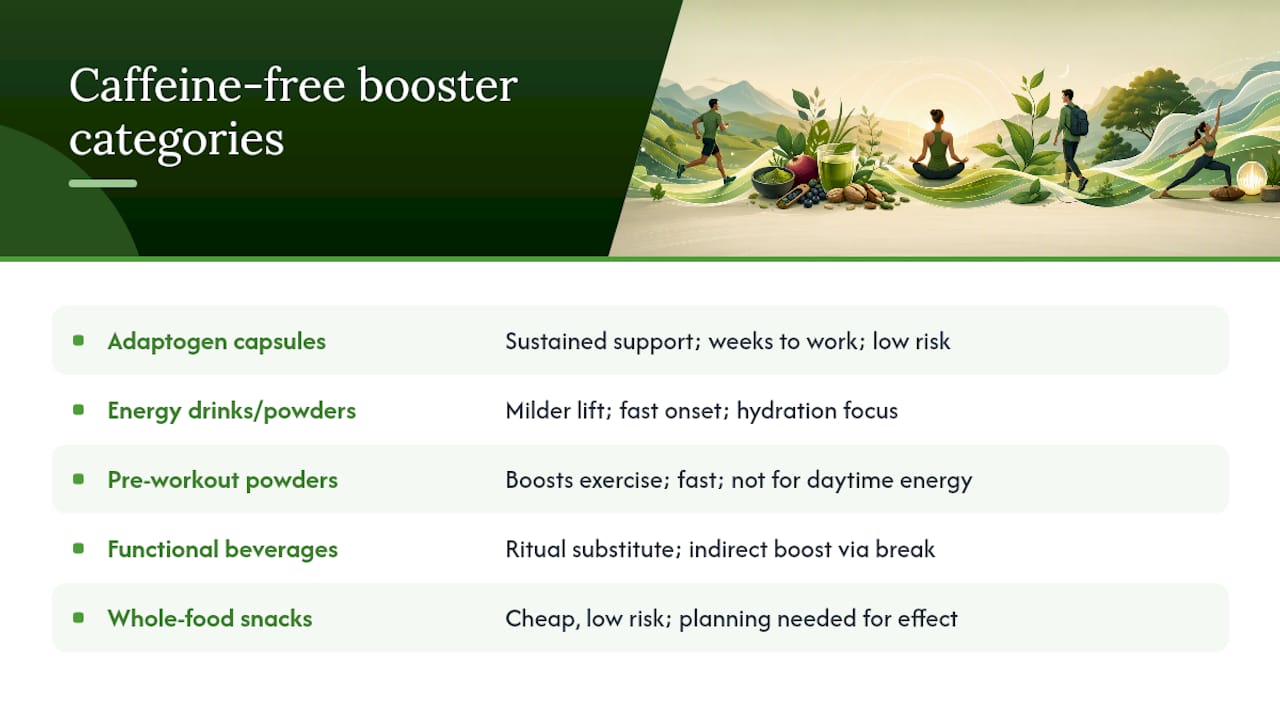
Herbal and adaptogenic capsules (ashwagandha, rhodiola, maca blends) offer sustained energy support with minimal side-effect risk for most healthy adults. The downside: results take weeks, not minutes, and quality varies enormously by brand.
Caffeine-free energy drinks and powders aim to deliver focus and hydration through B vitamins, electrolytes, and amino acids instead of stimulants. Manufacturers in this space position them as a drop-in replacement for a caffeinated can, though the effect is generally milder and more about hydration than a noticeable lift.
Stimulant-free pre-workout powders solve a narrower problem: exercise performance. They’re not designed for general daytime energy and won’t help you push through a boring afternoon at your desk.
Functional beverages like caffeine-free chai or chicory coffee replace the ritual of a hot drink without any stimulant payload. The energy benefit here is mostly indirect, better hydration and a mental break, rather than a pharmacological effect.
Whole-food snacks (nuts, fruit, yogurt) cost the least and carry the fewest risks, but they require more planning than opening a bottle or a capsule. Matching the format to your actual problem, sustained resilience versus a same-day boost versus workout performance, matters more than picking whichever product has the loudest marketing.
What Do Caffeine-Free Energy Supplements Typically Cost?
Pricing in this category runs a wide range, and the spread usually tracks ingredient quality and testing rigor more than marketing budget.
Basic single-ingredient capsules (a standalone ashwagandha or rhodiola product) tend to sit at the lower end of the market. Multi-ingredient blends and stimulant-free pre-workout powders cost more because they combine several dosed ingredients, and effective doses of things like creatine and beta-alanine require more raw material per serving than a typical capsule.
Subscription models, common across the caffeine-free supplement space, usually shave a percentage off the one-time price in exchange for recurring delivery. That’s worth it if you’ve already confirmed a product works for you; it’s not worth committing to before you’ve tested a single bottle.
Value assessment here isn’t just about price per bottle. A cheap product with unclear dosing and no third-party testing can cost you more in wasted money and wasted weeks than a pricier one that’s transparent about what’s inside. Bundles, like combining a stamina formula with a testosterone-support product, often make sense financially if you already know you want both, since bundling typically beats buying each product separately over time.
The honest calculation: price per effective dose, not price per bottle. A product with a fully dosed, third-party-tested formula at a higher sticker price frequently delivers better value than a cheaper bottle with a diluted proprietary blend.
How Do You Spot a Reputable Caffeine-Free Supplement Brand?
Reputable brands in this space share a specific set of traits, and they’re easy to check if you know where to look.
Manufacturing transparency comes first. A trustworthy brand states plainly where its products are made and under what certification, GMP compliance and FDA facility registration are the two to look for. If a company is vague about manufacturing location, treat that as a warning sign, not an oversight.
Third-party lab testing separates serious brands from the rest of the market. Ask directly for a Certificate of Analysis if it isn’t posted; a brand with nothing to hide will provide one without hesitation.
Clear, specific dosing on every label matters more than flashy ingredient lists. Brands that hide behind “proprietary blend” language are usually doing so because the actual dose is lower than a competitor’s fully disclosed formula.
A real guarantee signals confidence. Organicufuel backs its products with a money-back guarantee, which is a meaningful signal precisely because a company only offers that when it expects the product to work as described.
Consistent customer feedback over time, not just a handful of curated testimonials, tells you more than any single review. Look for patterns across many reviews rather than isolated five-star praise. A brand willing to publish detailed product background instead of vague marketing copy is usually one that has done its homework on the ingredients it sells.
What Side Effects Can Caffeine-Free Energy Supplements Cause?
Caffeine-free doesn’t mean risk-free, and that’s the single most misunderstood point in this entire category.
Adaptogens like ashwagandha can cause mild digestive upset, drowsiness, or headaches in some people, especially at higher doses or when starting fresh. Ashwagandha specifically has documented interactions with thyroid medication and can affect thyroid hormone levels, so anyone on thyroid treatment needs a clinician’s input before starting it.
Rhodiola can cause jitteriness or insomnia in sensitive individuals, ironic given it’s marketed as a calm-energy alternative, and it may interact with blood pressure medications or antidepressants. Maca is generally well tolerated but can cause digestive discomfort in some people at higher doses.
Stimulant-free pre-workout ingredients carry their own considerations. Beta-alanine commonly causes a harmless tingling sensation (paresthesia) that surprises first-time users but isn’t dangerous. High-dose creatine can cause water retention or mild digestive upset in some people, and anyone with kidney concerns should check with a doctor before regular use.
The FDA’s broader guidance on stimulant sensitivity applies here too: individual tolerance varies enormously, and starting at the lowest recommended dose while monitoring your own response is the safest approach with any new supplement, caffeine-free or not. Pregnant or breastfeeding individuals should treat every herbal supplement as a clinician-consult item, not a self-directed choice.
What Do Real Users Say About Caffeine-Free Energy Products?
Consumer feedback across the caffeine-free supplement category tends to cluster around a few consistent themes, whether the product is an adaptogenic capsule or a stimulant-free pre-workout.
People who report the best results are almost universally the ones who gave a product several weeks before judging it. Reviews that complain about “no effect” often come from users who expected an immediate stimulant-like jolt and quit after three or four days, before adaptogens have had time to build any measurable resilience.
Users switching from caffeine specifically tend to praise the absence of an afternoon crash and the lack of jitters, even when they describe the initial energy lift as milder than coffee. That trade-off, smoother but less intense, shows up again and again in community discussion threads like the r/nutrition energy conversation, where people default back to whole-food strategies when supplements alone don’t fully solve the problem.
Negative reviews cluster around two causes far more than ineffective ingredients: unclear dosing on the label and unmet expectations about onset speed. Both are avoidable if you read labels carefully before buying and set expectations around the two-to-four-week window adaptogens typically need.
The pattern across genuine feedback is consistency of use matters more than which specific brand you choose, provided the brand is transparent about dosing and third-party tested.
Why the Sleep-First Approach Gets Ignored, and Shouldn’t
Most advice on caffeine-free energy jumps straight to supplements because that’s where the money and the marketing sit. That’s backward. The research consistently ranks sleep and hydration as the highest-leverage changes available, yet they get a single bullet point in most articles before rushing to the ingredient list.
The uncomfortable truth is that no adaptogen, however well-sourced, compensates for five hours of sleep a night. Ashwagandha and rhodiola work by supporting your body’s existing stress response and energy pathways, not by replacing what chronic sleep debt destroys. Treating a supplement as a fix for a sleep problem sets you up for disappointment and a wasted bottle.
Where supplements genuinely earn their place is the gap between “doing everything right” and “still feeling depleted.” That’s a real gap, and it’s exactly where a lab-tested, transparently dosed product belongs. Organicufuel’s approach, built around clear labeling and third-party testing, works because it respects that gap instead of pretending to replace the fundamentals.
Ready to Build Your Caffeine-Free Energy Plan?
You’ve read about sleep, hydration, movement, and adaptogens. The one piece most people skip is finding a supplement they can actually trust once they’re ready to add one. Organicufuel closes that gap with lab-tested, GMP-certified, FDA-registered formulas made in the USA, so you’re not gambling on a proprietary blend with hidden doses.
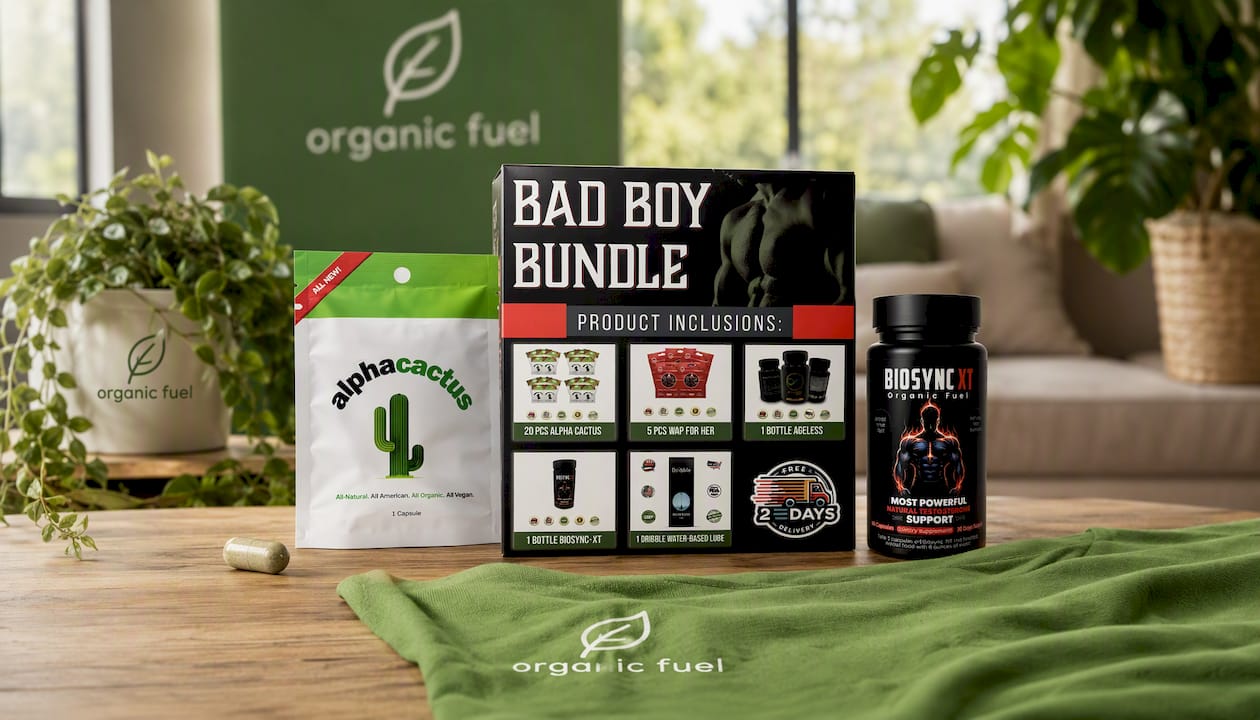
If sustained stamina and vitality are your goal, Alpha Cactus is built around the adaptogenic support strategy covered above. If you want a broader daily regimen, the Bad Boy Bundle combines multiple formulas at a better combined value than buying each separately. And if your energy dips trace back to hormonal balance, BioSync-XT targets that root cause directly. Every purchase comes with Organicufuel’s money-back guarantee, so start with one product, track how you feel over a few weeks, and adjust from there.
Frequently Asked Questions
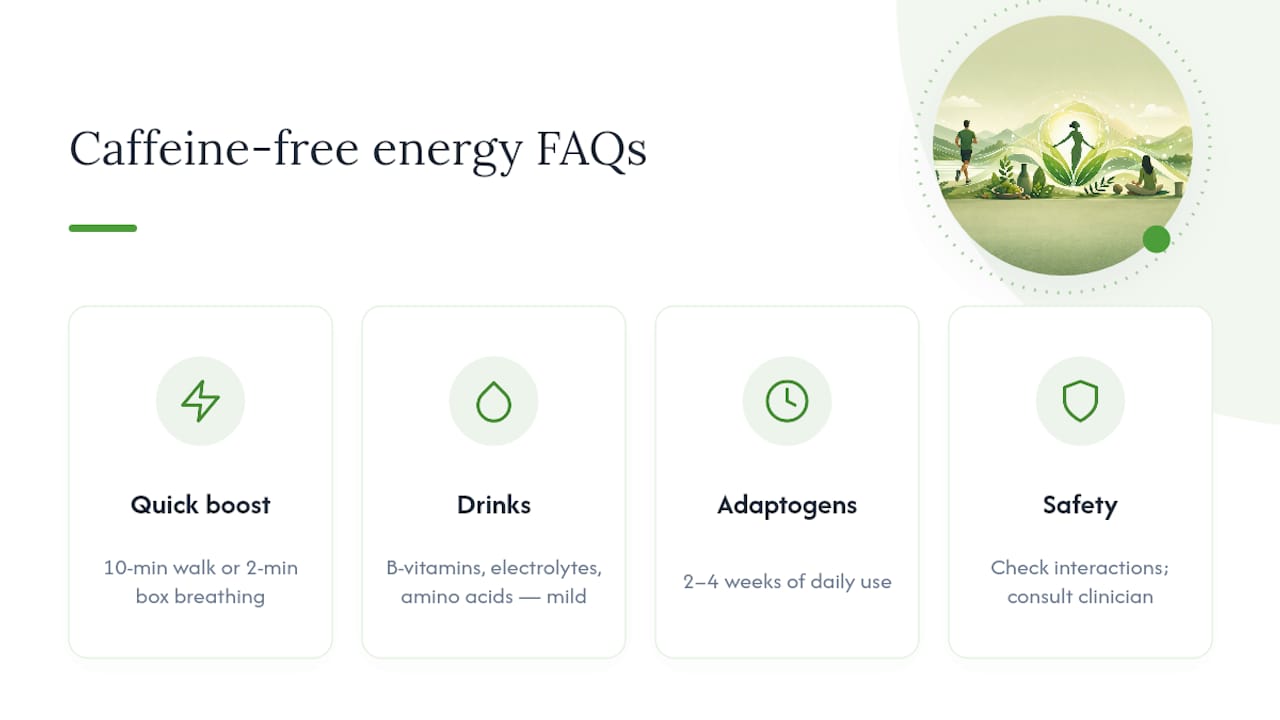
What’s the fastest way to get caffeine-free energy without jitters? A brisk 10-minute walk or two minutes of box breathing raises alertness within minutes. It won’t last as long as a supplement’s effect, but it’s the quickest lever available with zero cost or risk.
Is there an energy drink with no caffeine that actually works? Caffeine-free energy drinks typically rely on B vitamins, electrolytes, and amino acids rather than stimulants. They tend to support hydration and mild alertness more than deliver a strong lift, so treat them as a supporting tool, not a caffeine replacement.
How long do adaptogens take to work for energy? Give any adaptogen, ashwagandha, rhodiola, or maca, two to four weeks of consistent daily use before judging results. They build resilience gradually rather than delivering an immediate jolt.
Can I take a caffeine-free pre-workout every day? Most stimulant-free pre-workout ingredients, like creatine and beta-alanine, are designed for daily use and build effectiveness over time. Check the label for total daily creatine intake, and consult a doctor if you have kidney concerns.
Are caffeine-free supplements safe with prescription medication? Not automatically. Ashwagandha interacts with thyroid medication, and several adaptogens can interact with blood pressure drugs or antidepressants. Always check with a clinician before combining herbal supplements with any prescription.
This article is general information, not a substitute for advice from a qualified doctor. Consult a qualified healthcare professional about your own circumstances before acting on anything here.
Sources
- Spilling the beans: How much caffeine is too much? – FDA
- Caffeine alternatives: Getting your energy boost without coffee – OSF HealthCare
- Chai caffeine vs coffee: Which to pick for steady energy – Dropout Chaiwala


Comments (0)
There are no comments for this article. Be the first one to leave a message!