
BLUF: For reliably raising plasma arginine and supporting nitric-oxide–mediated blood flow, citrulline generally outperforms oral arginine. The reason comes down to plumbing, not potency. Oral arginine gets ambushed in the gut and liver before it ever reaches your bloodstream, while citrulline slips past that checkpoint and gets converted to arginine in the kidneys. A pharmacokinetic study in mice found supplemental citrulline raised systemic arginine availability more efficiently than an equivalent arginine dose, and human pharmacokinetic work from Schwedhelm and colleagues backs that up with real plasma data.
Here’s what that means in practice:
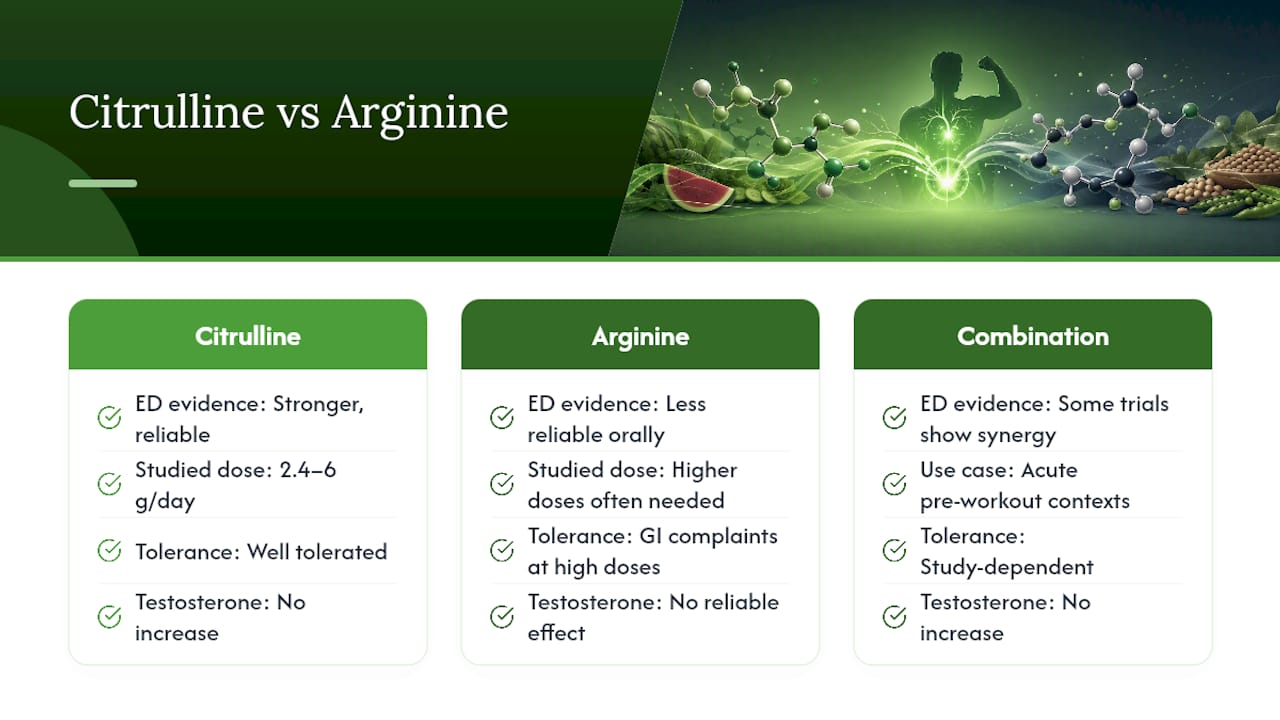
- For exercise performance: chronic citrulline dosing (2.4 to 6 grams daily for one to two weeks) has the more consistent trial record.
- For blood flow and ED-adjacent support: citrulline’s biomarker improvements are more reliable, though clinical endpoints like blood pressure remain mixed across studies.
- For safety: citrulline causes fewer gastrointestinal complaints at effective doses than high-dose arginine.
- The caveat that matters most: anyone on blood pressure medication, nitrates, or PDE5 inhibitors should talk to a clinician before starting either supplement, since both can lower blood pressure further.
Key Takeaways
Citrulline outperforms oral arginine for raising systemic arginine because it bypasses first-pass liver metabolism, giving it the stronger evidence base for exercise, circulation, and ED-adjacent support.
| Point | Details |
|---|---|
| Choose citrulline first | It raises plasma arginine more reliably than oral arginine due to bypassing first-pass liver metabolism. |
| Dose chronically for best results | Use 2.4 to 6 grams daily for 7 to 16 days rather than relying on a single acute dose. |
| Don’t expect a testosterone effect | Any circulation benefit comes from nitric-oxide pathways, not hormonal changes. |
| Watch for medication interactions | Both supplements can lower blood pressure further when combined with antihypertensives or nitrates. |
| Consider Alpha Cactus for vascular support | Organicufuel’s formula applies citrulline’s evidence base toward circulation support with lab-tested, GMP-certified production. |
Table of Contents
- Citrulline vs Arginine: A Side-by-Side Comparison
- Why Citrulline Raises Arginine More Reliably Than Arginine Itself
- What the Exercise Performance Research Actually Shows
- Blood Flow, Blood Pressure, and Erectile Function: What’s Actually Proven
- How Much Citrulline or Arginine Should You Actually Take?
- Is Citrulline or Arginine Safe to Take Daily?
- How Organicufuel Applies This Evidence in Practice
- The Real Lesson Buried in the Citrulline vs Arginine Debate
- Get Circulation Support Built Around This Research
- Frequently Asked Questions
- Sources
Citrulline vs Arginine: A Side-by-Side Comparison
Before digging into the biochemistry, here’s the practical shape of the decision. The short version: citrulline wins on reliability, arginine wins on raw name recognition and not much else.
- Bioavailability: Citrulline avoids first-pass metabolism almost entirely. Oral arginine loses a substantial share to gut and liver arginase before it reaches circulation, which is the central reason the Schwedhelm pharmacokinetic study found citrulline dosing produced a better arginine/ADMA ratio than arginine dosing.
- Onset and duration: Arginine, when it does get through, can produce a faster but shorter-lived rise in plasma levels. Citrulline builds more gradually and sustains elevated arginine levels longer, which is part of why chronic dosing protocols favor it.
- Typical effective doses: Citrulline trials commonly land in the 2.4 to 6 grams per day range. Arginine studies often require considerably higher doses to see comparable plasma effects, which creates its own problems (see below).
- Best-use cases: Citrulline shows up more often in exercise-performance and vascular-support research. Arginine has a longer supplement-industry history but a thinner record of consistent human trial results at tolerable doses.
- Side-effect profile: Arginine is the more likely of the two to cause bloating, cramping, or diarrhea at doses high enough to matter. Citrulline is generally better tolerated at its effective range.
Citrulline pros: more reliable arginine elevation, better tolerability, decent evidence base for exercise and circulation support. Citrulline cons: effects build over days to weeks rather than instantly, and citrulline malate (the exercise-focused form) has less consistent acute results than the amino acid alone.
Arginine pros: direct precursor to nitric oxide with no conversion step needed once absorbed, and it’s cheap and widely available. Arginine cons: most of an oral dose never makes it past the liver, so you need more of it to get less benefit, with a higher chance of GI distress along the way.
Why Citrulline Raises Arginine More Reliably Than Arginine Itself
This sounds like a paradox until you follow the actual metabolic route each compound takes.
- Oral arginine hits a wall immediately. Once swallowed, arginine passes through the intestinal wall and straight into the liver, where an enzyme called arginase breaks a large share of it down before it ever reaches general circulation. This is called first-pass metabolism, and it’s the single biggest limitation of arginine as an oral supplement.
- Oral citrulline takes the scenic route around that wall. Citrulline isn’t a substrate for intestinal or hepatic arginase, so it passes through the gut and liver largely untouched. It travels to the kidneys, where it gets converted into arginine and released into systemic circulation.
- The kidneys become a steady arginine factory. Because this conversion happens after the liver bottleneck, the arginine that results is available to the rest of the body, including vascular endothelium, where it matters most for nitric oxide production.
- Nitric oxide synthase does the real work from there. Both pathways eventually feed the same enzyme, nitric oxide synthase (NOS), which converts arginine into nitric oxide and citrulline as a byproduct (yes, the body recycles some of its own citrulline this way). What differs is how much arginine actually reaches that enzyme at the tissue level.
The arginine/ADMA ratio is the biomarker researchers watch most closely here. ADMA (asymmetric dimethylarginine) is a naturally occurring compound that competes with arginine for the same NOS enzyme, effectively jamming the machinery. A higher arginine/ADMA ratio means more usable substrate relative to that competitive inhibitor, and it’s a more clinically meaningful number than plasma arginine alone.
Statistic worth sitting with: in the mouse-based pharmacokinetic work, supplemental citrulline increased plasma arginine concentrations by roughly 35% more than an equivalent arginine dose, while around 70% of the oral arginine dose was lost to splanchnic (gut and liver) extraction before it ever reached systemic circulation. That gap is the whole story in one number.
There’s also a ceiling effect worth knowing about. Both compounds show diminishing returns at very high doses, since arginine transport across cell membranes is limited by a finite number of transporter proteins. Past a certain point, more supplement doesn’t mean proportionally more arginine delivered to tissue. This is one reason Examine’s research synthesis points to moderate, sustained dosing over sporadic mega-dosing.
What the Exercise Performance Research Actually Shows
Athletes and gym regulars care about one question: does this actually move the needle on output? The trial data gives a nuanced answer that depends heavily on which protocol you’re looking at.
Chronic citrulline dosing is the most consistent finding. Trials using 2.4 to 6 grams of citrulline daily for 7 to 16 days show the most repeatable improvements in nitric-oxide markers, and some report modest gains in muscular endurance and reduced perceived exertion during training. This isn’t a supplement you take once before a workout and expect a dramatic jump. It’s closer to a loading protocol that builds circulatory support over one to two weeks.
Acute citrulline malate is a mixed bag. The 6 to 8 gram pre-workout dose that shows up on pump-focused supplement labels has a much less consistent research record than the chronic protocol. Some studies find modest benefits for anaerobic power output and subjective fatigue, others find nothing distinguishable from placebo. Part of the inconsistency likely comes from citrulline malate blends varying in actual citrulline content, and part comes from single-dose timing being a fundamentally noisier variable than multi-day loading.
Arginine alone underperforms here. Studies using standalone arginine for exercise performance report inconsistent results, and the doses needed to see any plasma effect tend to be high enough to bring gastrointestinal side effects into play. The narrative review in Nutrients synthesizing this literature notes that citrulline produces more consistent arginine elevation and exercise-related outcomes than arginine, even though clinical endpoints downstream remain variable.
Combining the two shows promise in specific contexts. A handful of crossover trials testing arginine plus citrulline together report improved nitric-oxide markers and performance outcomes compared to either compound alone. The logic makes sense on paper: arginine (what does get absorbed) provides an immediate spike, while citrulline’s slower renal conversion sustains elevated arginine for hours afterward. This combined approach shows up more in acute pre-workout contexts than chronic ones, and the effect size varies enough across studies that it’s better described as a promising pattern than a settled conclusion.
- Trained athletes chasing marginal performance gains are the population where any of these effects, when present, tend to be most noticeable.
- Recreational lifters are less likely to feel a dramatic subjective difference, though the underlying vascular benefit may still be there.
- Chronic loading (citrulline daily for at least a week) has a stronger evidence base than any single acute pre-workout dose.
Pro Tip: If you’re deciding between an acute pre-workout dose and a daily loading protocol, run the daily version for two weeks before judging whether it’s working. Single-session judgments on citrulline are notoriously unreliable because the strongest effects in the research show up after repeated dosing, not one scoop before a session.
Blood Flow, Blood Pressure, and Erectile Function: What’s Actually Proven
This is where the evidence needs the most careful reading, because a biomarker moving in the right direction doesn’t automatically translate into a clinical outcome you’d notice.
Citrulline supplementation reliably improves the arginine/ADMA ratio and raises urinary nitrate and cGMP levels in trials, both of which are downstream signals of increased nitric oxide activity. The Schwedhelm pharmacokinetic study documented this improvement more consistently with citrulline dosing than with arginine dosing at comparable amounts.
Where things get murkier is flow-mediated dilation (FMD), the ultrasound-based test that measures how well an artery widens in response to increased blood flow, and actual blood pressure outcomes. Results across trials are inconsistent, and the Nutrients narrative review points to a few likely explanations:
- Sample size limitations. Many of these trials run small, which makes it hard to detect a modest effect against natural variation.
- Population differences. People with existing endothelial dysfunction (older adults, those with cardiovascular risk factors) tend to show more measurable benefit than young, healthy volunteers whose vascular function is already close to optimal.
- Dietary and lifestyle confounders. Baseline nitrate intake from vegetables, sodium intake, and training status all influence how much room there is for a supplement to move the needle.
Statistic worth noting: small clinical trials in populations with cardiovascular strain, including some heart-failure and pulmonary-pressure studies, used roughly 3 grams of citrulline and reported measurable hemodynamic changes. That’s a meaningfully different population and dose context than a healthy 28-year-old taking a pre-workout supplement, and the results shouldn’t be read across from one group to the other.
On erectile function specifically, the honest summary is this: small trials suggest a mild benefit tied to improved blood flow, consistent with citrulline’s role as a nitric-oxide precursor. This is a circulatory mechanism, not a hormonal one. There’s no reliable clinical evidence that citrulline raises testosterone, and any marketing claiming otherwise is overselling the science. If you’re weighing citrulline against prescription options, it helps to understand how PDE5 inhibitors like sildesnafil and tadalafil work by comparison, since citrulline supports the same nitric-oxide pathway through a slower, supplemental route rather than a pharmaceutical one.
People with diagnosed endothelial dysfunction or borderline circulatory issues appear to have more room to benefit than healthy volunteers with already-efficient blood flow. That’s not a knock on the supplement. It’s just how biomarker-based interventions tend to work: the more room there is to improve, the more improvement shows up on a test.
How Much Citrulline or Arginine Should You Actually Take?
Dosing is where a lot of supplement confusion starts, mostly because label doses and trial doses don’t always match.
- Chronic L-citrulline: 2.4 to 6 grams per day. This is the range most consistently used in the human trials Examine’s research breakdown synthesizes, typically taken daily for 7 to 16 days to see nitric-oxide marker improvements and, in some cases, performance benefits.
- Acute citrulline malate: 6 to 8 grams pre-workout. Because citrulline malate is a compound (citrulline bound to malic acid), you need a slightly higher gram amount to deliver an equivalent citrulline dose. Read labels carefully. A product listing “8g citrulline malate” is not delivering 8 grams of pure citrulline.
- Arginine: typically 6 grams or more in research settings. Higher doses were generally needed to produce measurable plasma changes, and this is exactly the range where gastrointestinal side effects become more common.
- Combined Arg + Cit protocols: trials testing this combination have used varying ratios and durations, generally in acute pre-workout contexts, with the rationale being an immediate arginine bump paired with citrulline’s slower, sustained conversion.
When comparing products, check whether the label specifies L-citrulline or citrulline malate, since the effective dose differs between the two forms. A reputable label states the actual citrulline content, not just the total compound weight.
Pro Tip: If a product doesn’t specify whether its dose is L-citrulline or citrulline malate, treat that as a red flag on transparency, not just a minor labeling gap. It usually means the effective dose is lower than the number on the front of the bottle suggests.
Is Citrulline or Arginine Safe to Take Daily?
Both compounds have reasonable safety track records at studied doses, but they’re not interchangeable in terms of tolerability or risk profile.
- Gastrointestinal effects are more common with arginine, particularly at the higher doses required to produce a plasma effect. Bloating, cramping, and loose stools show up more frequently in arginine trial arms than citrulline arms.
- Citrulline is generally better tolerated at its effective dosing range, which is part of why it has become the more commonly recommended option in performance and circulation contexts.
- Both can lower blood pressure, which is the point for people seeking vascular support but a genuine caution for anyone already on antihypertensive medication or nitrate-based drugs (common in heart disease treatment). Combining either supplement with these medications risks additive blood-pressure-lowering effects.
- No reliable evidence supports a testosterone-boosting effect from citrulline or arginine. Be skeptical of any product or article claiming otherwise. The nitric-oxide pathway and the hormonal pathway are separate systems.
- Start low and monitor. If you’re on blood pressure medication, a PDE5 inhibitor, or any nitrate-containing drug, talk to your clinician before adding either supplement. Otherwise, starting at the lower end of the trial-supported range and watching how you respond over a week or two is the more sensible approach than jumping straight to the highest dose you’ve seen marketed.
How Organicufuel Applies This Evidence in Practice
Organicufuel builds its formulations around the same pharmacokinetic principle this article has walked through: citrulline’s ability to bypass first-pass metabolism makes it a more dependable lever for circulatory support than arginine alone. Alpha Cactus is formulated with that in mind, targeting blood-flow and vascular support rather than making hormonal claims the underlying research doesn’t support.
A few things worth knowing about how Organicufuel approaches this:
- Every batch is lab-tested for purity and potency before it reaches a customer, and production runs through GMP-certified, FDA-registered US facilities.
- The formulation philosophy leans on evidence-aligned dosing logic rather than proprietary mega-blends with unclear per-ingredient amounts.
- Organicufuel backs its products with a money-back guarantee, and customer feedback on Alpha Cactus points to real-world satisfaction alongside the clinical rationale.
- The ingredient breakdown for Alpha Cactus is public, so you can see exactly what’s in the formula rather than taking a marketing claim on faith.
The product is positioned as circulation and vascular support, consistent with what the ED-focused research actually shows: nitric-oxide-mediated blood flow improvement, not a testosterone shortcut.
| Point | Details |
|---|---|
| Evidence-aligned formulation | Alpha Cactus targets nitric-oxide-mediated blood flow support, not hormonal claims unsupported by trial data. |
| Transparent sourcing | Lab-tested, GMP-certified production with a public ingredient breakdown for customers to review. |
| Risk reversal | A money-back guarantee backs the product for customers wanting to try it without long-term commitment. |
The Real Lesson Buried in the Citrulline vs Arginine Debate
The conventional advice treats this as a simple upgrade story: citrulline is “better,” so take that instead. The research supports that conclusion, but it buries a more useful point underneath it. Biomarkers moving in the right direction (arginine/ADMA ratio, urinary nitrate, cGMP) are not the same thing as a guaranteed clinical outcome you’ll feel. Flow-mediated dilation and blood pressure results stay mixed even when the biochemistry looks clean on paper, and that gap between mechanism and lived outcome is exactly where supplement marketing tends to oversell.
What the evidence actually supports is more modest and more useful: citrulline is the more reliable tool for supporting the nitric-oxide pathway, dosed consistently over one to two weeks rather than chased for an instant effect, and healthy people with already-efficient circulation should expect a smaller benefit than someone with genuine endothelial strain. Prioritize the mechanism you can trust, not the promise that sounds biggest on a label.
Get Circulation Support Built Around This Research
If the biochemistry above told you anything, it’s that not every “nitric oxide” supplement on the shelf is built the same way. Organicufuel designed Alpha Cactus around the same first-pass metabolism problem this article walked through, favoring dosing and sourcing choices that map to what the trial data actually supports rather than what sounds impressive on packaging.
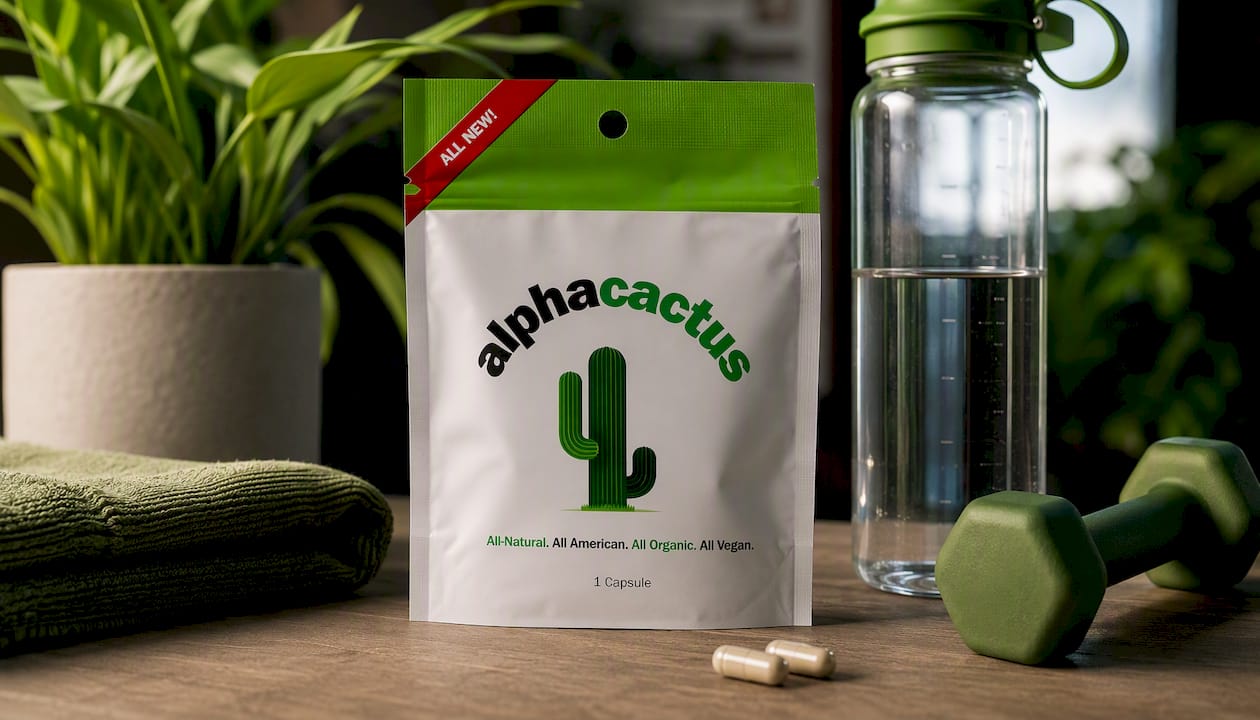
Every batch runs through US lab testing in GMP-certified, FDA-registered facilities, and the formulation is built for circulation and vascular support rather than vague “male enhancement” promises. If you’re on blood pressure medication or a nitrate-based drug, check with your clinician first, since the caution that applies to citrulline and arginine generally applies here too. Beyond that, Organicufuel backs the product with a money-back guarantee, so trying it comes with a real safety net rather than a locked-in purchase. Visit the Alpha Cactus product page to review the full ingredient list and place an order.
Frequently Asked Questions
Is citrulline or arginine better for ED support? Citrulline generally has the stronger evidence for ED-adjacent blood flow support, since it raises plasma arginine and nitric-oxide markers more reliably than oral arginine. Improvements are tied to circulation, not testosterone.
What’s the difference between L-citrulline and citrulline malate? L-citrulline is the pure amino acid. Citrulline malate combines it with malic acid, so a labeled dose of citrulline malate contains less actual citrulline than the same gram amount of pure L-citrulline. Check labels for the specified citrulline content.
Does taking citrulline every day have side effects? Citrulline is generally well tolerated at studied doses of 2.4 to 6 grams daily, with fewer gastrointestinal complaints than high-dose arginine. Anyone on blood pressure medication should monitor for excessive blood-pressure-lowering effects.
Is there a “dark side” to taking arginine supplements? The main downsides are gastrointestinal discomfort at the higher doses often needed for effect, and a risk of additive blood-pressure lowering when combined with nitrates or antihypertensive drugs. It’s not inherently dangerous at moderate doses, just less efficient and less well tolerated than citrulline.
Does combining citrulline and arginine work better than either alone? Some trials suggest a synergy, with arginine providing an immediate spike and citrulline sustaining arginine availability afterward. The effect isn’t universal across studies, but the combination shows promise in specific acute pre-workout contexts.
Does citrulline increase testosterone? No. There’s no reliable clinical evidence supporting a testosterone-boosting effect from citrulline. Its role in blood flow and ED support comes from the nitric-oxide pathway, a separate mechanism from hormone production.
This article is general information, not a substitute for advice from a qualified doctor. Consult a qualified healthcare professional about your own circumstances before acting on anything here.
Sources
The claims in this article draw on human pharmacokinetic research, trial-dosing syntheses, and narrative reviews rather than marketing copy. For readers who want to go to the primary material:
- Supplemental Citrulline Is More Efficient Than Arginine in Increasing Systemic Arginine Availability in Mice
- Research Breakdown on Citrulline - Examine
- Pharmacokinetic and pharmacodynamic properties of oral L-citrulline and L-arginine: impact on nitric oxide metabolism (Schwedhelm et al.)
- Dietary Arginine and Citrulline Supplements for Cardiovascular Health and Athletic Performance: A Narrative Review
Recommended
- Alpha Cactus: The Natural Alternative to ED Medications – Organic Fuel
- Why Men Are Switching to Natural Enhancement Supplements Like Alpha Ca – Organic Fuel
- Exploring the Ingredients of Alpha Cactus: Nature’s Answer to ED – Organic Fuel
- Elevate Your Sexual Performance Naturally with AlphaCactus Organic Mal – Organic Fuel


Comments (0)
There are no comments for this article. Be the first one to leave a message!