

A natural wellness routine is a repeatable daily structure built around sleep, light, movement, food, and stress management, without relying on prescription intervention as the first line of support. The single biggest lever is stacking four things together: a fixed wake time, morning daylight, some form of daily movement, and whole-food meals. Everything else, including botanicals, is optional layering on top of that foundation.
TL;DR:
- Consistent wake times and morning light exposure are crucial for regulating circadian rhythm without overcomplicating a wellness routine.
- Embedding daily movement, whole-food meals, and stress management techniques forms a powerful foundation, with supplements serving as optional reinforcement.
- Start with one habit, track subjective and objective markers, and adjust gradually over four to six weeks to build sustainable routines.
- Timing of botanicals and supplements should align with their intended effects, such as energizers in the morning and relaxants in the evening.
- Seasonal changes require adjusting light exposure, outdoor activity, and hydration to maintain consistency and effectiveness year-round.
Table of Contents
- The core elements of a natural wellness routine
- Sample day: three adaptable routine templates
- How to personalize, build, and test your routine
- What the evidence says about natural approaches and safety
- Tracking your progress without overcomplicating it
- Balancing mental and emotional health with natural techniques
- Where natural wellness fits with conventional healthcare
- Adjusting your routine for the seasons
- Why we build routines around habits first, supplements second
- Optional support for your daily routine
- Sources
The core elements of a natural wellness routine
Most people overcomplicate this. The research points to a short list of high-leverage habits, and the order you tackle them in matters less than getting all of them into rotation eventually.
- Sleep timing and light hygiene: Go to bed and wake up within the same 30-minute window every day. The CDC recommends 7 or more hours nightly for most adults, and consistency matters almost as much as duration for circadian regulation.
- Morning anchors: Get outside within an hour of waking. Natural light exposure early in the day helps anchor your circadian rhythm, and pairing it with a glass of water before coffee rehydrates you after a night’s fluid loss.
- Daily movement: Combine incidental activity (walking, taking stairs, standing breaks) with structured exercise. The CDC’s physical activity guidance points to a mix of strength and aerobic work as the most protective pattern for metabolic and cardiovascular health.
- Nutrition basics: Build meals around whole foods, protein, and fiber first, then fill in around them. Harvard’s nutrition research backs a plant-forward pattern with regular fruit and vegetable intake as a long-term health driver.
- Hydration and electrolytes: Thirst is a lagging indicator. If you’re active or sweating heavily, add electrolytes rather than just more plain water.
- Stress anchors: Five minutes of breathwork, a short mindfulness practice, or even a phone call with a friend counts. Stress management doesn’t require an hour on a cushion.
- Supplement safety: If you add anything botanical, introduce one product at a time and give it two to four weeks before judging results. Favor products that publish third-party lab testing.
Sample day: three adaptable routine templates
You don’t need to build a routine from scratch. Pick the template closest to your life right now, then adjust.
- The short routine (10 to 20 minutes). Wake at a consistent time, get 5 minutes of outdoor light, drink 16 ounces of water, and do a 5 minute mobility or breathing sequence before your first task. This is the floor, not the ceiling, and it’s the version to fall back on during a rough week.
- The balanced routine (45 to 60 minutes). Morning: light exposure plus a 20 minute walk or resistance session, protein-forward breakfast. Midday: a 10 minute outdoor break away from your desk, a whole-food lunch with vegetables and fiber. Evening: dim the lights an hour before bed, put screens away, and do a short wind-down stretch or journal entry.
- The performance-focused routine. Structured training 4 to 5 days a week, with recovery days built around mobility work and longer sleep windows. Time carbohydrate-heavy meals around training sessions, and reserve any energy-support botanicals for mornings when training is scheduled rather than taking them daily.
Timing matters for supplements too. Energy or stimulant-leaning botanicals belong in the morning; anything marketed for relaxation or sleep support belongs in the evening. If you travel across time zones or work rotating shifts, anchor your routine to light exposure and meal timing rather than the clock. Get bright light shortly after you wake in your new schedule, even if that’s technically the middle of the night back home, and keep movement and meal windows consistent relative to your new wake time rather than trying to force old habits onto a new schedule.
How to personalize, build, and test your routine
Start with one anchor habit, not five. Behavioral research on habit formation consistently finds that small, repeatable changes stick better than ambitious overhauls attempted all at once. Pick the habit that addresses your biggest complaint (poor sleep, low energy, high stress) and give it 4 to 6 weeks before adding anything new.
- Attach the new habit to something you already do daily (habit stacking), like stretching right after you brush your teeth.
- Track subjective markers weekly: energy, sleep quality, and mood on a simple 1 to 10 scale.
- Reduce friction by prepping the night before. Laid-out workout clothes and pre-chopped vegetables remove the decision fatigue that kills consistency.
- For shift workers or frequent travelers, keep the anchor habit (usually light exposure or a fixed first-meal time) even when everything else shifts.
- Know when to stop. If a change consistently worsens sleep, mood, or energy after a fair trial, drop it rather than pushing through.
Pro Tip: Pair your weekly subjective check-ins with a periodic objective marker, like resting heart rate or a blood panel your doctor already orders, every few months. Subjective tracking tells you how you feel; objective data tells you whether that feeling matches what’s happening physiologically.
Talk to a clinician before starting any new supplement if you’re on prescription medication, pregnant, or managing a chronic condition. That’s not a formality. Botanical compounds can interact with blood thinners, blood pressure medication, and other prescriptions in ways that aren’t always listed on the label.

What the evidence says about natural approaches and safety
Whole-person health, the framework the NCCIH uses to describe integrative care, treats sleep, movement, stress, and nutrition as interconnected systems rather than isolated boxes to check. That’s the reason a routine outperforms a single supplement: you’re addressing several biological levers at once instead of hoping one product compensates for four missing habits.
Circadian-aligned timing has the strongest evidence base of any single lever discussed here. Morning light, consistent meal windows, and evening screen reduction all support the same underlying clock mechanism.
Before adding any botanical to your routine, run it through this checklist:
- Choose products with published third-party lab testing, not just an in-house quality claim.
- Introduce one new supplement at a time so you can actually attribute any effect (or side effect) to it.
- Check for interactions with existing medications, ideally with a pharmacist or physician.
- Give a reasonable trial window, generally several weeks, before deciding whether it’s working.
Organicufuel builds its formulations around this standard: ingredients tested in US labs, one product line per goal rather than a kitchen-sink formula, and a straightforward money-back guarantee if a product doesn’t deliver the results you were hoping for.
Tracking your progress without overcomplicating it
You don’t need an app for every metric. A simple notebook, a notes app, or a habit-tracking spreadsheet works fine, and the format matters less than the consistency of use.
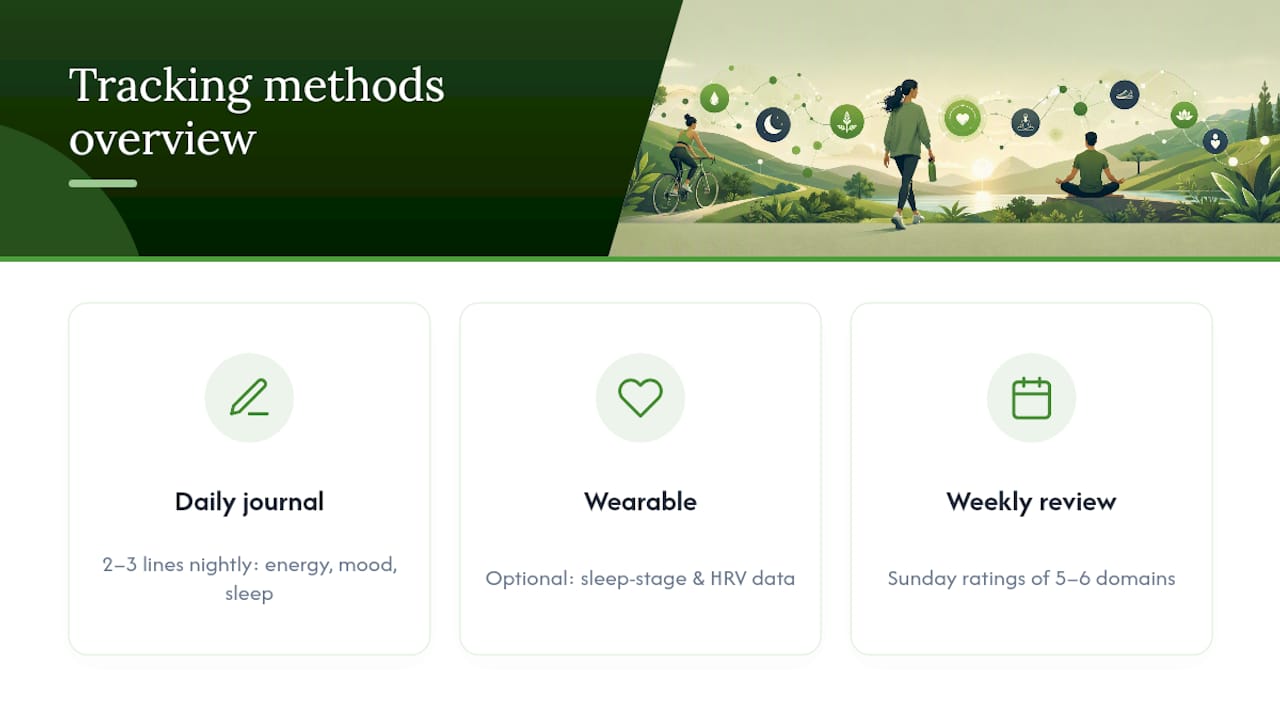
Three tracking methods cover almost everyone’s needs. Daily journaling, even two or three lines before bed noting energy, mood, and sleep quality, surfaces patterns within a couple of weeks that you’d otherwise miss. Wearable trackers add objective sleep-stage and heart-rate-variability data if you want more granularity, though they’re not required to make progress. A weekly self-assessment, sitting down every Sunday and rating five or six domains (sleep, energy, stress, digestion, mood, movement) on a simple scale, gives you a trend line without demanding daily effort.
The mistake most people make is tracking everything at once and abandoning it within a week. Pick one method and one or two metrics that matter most to your goals right now. If sleep is your biggest issue, track sleep quality and next-day energy. Add more metrics only once the first ones feel automatic.
Review your notes every two to four weeks, not daily. Daily fluctuation is noise. The trend over several weeks is signal, and that’s what tells you whether a change in your routine, or a new botanical, is actually working.
Balancing mental and emotional health with natural techniques
Physical habits and emotional regulation aren’t separate systems, they run on the same nervous system. A short mindfulness or breathwork practice, even five minutes, activates the parasympathetic nervous system and measurably lowers physiological stress markers over time.

The techniques that work best share one trait: they’re low-friction enough to do on a bad day. Box breathing (four counts in, four held, four out, four held) takes under two minutes and works well before high-pressure moments. Journaling, even unstructured venting for five minutes, helps externalize rumination that otherwise loops all day. Time in nature, even a 15 minute walk outside, has a consistent calming effect that indoor exercise doesn’t fully replicate.
Social connection deserves more credit than it usually gets in wellness content. A short phone call or in-person conversation does something a solo meditation session can’t: it regulates your nervous system through another person’s presence, a mechanism researchers call co-regulation. Build at least one genuine social touchpoint into your week that isn’t just a work meeting.
None of this replaces treatment for clinical anxiety or depression. These techniques are supportive daily practices, not substitutes for therapy or medication when those are clinically indicated. Use them as your baseline, and treat professional mental health support as a parallel track rather than a last resort.
Where natural wellness fits with conventional healthcare
A natural wellness routine works best as a complement to conventional care, not a replacement for it. The World Health Organization’s guidance on integrative medicine explicitly frames evidence-based complementary approaches as additions to standard care, used safely and appropriately, rather than alternatives to it.
Practically, that means a few things. Tell your doctor about every supplement you’re taking, even ones that seem harmless, because interactions with prescriptions are more common than most people assume. Use your annual physical and bloodwork as the objective backstop to the subjective tracking you’re doing at home. If a natural approach isn’t moving the needle on a real problem, like persistent fatigue or unexplained weight changes, that’s a signal to get evaluated, not a reason to try a stronger supplement.
The healthiest framing treats your daily routine as the maintenance layer and your physician as the diagnostic layer. One handles day-to-day resilience; the other catches the things a journal entry never will.
Adjusting your routine for the seasons
Your routine shouldn’t stay static year-round. Daylight hours shift dramatically between summer and winter, and that alone justifies real adjustments to timing and structure.
In winter, shorter days mean less natural light exposure, which can affect mood and sleep quality. Get outside during the brightest part of the day, even for 10 minutes, and consider a light therapy lamp if you live somewhere with limited winter sun. Movement often shifts indoors; that’s fine, but try to preserve at least one outdoor session weekly if you can manage it safely.
Summer brings the opposite problem: too much light too late, which can push bedtime later than intended. Blackout curtains and a consistent wind-down routine matter more in summer than most people realize. Hydration needs also climb with heat and activity, so electrolyte intake deserves more attention.
Spring and fall are natural points to reassess. Use the seasonal transition as a built-in checkpoint: review your tracking notes from the past few months, and decide whether your current habits still fit your schedule and goals.
Why we build routines around habits first, supplements second
We’ve watched people chase a single product to fix problems that were really about sleep debt, sedentary days, or chronic under eating. Supplements work best as reinforcement for habits already in motion, not substitutes for them. That’s why Organicufuel formulates for people who’ve already got the fundamentals moving and want a responsibly sourced, lab-tested addition, not a shortcut. Try one change aligned with the evidence here before adding a product. If you already have the basics down, a well-tested botanical can be the layer that closes the gap.
— Organic
Optional support for your daily routine
Once your sleep, movement, and nutrition habits are consistent, a lab-tested supplement can reinforce what you’re already doing, not replace it. Organicufuel builds its lineup around specific routine goals instead of one catch-all formula, so you’re adding something targeted rather than guessing.

For readers building a morning-energy routine, the Bad Boy Bundle pairs with an early workout or a demanding work schedule where sustained energy matters more than a quick spike. If your focus is longer-term hormonal and vitality support as part of an aging-conscious routine, Ageless For Men is built for that use case specifically, complementing consistent sleep and resistance training rather than compensating for their absence. Travelers or anyone who wants a minimalist kit without juggling four separate bottles can start with the Holiday Fire Deal 4-in-1 collection, which bundles core support into one order at a lower per-product cost than buying each individually.
Browse the full product lineup to match a bundle to the routine goal you’re working on right now.
Sources
- Whole Person Health: What It Is and Why It’s Important | NCCIH
- PMC article on circadian health and behavior
- How much sleep do I need? | CDC
- How many fruits and vegetables do we really need? | Harvard Health
- Physical Activity Basics: Adults | CDC


Comments (0)
There are no comments for this article. Be the first one to leave a message!