
Rhodiola, cordyceps, Panax ginseng, and ashwagandha have the strongest track record for steady, non-jittery energy, with rhodiola standing out for stress-related fatigue and cordyceps for endurance. None of them work like caffeine, and none of them replace sleep, food, or a doctor’s visit if fatigue is persistent. If you’re pregnant, breastfeeding, or taking medication for blood pressure, thyroid function, or blood clotting, talk to a healthcare provider before starting any of them.
TL;DR:
- Rhodiola supports mitochondrial function and is best for stress-related exhaustion and endurance, with typical doses taken in the morning to avoid sleep disruption.
- Cordyceps enhances oxygen utilization during sustained cardio, making it suitable for athletes, with side effects like mild gastrointestinal upset being rare.
- Ginseng provides both physical stamina and cognitive benefits but must be timed carefully, as it can interfere with sleep and affect blood sugar or blood pressure.
- Adaptogens generally work by normalizing the stress response over weeks, not by providing immediate energy, making patience and proper timing essential for effectiveness.
- Use supplements from verified brands with transparent testing, and carefully match the herb to your fatigue type for better results and safety.
Table of Contents
- The Best Adaptogens for Energy, Ranked by Use Case
- How Do Adaptogens Actually Boost Energy?
- When and How Much Should You Take?
- Are There Risks or Side Effects to Watch For?
- What Makes Organicufuel’s Approach to Energy Support Different?
- The Conventional Wisdom on Adaptogens Gets One Thing Wrong
- Which Organicufuel Product Fits Your Energy Goals?
- Sources
The Best Adaptogens for Energy, Ranked by Use Case
Not every adaptogen does the same job. Some steady your mood under chronic stress. Others push oxygen efficiency during a workout. Matching the herb to the actual problem, physical fatigue, mental fog, or slow recovery, matters more than picking whatever’s trending on a supplement label this month.
Rhodiola rosea sits at the top of most lists for a reason: it’s one of the few adaptogens with a plausible, well-documented mechanism tied directly to energy production. Research summarized by the National Center for Complementary and Integrative Health points to rhodiola supporting mitochondrial function and cellular ATP output, which is the actual currency your muscles and brain spend to do anything. It’s best for stress-related exhaustion and endurance tasks, the kind of tired that comes from weeks of overload rather than one bad night’s sleep. Standardized extracts typically list rosavins and salidroside in small but measurable amounts, with common doses taken daily, usually in the morning. Watch for mild jitteriness or insomnia if taken too late.
Cordyceps built its reputation in altitude and endurance sports circles, and the evidence, while still limited to small trials and preclinical work, backs some of that reputation. Reviews of adaptogenic herbs in athletic contexts note improved endurance measures and reduced markers of exercise fatigue with cordyceps and related herbs. It’s best for athletes and anyone doing sustained cardio work, since the proposed mechanism involves better oxygen utilization during exertion. Doses are generally taken before training, with amounts varying by product and user tolerance. Side effects are rare but can include mild GI upset.
Panax ginseng (and its cousin, American ginseng) is the classic stamina herb, used for centuries in traditional Chinese and Korean medicine before Western researchers started studying it. It offers a dual benefit: physical stamina support alongside a measurable cognitive lift, useful if your fatigue shows up as both a tired body and a foggy head. Typical doses involve daily intake of standardized extract, adjusted by individual needs. Because ginseng has mild stimulant properties, taking it late in the day can interfere with sleep, and it can also affect blood sugar and blood pressure, so anyone on diabetes or hypertension medication should check with a doctor first.
Bacopa monnieri doesn’t give you physical pep, but it’s one of the better-studied options for sustained mental energy, the kind that keeps you sharp through a long afternoon instead of crashing at 2 p.m. It’s slower to kick in than most adaptogens, often requiring several weeks to show its full cognitive effect, with doses standardized to a significant concentration of bacosides. Mild nausea is the most common complaint, usually resolved by taking it with food.
Ashwagandha works differently than the herbs above. Instead of pushing energy output, it steadies the stress response that drains energy in the first place. Human and preclinical research reviewed in studies on adaptogens’ stress-protective mechanisms suggests it may reduce fatigue tied to chronic stress rather than acute exertion. It’s best for people whose “tiredness” is really burnout, not deconditioning. Standard doses involve root extract standardized to withanolides, usually taken in the evening since it tends to be calming rather than stimulating. It can lower thyroid hormone levels and cortisol, so it’s not ideal for anyone with hyperthyroidism or on corticosteroids.
A handful of others round out the list, each with a narrower use case:
- Schisandra: supports liver function and mental stamina under stress; typical dose 500 to 2,000 mg of berry extract.
- Holy basil (tulsi): eases stress-related fatigue and supports blood sugar balance; commonly used as tea or 300 to 600 mg extract.
- Licorice root (deglycyrrhizinated for daily use): traditionally used for adrenal support, but raises blood pressure in some people with prolonged use.
- Astragalus: used for immune resilience and general vitality; 250 to 500 mg extract is typical.
- Reishi mushroom: calming rather than stimulating, better suited to recovery and sleep quality than daytime energy.
Pro Tip: If you’re not sure which herb fits your situation, ask yourself one question: is the fatigue mental, physical, or stress-driven? That single distinction eliminates half the options on any supplement shelf.
How Do Adaptogens Actually Boost Energy?
Adaptogens don’t flood your system with stimulants. They work more like a thermostat than a light switch, nudging your stress response back toward a stable range instead of forcing a spike.
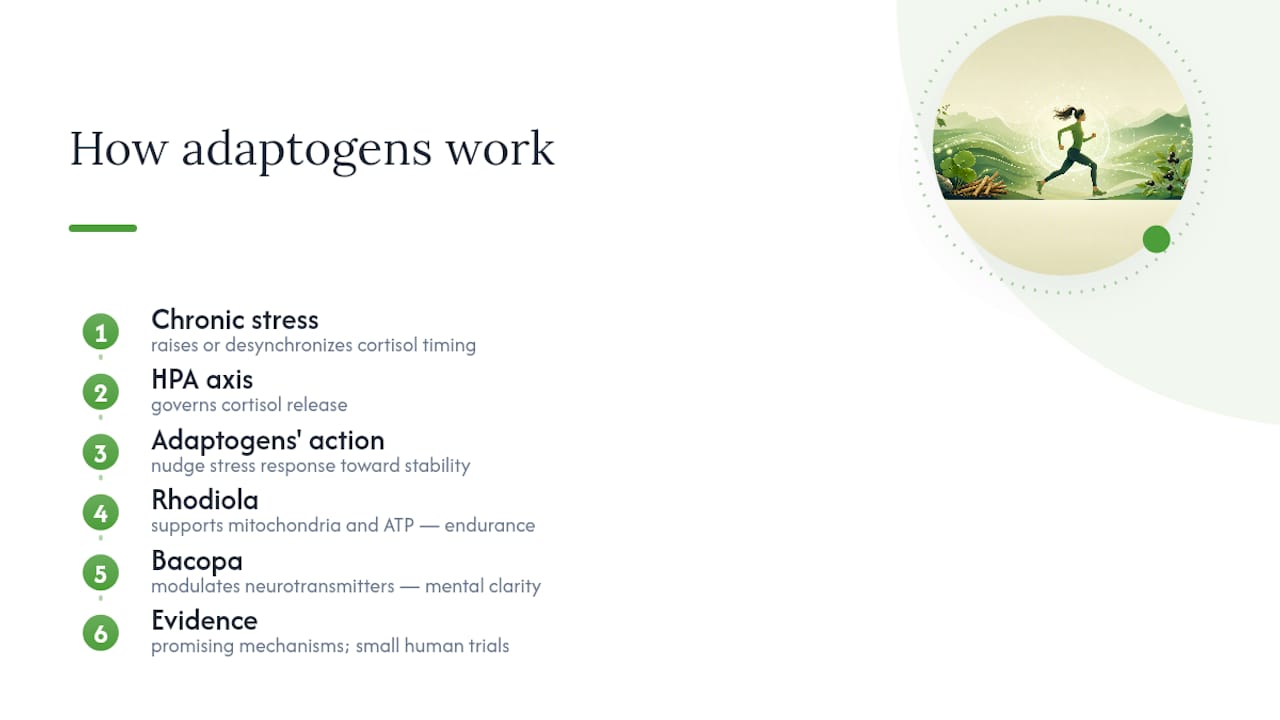
The leading theory, described in resources like the VA’s Whole Health Library, centers on the hypothalamic-pituitary-adrenal (HPA) axis, the system that governs cortisol release. Chronic stress keeps cortisol either too high or erratically timed, and that dysregulation is a major driver of the fatigue people describe as “wired but tired.” Adaptogens appear to help normalize that pattern rather than suppress it outright, which is why the effect feels different from caffeine’s jolt-and-crash cycle.
Rhodiola’s role goes a step further, into the cells themselves. Its documented support for mitochondrial function and ATP production gives it a more direct mechanical link to physical endurance than most other adaptogens, which is part of why it shows up so often in athletic performance research. Bacopa, meanwhile, appears to work through neurotransmitter pathways tied to memory and processing speed, explaining why its energy benefit reads more “mental clarity” than “physical pep.”
The honest summary from the research: adaptogens are supportive tools for managing the stress response, not a substitute for treating the root causes of exhaustion, whether that’s poor sleep, nutritional gaps, or an undiagnosed medical condition.
Most of this evidence comes from a mix of human trials and animal or cell-based models, and study sizes tend to be small. That doesn’t make the findings useless, but it does mean the confidence level is “promising and mechanistically plausible,” not “proven beyond doubt.” A broader look at the evidence for adaptogens and stress makes a similar point: the biological story holds together, but the volume of large, rigorous human trials still lags behind the popularity of these herbs.
When and How Much Should You Take?
Timing determines whether an adaptogen helps or backfires. Get it wrong and a “stress support” herb turns into an insomnia trigger.
- Take stimulating adaptogens early. Rhodiola, cordyceps, and ginseng work best taken in the morning or early afternoon; clinical guidance from Cleveland Clinic specifically flags late-day dosing as a common cause of disrupted sleep.
- Save calming adaptogens for evening. Ashwagandha and reishi fit better at night, supporting recovery instead of competing with your morning energy needs.
- Check extract standardization before buying. Look for salidroside content in rhodiola, withanolide percentage in ashwagandha, and ginsenoside content in ginseng rather than trusting a generic “proprietary blend.”
- Give it four to eight weeks before judging results. Adaptogens build effect gradually; a single dose rarely tells you anything useful.
- Taper off rather than stopping cold, especially with ashwagandha, to avoid a rebound in stress symptoms.
Two sample stacks illustrate the stacking logic. A focus and endurance stack might combine morning cordyceps with rhodiola before a workout, a pairing supported by research on adaptogenic herbs in athletic performance, since both compounds target endurance through different mechanisms. A recovery and sleep stack pairs evening ashwagandha with reishi, leaning on their calming, cortisol-moderating profile instead of stacking two stimulating herbs, which only compounds the risk of overstimulation.
Pro Tip: Never combine two stimulating adaptogens (like ginseng and rhodiola) late in the day. The additive effect can wreck sleep quality even if each herb alone feels fine.
Buy from brands that publish third-party lab results and GMP certification. A supplement without a visible certificate of analysis is a guess, not a guarantee.
Are There Risks or Side Effects to Watch For?
Most adaptogens are well tolerated, but “natural” doesn’t mean “risk-free.” Roughly a dozen commonly studied adaptogens carry documented interaction warnings, according to guidance compiled by MedlinePlus, which is reason enough to read labels carefully before combining them with prescription medication.
- Stimulating herbs (ginseng, rhodiola, cordyceps) can cause insomnia, jitteriness, or mild GI upset, especially at higher doses.
- Ashwagandha and licorice can shift blood pressure and thyroid hormone levels, which matters for anyone on antihypertensives or thyroid medication.
- Several adaptogens have theoretical interactions with anticoagulants, sedatives, and immune-modulating drugs, so checking for medication interactions before starting is worth the five minutes it takes.
- Pregnant or breastfeeding people, and anyone with autoimmune disease or bipolar disorder, should get clinician sign-off first, since some adaptogens can influence immune activity or mood regulation.
Start with a low dose, track sleep and energy in a simple log, and stop immediately if you notice new blood pressure symptoms, rapid heartbeat, or mood shifts.
What Makes Organicufuel’s Approach to Energy Support Different?
Organicufuel formulates its herbal supplements with ingredients tested in US labs, manufactured under GMP-certified, FDA-registered conditions rather than sourced from unverified overseas blends. That distinction matters more than most shoppers realize, since adulteration and mislabeling are common problems in the loosely regulated supplement industry.
The brand’s flagship formula, Alpha Cactus, builds on the same evidence-based logic covered above, pairing herbal ingredients with transparent sourcing and testing documentation. Every product ships with a 100% money-back guarantee, which shifts the risk off the customer’s shoulders while they evaluate whether a given formula fits their body and routine. Detailed lab reports and formulation credentials are available through Organicufuel’s product pages for readers who want to check ingredient sourcing before buying.

These proof points don’t replace your own judgment about dose, timing, and interactions. They give you a baseline: a product that’s been tested for what it claims to contain, backed by a guarantee if it doesn’t deliver.
The Conventional Wisdom on Adaptogens Gets One Thing Wrong
Most adaptogen content treats every herb as interchangeable, as if swapping ashwagandha for rhodiola makes no real difference. That’s backwards. The research actually supports fairly specific matching: rhodiola and cordyceps for people whose fatigue shows up physically, bacopa for cognitive flatness, ashwagandha for stress-driven burnout. Treating them as one undifferentiated “energy herb” category is why so many people try an adaptogen, feel nothing, and give up on the whole class.
The bigger gap is between marketing and mechanism. Adaptogens don’t override exhaustion the way stimulants do. They work slowly, over weeks, by nudging a dysregulated stress response back toward stability. That’s a less exciting pitch than “instant energy,” but it’s the honest one, and it’s also why timing, dose standardization, and patience matter more than which brand’s bottle looks the most premium. Readers who prioritize sourcing transparency and give an herb its full four to eight weeks before judging it get far better outcomes than readers chasing the next trending extract.
— Organic
Which Organicufuel Product Fits Your Energy Goals?
Once you know which kind of fatigue you’re dealing with, matching it to a formula gets simple. Alpha Cactus is built for general energy and vitality support, a fit for anyone whose main complaint is that steady afternoon drag rather than a specific athletic goal.

If your priority is recovery and staying power rather than a quick lift, Ageless For Men is formulated around endurance and sustained stamina, pairing well with the morning-dosing habits covered earlier. For readers who want a combined regimen instead of piecing together separate herbs and guessing at stacking order, the Bad Boy Bundle packages complementary formulas so the timing and dosing groundwork is already done.
Every Organicufuel formula is tested in US labs under GMP-certified, FDA-registered manufacturing, and every order carries a 100% money-back guarantee, so trying a new formula doesn’t mean committing blind. If steady, non-crash energy is the goal, start with Alpha Cactus’s product page to check current ingredient lists and choose the option that matches where your fatigue is actually coming from.
Sources
- Effects of adaptogens on the central nervous system and the molecular mechanisms associated with their stress—protective activity
- Adaptogens - Whole Health Library
- Adaptogens (Cleveland Clinic)
- Adaptogenic herbs: A natural way to improve athletic performance


Comments (0)
There are no comments for this article. Be the first one to leave a message!