

Over-the-counter testosterone boosters rarely cause hair loss because most don’t raise your hormone levels enough to matter. Medically prescribed testosterone replacement therapy (TRT) is a different story: it can meaningfully raise dihydrotestosterone (DHT), and in people with a genetic predisposition to androgenetic alopecia, that shift can speed up shedding that was likely coming anyway.
The single biggest factor isn’t the product, it’s your genes. If androgenetic alopecia doesn’t run in your family, both OTC boosters and TRT carry a low hair-loss risk. If it does, TRT deserves a real conversation with a clinician before you start.
Before touching either category, take three steps:
- Map your family history of pattern baldness on both sides.
- Get baseline hormone labs (testosterone, DHT, SHBG) if you’re considering TRT.
- Talk to a prescriber, not a supplement label, before starting anything that alters your hormones.
Quick fact: Prescribed TRT can raise DHT by roughly 2 to 3 times above baseline, depending on dose and delivery method, according to clinical commentary from Baylor College of Medicine.
Key Takeaways
Testosterone boosters rarely cause hair loss on their own; the real risk driver is DHT elevation from medically dosed TRT in people genetically predisposed to androgenetic alopecia.
| Point | Details |
|---|---|
| Genetics decide risk | Family history of pattern baldness matters more than your testosterone level. |
| OTC boosters carry low hair risk | Most lack the potency to raise DHT meaningfully, per Medical News Today. |
| TRT carries documented risk | It can raise DHT roughly 2 to 3 times baseline, per Baylor College of Medicine. |
| Prevention beats reaction | Discuss DHT-blockers like finasteride before starting TRT if you’re high-risk. |
| Organicufuel offers a non-prescription option | Ageless For Men supports vitality naturally, but isn’t a substitute for TRT or dermatology care. |
Table of Contents
- Why DHT, Not Testosterone, Drives Hair Loss
- OTC Boosters vs. TRT: What the Evidence Actually Shows
- Who’s at Risk, and How Fast Can Thinning Start?
- What Actually Prevents or Slows the Damage
- What to Test Before You Start, or the Moment You Notice Thinning
- Where Organicufuel Fits for Hair-Conscious Readers
- Why the Hair-Loss Panic Around Testosterone Is Mostly Misplaced
- Try Ageless For Men If You Want Natural Support Without a Prescription
- Sources
Why DHT, Not Testosterone, Drives Hair Loss
Testosterone itself doesn’t shrink hair follicles. An enzyme called 5-alpha reductase converts a portion of your circulating testosterone into DHT, and DHT is what actually binds to receptors on scalp follicles that are genetically wired to react to it. Over months and years, that binding shrinks, or “miniaturizes,” those follicles until they stop producing visible hair.
Here’s the part that surprises most people: total testosterone levels don’t predict who goes bald. The American Hair Loss Association notes that men with high testosterone can keep a full head of hair for life, while men with below-average testosterone can still lose it on a predictable, patterned schedule. What matters is how sensitive your specific follicles are to DHT, a trait passed down through your family tree, not how much androgen is floating in your bloodstream.
That’s also why your beard can thicken while your hairline recedes at the same time. Facial and body hair follicles typically respond to DHT by growing more robustly. Scalp follicles in genetically susceptible zones (the crown, the temples) respond by shutting down. Same hormone, opposite reaction, because the receptor behavior is location-specific.
Three things determine your actual risk profile:
- Whether close relatives, especially on your mother’s side, show a pattern-baldness history.
- Whether you’ve already noticed early miniaturization (finer, shorter hairs at the temples or crown).
- How much your treatment, supplement or prescription, actually shifts your circulating DHT.
Pro Tip: Take a photo of your hairline and crown under the same lighting every three months. Miniaturization is gradual, and photos catch changes your mirror won’t.
OTC Boosters vs. TRT: What the Evidence Actually Shows
The evidence gap between these two categories is wide, and it’s the reason blanket statements about “testosterone causing hair loss” mislead more than they inform.
Most over-the-counter testosterone boosters, the fenugreek, ashwagandha, and maca-based formulas lining supplement shelves, simply don’t move the needle enough to trigger meaningful DHT increases. A systematic review of herbal testosterone-boosting ingredients found mixed, largely unreplicated results for these compounds in healthy men. Medical News Today’s review of testosterone boosters reaches a similar conclusion: there isn’t robust clinical evidence that most OTC products raise testosterone enough to matter, which also means there isn’t much mechanism left for them to accelerate hair loss.
Medically supervised TRT operates on a completely different scale. Because it delivers a controlled, often substantial dose of exogenous testosterone, a meaningful fraction converts to DHT. That’s the biological basis for the Baylor College of Medicine’s clinical guidance that TRT can accelerate androgenetic alopecia in people already predisposed to it.
- Low documented hair-loss risk: most OTC herbal boosters, largely because they don’t raise hormone levels much.
- Higher, better-documented risk: prescription TRT, particularly in people with a family history of pattern baldness.
- Wild card: unregulated OTC products with undisclosed ingredients, which introduce uncertainty regardless of hair-loss risk.
The takeaway isn’t “boosters bad, TRT worse.” It’s that the decision to use either one belongs in a clinical conversation, not a supplement aisle. If you have diagnosed low testosterone, TRT prescribed and monitored by a physician remains the evidence-backed path. If you’re otherwise healthy and just want more energy or drive, the case for OTC boosters is thinner on efficacy than it is scary on hair-loss risk.
Who’s at Risk, and How Fast Can Thinning Start?
Genetics set the ceiling on your risk; dose, delivery method, and time set the pace.
You’re in the higher-risk group if:
- A parent, sibling, or grandparent has visible pattern baldness.
- You’ve already noticed early thinning at the temples or crown before starting any testosterone product.
- You’ve been told by a dermatologist that you show early androgenetic alopecia markers.
For people in that group, TRT doesn’t create a new problem so much as pull an existing one forward. Instead of thinning gradually over a decade, someone genetically predisposed might see visible acceleration within a year or two of starting therapy, though the exact timeline varies by dose and individual biology.
Delivery method matters more than most people expect. Clinical reviews of testosterone delivery routes note that transdermal formulations, gels and patches applied to the skin, can produce higher peripheral DHT spikes compared with some intramuscular injection regimens. That’s a meaningful data point if hair preservation is a priority: it’s a conversation worth having with your prescriber before you pick a formulation, not after.

What Actually Prevents or Slows the Damage
If you’re already on TRT, considering it, or just noticed thinning while using an OTC booster, the treatment landscape here is genuinely well established, and that’s good news.
1. Finasteride. This prescription drug blocks type-2 5-alpha reductase, the enzyme responsible for most scalp DHT conversion, and typically reduces serum DHT by roughly 65 to 70 percent. For men on TRT who are genetically predisposed to hair loss, co-prescribing finasteride is a common strategy to blunt the DHT surge without abandoning testosterone therapy altogether.
Finasteride is FDA-indicated for men only. Women who are or may become pregnant must not handle crushed or broken finasteride tablets, due to the risk of harm to a male fetus. It can also cause sexual side effects (reduced libido, erectile dysfunction) in a minority of men, which usually resolve after stopping treatment. Discuss these risks with a physician before starting.
2. Dutasteride. This one blocks both type-1 and type-2 5-alpha reductase, so it suppresses DHT more completely than finasteride. That stronger effect comes with a different side-effect profile, so it’s a decision to make with a prescriber, not a default upgrade.
3. Topical minoxidil. Minoxidil doesn’t touch DHT at all. It works by extending the follicle’s growth phase and improving blood flow to the scalp, which makes it a useful complement to a DHT-blocker rather than a replacement for one.
4. Procedural add-ons. Platelet-rich plasma injections, microneedling, and red-light therapy are clinician-directed options that some dermatologists use alongside medication, according to the American Academy of Dermatology, though they typically work best as supplements to, not substitutes for, the treatments above.
A practical protocol looks like this:
- Before starting TRT, tell your prescriber if pattern baldness runs in your family.
- If you’re high-risk, ask about co-prescribing a DHT-blocker from day one rather than waiting for visible thinning.
- Choose a delivery method with your prescriber that balances symptom control against hair-preservation goals.
- Recheck hormone levels and scalp photos at regular intervals, typically every 6 to 12 months.
- Layer in lifestyle basics, such as stress management and adequate protein intake, as supportive measures, not primary treatment.
Pro Tip: If you’re starting TRT and know pattern baldness runs in your family, ask about starting a DHT-blocker at the same time. Playing catch-up after visible thinning is much harder than staying ahead of it.
What to Test Before You Start, or the Moment You Notice Thinning
A baseline hormone panel, total and free testosterone, SHBG, LH/FSH, and DHT when relevant, gives you and your clinician a real reference point instead of a guess. Pair it with scalp photos taken before you start anything.
- See a primary care physician, endocrinologist, or urologist for hormone evaluation and TRT management.
- See a dermatologist for hair-specific treatment, especially if you’re already noticing thinning.
- If you’re on OTC boosters and seeing early shedding, pause the supplement, get labs drawn, and get a dermatology opinion before it progresses further.
Pro Tip: Bring your family history and scalp photos to your first appointment. It saves a visit and gives your clinician a real baseline to work from immediately.
Where Organicufuel Fits for Hair-Conscious Readers
Organicufuel formulates its supplements, including BioSync-XT and Alpha Cactus, with ingredients tested in US labs and backed by a money-back guarantee.
- These products are designed as natural support, not hormone replacement, and they aren’t a substitute for clinically diagnosed low-testosterone treatment.
- If you suspect low T or notice hair thinning, a conversation with a physician still comes first; supplements support wellness, they don’t replace diagnosis.
- Readers interested in ingredient safety can review our breakdown of herbal enhancement pill safety before starting anything new.
Why the Hair-Loss Panic Around Testosterone Is Mostly Misplaced
Most of the anxiety around this topic comes from lumping OTC boosters and TRT into one category, and that conflation does readers a disservice. The evidence points somewhere more specific: your genes decide whether you’re vulnerable, and the dose and delivery of whatever you’re taking decides how fast that vulnerability shows up.
What gets overlooked constantly is timing. People wait until they see thinning before asking about DHT-blockers, when the smarter move is asking before starting TRT, especially if pattern baldness already runs in the family. Prevention here is genuinely more effective than reversal.
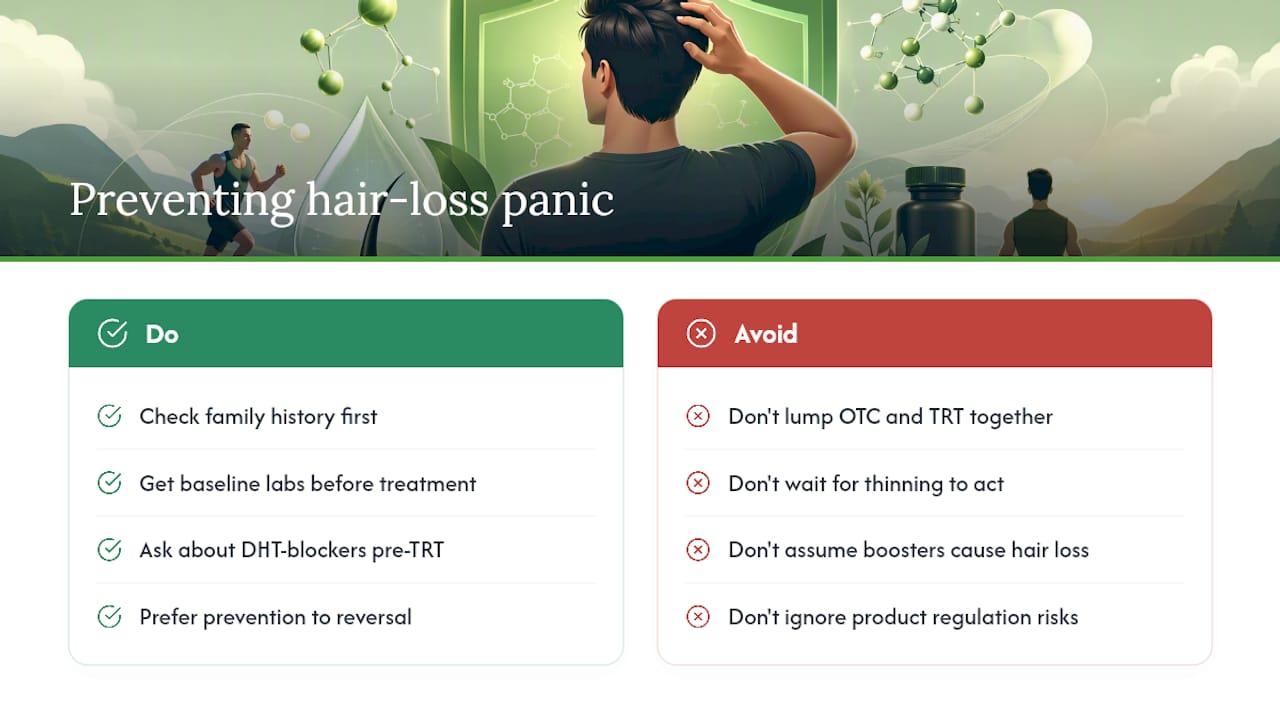
The other overlooked point: OTC boosters get blamed for a risk they mostly don’t carry, while the poor regulation and undisclosed ingredients in some of them is the real, underdiscussed concern. That’s a safety issue, not a hair issue, and conflating the two just muddies both conversations.
If you take one thing from this: get your family history and your labs before you get a prescription or a supplement bottle. Everything else is a downstream decision.
— Organic
Try Ageless For Men If You Want Natural Support Without a Prescription
If you’re looking for vitality and drive support without stepping straight into hormone therapy, Ageless For Men is built for exactly that middle ground: men who want a natural, non-prescription option before considering anything more clinical.

It’s formulated with organic ingredients tested in US labs, and it’s backed by Organicufuel’s money-back guarantee, so trying it doesn’t mean committing blind. One thing worth saying plainly: if you’re already on prescribed TRT, talk to your doctor before adding any supplement to the mix, since combining hormone-active products without medical input is never the smart move. For most men just looking for a natural first step, checking out the Ageless For Men product page is the easiest way to see if it fits your goals.
Sources
This article is general information, not a substitute for advice from a qualified doctor. Consult a qualified healthcare professional about your own circumstances before acting on anything here.


Comments (0)
There are no comments for this article. Be the first one to leave a message!