

Most lifters get the best results taking pre-workout 20 to 60 minutes before training, with 30 to 45 minutes hitting the sweet spot for the average person. Caffeine peaks in your blood between 30 and 75 minutes after you swallow it, so that window isn’t arbitrary. Ingredients, meal timing, and body size shift things by 10 to 20 minutes in either direction. One caution up front: skip the caffeine load if your workout starts within six hours of bedtime.
TL;DR:
- Pre-workout effects peak between 30 and 75 minutes after intake, with individual factors like meal timing and body size influencing this window.
- Caffeine starts working in 15 to 30 minutes, with peak effects around 30 to 75 minutes, while ingredients like citrulline and beetroot take longer to fully activate.
- Small body size and fast metabolism can cause effects to appear sooner, especially when training on an empty stomach, while larger or slower metabolisms require longer timing adjustments.
- For most workout types, a 30 to 60 minute pre-training window suits performance, but evening workouts require caffeine caution to avoid sleep disruption.
- Testing your timing over three sessions helps identify the optimal lead time, with consistency more important than perfection in timing for long-term results.
Table of Contents
- What Is the Best Pre-Workout Timing Window?
- What Affects How Fast Pre-Workout Kicks In?
- How Long Do Pre-Workout Ingredients Take to Kick In?
- How Should You Time Pre-Workout for Different Workouts?
- What Are the Safety Rules for Pre-Workout Timing?
- How Do You Find Your Personal Pre-Workout Timing?
- What Makes Organic Fuel’s Approach to Timing Different?
- Which Organic Fuel Product Fits Your Pre-Workout Timing?
- Does Perfect Timing Matter More Than Consistency?
- Sources
What Is the Best Pre-Workout Timing Window?
Caffeine doesn’t hit instantly. It absorbs through your gut, moves into your bloodstream, and typically peaks between 30 and 75 minutes after consumption. That’s why the standard advice lands on a 30 to 60 minute pre-workout window rather than something shorter or vaguer.
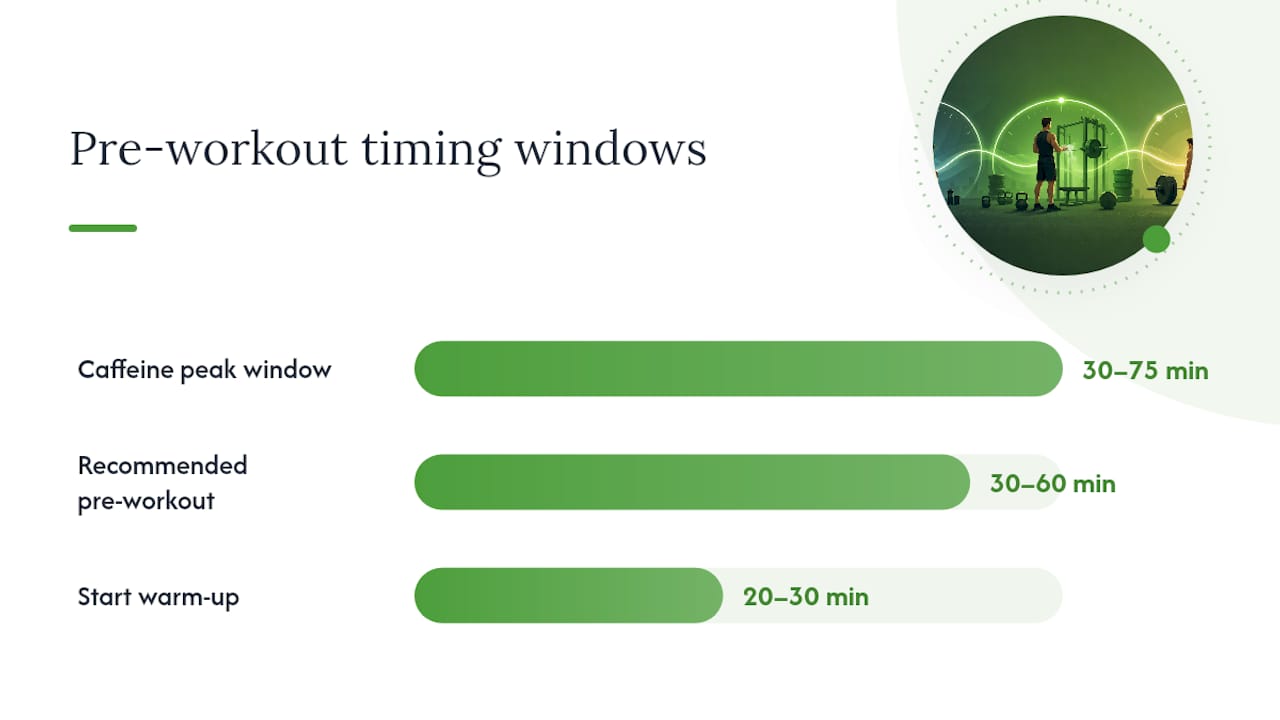
Look closer at the research behind that recommendation, and a pattern shows up. A lot of the clinical trials on pre-workout formulas dosed subjects 30 to 40 minutes before testing, which is narrower than the broad range most labels print. That tighter cluster is worth paying attention to if you want your gym performance to match what showed up in a lab.
A simple rule of thumb makes this easy to apply:
- Take your pre-workout, then start your warm-up 20 to 30 minutes later.
- By the time you’re loading your first working set, caffeine and other stimulants should be climbing toward peak effect.
- If you train fasted or metabolize caffeine quickly, lean toward the earlier end of the window.
- If you eat beforehand or process caffeine slowly, lean toward the later end.
This isn’t a rigid formula. It’s a starting point you adjust once you know how your body responds.
What Affects How Fast Pre-Workout Kicks In?
Ingredients don’t all work on the same clock. Caffeine hits fast. Pump ingredients like citrulline and beetroot take their time. Understanding the differences is what separates guessing from actually dialing in your timing.
- Caffeine typically starts working within 15 to 30 minutes and peaks around 30 to 75 minutes in.
- Beta-alanine produces a tingling sensation (paresthesia) within 10 to 20 minutes, which many lifters use as a rough signal that the product is active.
- Citrulline needs longer, often 45 to 60 minutes, for vasodilation and pump to build.
- Beetroot-based nitrates are the slowest of the bunch and may need two to three hours for full nitric oxide effect.
Meal state matters just as much as the ingredient list. Training on an empty stomach speeds absorption, while a full meal beforehand can delay it by some additional time. Powders generally absorb faster than capsules since there’s no shell to break down first. Bodyweight and individual metabolism add another layer. A smaller person or a fast metabolizer often feels effects sooner and stronger than someone larger or slower to process caffeine.
Pro Tip: Use the beta-alanine tingle as your internal clock. Once you feel it, you know your other ingredients are already circulating, even if you can’t feel them directly.
How Long Do Pre-Workout Ingredients Take to Kick In?
Here’s how the most common pre-workout ingredients compare on onset, peak, and how long they actually last once they kick in.
| Ingredient | Onset | Peak Effect | Duration |
|---|---|---|---|
| Caffeine | about 15–30 minutes | roughly 30–75 minutes | several hours |
| Beta-alanine | 10–20 min (tingling) | Cumulative, builds over weeks | Short-lived per dose |
| Citrulline | 30–45 min | 45–60 min | 1–2 hours |
| Beetroot (nitrates) | 60 min | 2–3 hours | 2–3 hours |
| Creatine | No acute effect | Builds over 1–2 weeks of daily use | Ongoing while supplementing |
Notice that creatine breaks the pattern entirely. It’s not a timing-sensitive ingredient at all. It works through daily saturation of muscle stores, not a single pre-workout dose, so when you take it on training day barely matters compared to whether you take it consistently.
How Should You Time Pre-Workout for Different Workouts?
Theory is nice, but you need a rule you can actually use on a Tuesday morning before squats. Here’s how to adjust based on your specific situation.
- Fasted morning training: Take it 15 to 30 minutes out. If you’re sensitive to stimulants, start with a smaller dose since an empty stomach speeds absorption.
- Training after a meal: Add 15 to 20 minutes to your usual window to account for slower digestion and delayed absorption.
- Strength and power days: Aim for 45 to 60 minutes pre-training so caffeine and pump ingredients peak right as you hit your heaviest sets.
- Endurance sessions: Take it 30 to 45 minutes ahead. Some endurance-focused research points toward the 45 to 60 minute range for sustained effort rather than a single explosive peak.
- Evening workouts: Skip high-caffeine formulas if you’re training within six hours of bedtime, or switch to a stimulant-free option entirely.
What Are the Safety Rules for Pre-Workout Timing?
Timing only matters if you’re also managing total intake. A well-timed dose stacked on top of three cups of coffee is still too much caffeine, regardless of when you took it.
- Track total daily caffeine, not just what’s in your pre-workout scoop. Coffee, energy drinks, and pre-workout add up fast.
- Caffeine can linger in your system for three to six hours, so late workouts often mean disrupted sleep.
- If you’re on medication, have a heart condition, or are pregnant, check with a healthcare provider before adding a stimulant supplement to your routine, and be extra cautious about interactions with other medications.
- For evening sessions, treat the six-hour rule as a hard line, not a suggestion, if sleep quality matters to you.
How Do You Find Your Personal Pre-Workout Timing?
Guessing wastes good workouts. Running a short experiment tells you exactly what your body needs.
- Pick a consistent dose and keep your meal state the same across three sessions.
- Test three different lead times: 20, 35, and 50 minutes before training.
- After each session, jot down perceived energy, focus, pump, and how you slept that night.
- Compare the three. The version where you felt strongest during working sets, with no sleep disruption, is your answer.
- Adjust in small 10 to 15 minute increments if none of the three felt exactly right.
Pro Tip: Don’t judge timing off one session. Energy, stress, and sleep the night before all skew results, so give each window a fair shot before deciding.
What Makes Organic Fuel’s Approach to Timing Different?
Organic Fuel formulates and lab-tests its supplements in the United States, with every batch checked for safety and potency before it reaches a customer. That matters for timing because stimulant-based and stimulant-free formulas behave differently in your body, and knowing which type you’re taking changes how you plan your pre-training window.
Products built around natural stimulant support call for the same 30 to 60 minute lead time discussed above. Others, like BioSync-XT, work on hormonal support over weeks rather than delivering an acute pre-workout effect, so timing on any single day matters far less than consistency. Organic Fuel backs its formulas with a money-back guarantee, which gives you room to test what actually fits your training schedule.
Which Organic Fuel Product Fits Your Pre-Workout Timing?
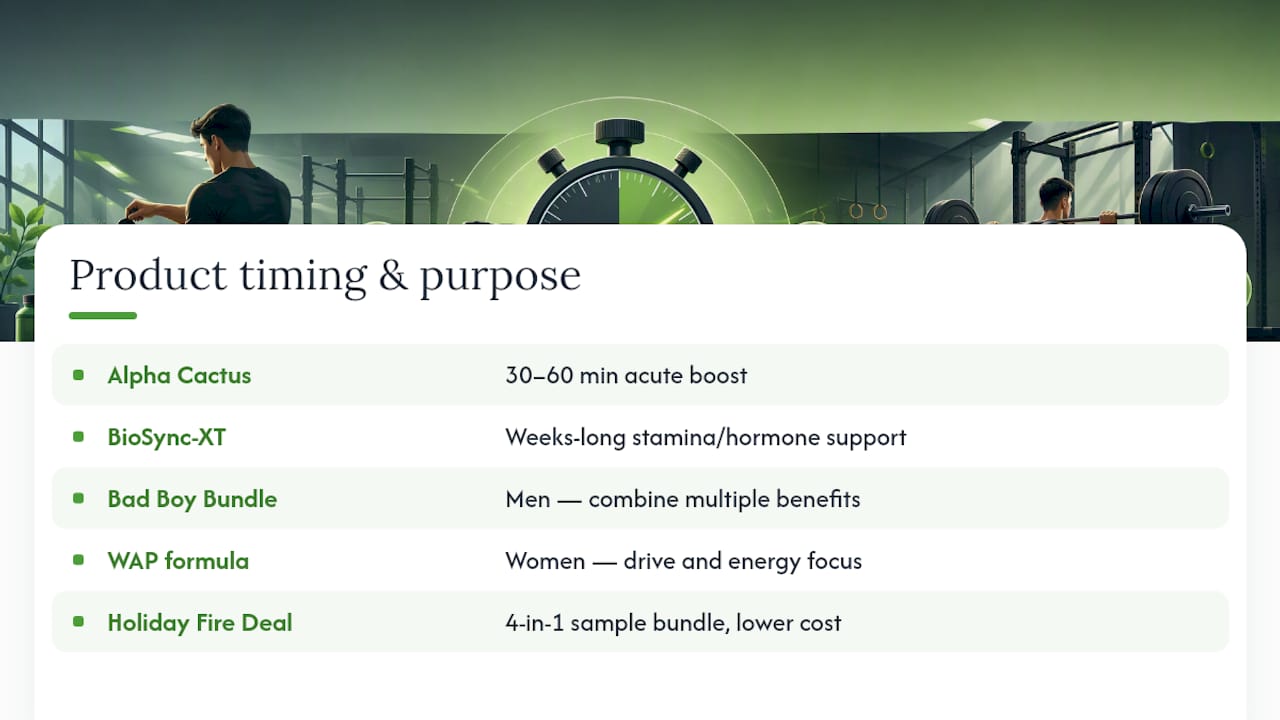
If you’re chasing an acute energy and performance boost, Alpha Cactus follows the same 30 to 60 minute timing rules covered above, built from natural ingredients rather than synthetic stimulant blends.
If your goals lean toward longer-term stamina and hormonal support instead of a same-day kick, BioSync-XT works on a different clock entirely, one measured in weeks, not minutes. Men looking to combine multiple benefits often start with the Bad Boy Bundle, and women focused on drive and energy have the WAP formula built specifically for that purpose. First-time buyers curious about trying several products at once can check the Holiday Fire Deal 4-in-1 collection for a lower-cost way to sample the lineup. Whichever line fits your goals, pick one, apply the timing window that matches its ingredient profile, and give it a real three-session test on your Alpha Cactus product page to see how it performs against your current routine.
Does Perfect Timing Matter More Than Consistency?
Chasing the perfect minute mark is a trap. What moves the needle is picking a window that works for your schedule and your gut, then sticking with it long enough to know if it’s actually helping. Three sessions of testing beats three months of guessing. If you’re on medication or managing a health condition, loop in your doctor before adding any new stimulant to your routine. Run the checklist above, pay attention to what your body tells you, and adjust from there.
— Organic
Sources
- Fitness experts reveal the best time to take pre-workout - Prevention
- The Best Time To Take Pre-Workout for Maximum Energy and Performance - Health
- PMC review on relevant supplement ingredients


Comments (0)
There are no comments for this article. Be the first one to leave a message!