

Neither category wins outright. What actually determines whether a supplement works comes down to chemical form, dose, and manufacturing quality, not whether the source was a plant or a lab. Vitamin E is a clear example: the natural form is more potent by weight than the synthetic version, while some synthetic folate is more bioavailable than the food-derived kind. A 2026 randomized trial backs this up directly.
TL;DR:
- Short-term blood tests show that both organic and synthetic multivitamins can lead to similar nutrient absorption within 30 days, but this does not guarantee long-term health benefits.
- Chemical form, such as stereochemistry in vitamin E or bioavailability in folate, plays a critical role in a supplement’s actual effectiveness, regardless of whether it is organic or synthetic.
- Labels like “organic” guarantee farming practices but provide no information about potency, dose, or whether the active compounds remain intact during processing.
- Third-party testing, proper ingredient sourcing, and verified dosing are essential indicators of a supplement’s quality beyond marketing claims or labels.
- When choosing supplements, focus on specific form and dose supported by scientific evidence, rather than assumptions based on organic or whole-food labels.
Table of Contents
- Organic Vs. Synthetic Supplements: What the Labels Actually Mean
- How Chemical Form Changes What a Supplement Actually Does
- What Human Trials Actually Show About Organic Vs. Synthetic Supplements
- A Decision Framework for Choosing a Supplement
- Reading Labels: How to Verify Quality and Safety
- Our Take: Why We Build Around Evidence, Not Labels
- Where BioSync-XT and Alpha Cactus Fit Into This Framework
- Sources
- FAQ
Organic Vs. Synthetic Supplements: What the Labels Actually Mean
Marketing language on supplement bottles rarely matches the chemistry inside them. “Organic” on a supplement label typically means the plant material was grown without synthetic pesticides or fertilizers, certified under USDA organic standards. It says nothing about the dose, the extraction method, or whether the active compound survived processing intact.
“Whole-food” supplements are made by concentrating and drying actual food (think dehydrated broccoli powder or acerola cherry extract) rather than isolating a single nutrient. A “food-derived extract” pulls one compound out of that whole food using solvents, heat, or pressure, which means it’s no longer really a whole food by the time it hits a capsule. “Synthetic” simply means the nutrient was built in a lab to match a molecular structure that also exists in nature.
Here’s the part most shoppers miss: extraction and synthesis can produce chemically identical molecules regardless of where they started. Ascorbic acid made in a fermentation tank is the same molecule as ascorbic acid pulled from an acerola cherry. The body doesn’t check the birth certificate.
A few label terms worth knowing:
- “Organic” guarantees farming practices, not potency or dosage accuracy.
- “Whole-food” means the nutrient is still bound to plant cofactors, but concentration varies by batch.
- “Standardized extract” guarantees a minimum percentage of a named active compound, which is often the most reliable claim on the label.
- “Natural” has no legal definition in supplement labeling and guarantees essentially nothing.
How Chemical Form Changes What a Supplement Actually Does
This is where the organic versus synthetic debate gets interesting, because the honest answer is: it depends entirely on the nutrient. Stereochemistry, the specific 3D shape of a molecule, determines how well your body’s enzymes recognize and use it. Two compounds can share an identical formula on paper and behave completely differently once they reach a cell receptor.

Vitamin E is the textbook case. Natural vitamin E, RRR-alpha-tocopherol (labeled “d-alpha” on a bottle), is a single stereoisomer. Synthetic vitamin E, all-rac-alpha-tocopherol (labeled “dl-alpha”), is a mixture of eight different stereoisomers, only some of which the body uses efficiently. According to the NIH Office of Dietary Supplements, the synthetic form is roughly half as active by weight as the natural one.
Vitamin E potency at a glance: if a label lists 268 mg of synthetic dl-alpha-tocopherol, it delivers roughly the same biological activity as 134 mg of natural d-alpha-tocopherol. Reading the milligram number alone, without checking which form it is, can lead you to under- or overestimate what you’re actually getting.
Folate flips the usual assumption on its head. The NIH folate fact sheet notes that certain synthetic folate forms can be more bioavailable than the folate naturally found in food, depending on the person and the condition. That’s a direct contradiction of the “natural is always better absorbed” claim you’ll see repeated across wellness blogs.
The food matrix matters too, but selectively. Whole-food extracts carry along phytochemicals, fiber, and cofactors that can influence how a nutrient behaves in the gut. That’s a real advantage for some applications, like plant compounds that need co-occurring antioxidants to function well. It’s a non-factor for others, like a mineral that gets absorbed the same way whether it arrived via spinach or a lab-grade citrate salt.
A quick rundown of where form matters most:
- Vitamin E: natural form outperforms synthetic by weight.
- Folate: synthetic forms can outperform food folate in specific contexts.
- Fat-soluble vitamins generally: absorption depends more on delivery format (oil-based softgel vs. dry tablet) than on organic origin.
- Minerals like magnesium or zinc: the compound they’re bound to (citrate, glycinate, oxide) matters more than whether the raw material was “organic.”
What Human Trials Actually Show About Organic Vs. Synthetic Supplements
The strongest recent data point comes from a 2026 randomized, single-blind, 30-day trial that gave healthy adults either an organically sourced or a synthetically derived multivitamin and mineral formula. Researchers tracked circulating micronutrient concentrations at the 2-hour mark and again after 30 days.
The result: both formulations produced broadly comparable changes in blood levels across the measured window. In other words, for the nutrients and timeframe tested, the body absorbed and used both versions in a similar way. That’s a meaningful data point in a category usually driven by anecdote and marketing copy rather than controlled comparison.
But read the fine print before treating this as a final verdict on organic versus synthetic supplements generally.
Short-term blood-level increases show that a nutrient got absorbed. They don’t show that absorption translated into a clinical outcome, whether that’s better bone density, fewer colds, or improved energy over a year of use. A 30-day circulation study and a long-term disease-prevention trial are answering two completely different questions.
That distinction shapes how you should read any supplement study, not just this one. A few things worth keeping in mind:
- Circulation studies measure bioavailability, not efficacy for a specific health goal.
- A 30-day window says nothing about what happens after six months or a year.
- Comparable blood levels between two products don’t guarantee comparable results for conditions like anemia, fatigue, or hormonal support, where individual absorption and metabolism vary.
- The Britannica explainer on natural versus synthetic vitamins makes the underlying point clearly: when the molecular structure matches, the body responds to the structure, not the origin story.
If you’re choosing a supplement for a specific outcome (say, testosterone support or stamina), look past the organic or synthetic label and ask whether the specific form and dose used in that product has been studied for that particular goal.
A Decision Framework for Choosing a Supplement
Skip the organic-versus-synthetic framing entirely and start with your actual goal. Here’s the sequence that keeps you from wasting money on the wrong product:
- Name the goal. Are you addressing a diagnosed deficiency, a general wellness gap, or a specific performance target like energy or stamina?
- Check whether you actually need more. A blood test or a documented dietary gap tells you more than a symptom list ever will.
- Pick the form with evidence behind it. For folate, that might mean methylfolate for absorption reasons. For vitamin E, that means checking whether the label says d-alpha or dl-alpha.
- Verify dose against established upper limits. More milligrams isn’t automatically better, and some nutrients have real toxicity ceilings.
- Inspect the quality documentation. Look for third-party testing, a certificate of analysis, and a manufacturing statement before buying.
Pro Tip: Keep a folder of screenshots of your Supplement Facts panels and any certificates of analysis you find. Six months from now, when you’re deciding whether to reorder, you’ll actually remember what you were taking and why.
Organic or whole-food options make the most sense when you have ethical or environmental preferences about farming practices, want the phytochemical cofactors that come bundled with a whole-food extract, or you’re managing sensitivities to synthetic fillers and binders. Synthetic or clinically specific forms tend to win when you need precise dosing, a nutrient with a long shelf-stability requirement, or a form that’s been directly validated in human trials for your particular use case.
Reading Labels: How to Verify Quality and Safety
The Supplement Facts panel is where marketing claims meet chemistry, and it’s worth actually reading instead of skimming. Look for the exact chemical form listed (not just “Vitamin E” but “d-alpha-tocopherol” specifically), the dose per serving, and how many servings the label assumes you’ll take daily. Ingredient lists on botanicals should name the plant species and which part was used, root, leaf, or seed, since potency and safety profiles differ dramatically between plant parts.
Third-party testing marks are the closest thing to an independent check you’ll find on a retail shelf. Look for USP verification, NSF certification, or a batch-specific certificate of analysis (COA) that a brand makes available on request or online. A GMP (Good Manufacturing Practice) statement on the label indicates the facility follows FDA-recognized manufacturing standards, though it’s not a substitute for actual third-party lab results.
Botanicals need extra scrutiny. The FDA has specifically warned that botanical supplements carry real risk of contamination with heavy metals or microbial pathogens, and that verifying identity and strength for plant-based ingredients is technically harder than for a single synthesized compound. An “organic” certification on a botanical says nothing about contaminant testing. For any herbal supplement, check for:
- A standardization marker (e.g., percentage of a named active compound).
- Batch-level contaminant testing for heavy metals and microbial content.
- Clear, specific dosing instructions rather than vague serving suggestions.
Our Take: Why We Build Around Evidence, Not Labels
We’ve built Organicufuel’s formulas around the same principle this whole article argues for: chemical form and manufacturing quality decide whether a supplement works, not a marketing label. Products are reportedly lab-tested and produced in facilities operating under GMP standards. Reviewing a certificate of analysis alongside the Supplement Facts panel is recommended for health-conscious buyers.
— Organic
Where BioSync-XT and Alpha Cactus Fit Into This Framework
If you’ve read this far, you already know the real question isn’t “organic or synthetic,” it’s “does this specific formula, at this specific dose, have quality documentation behind it.” That’s the standard we hold our own products to.
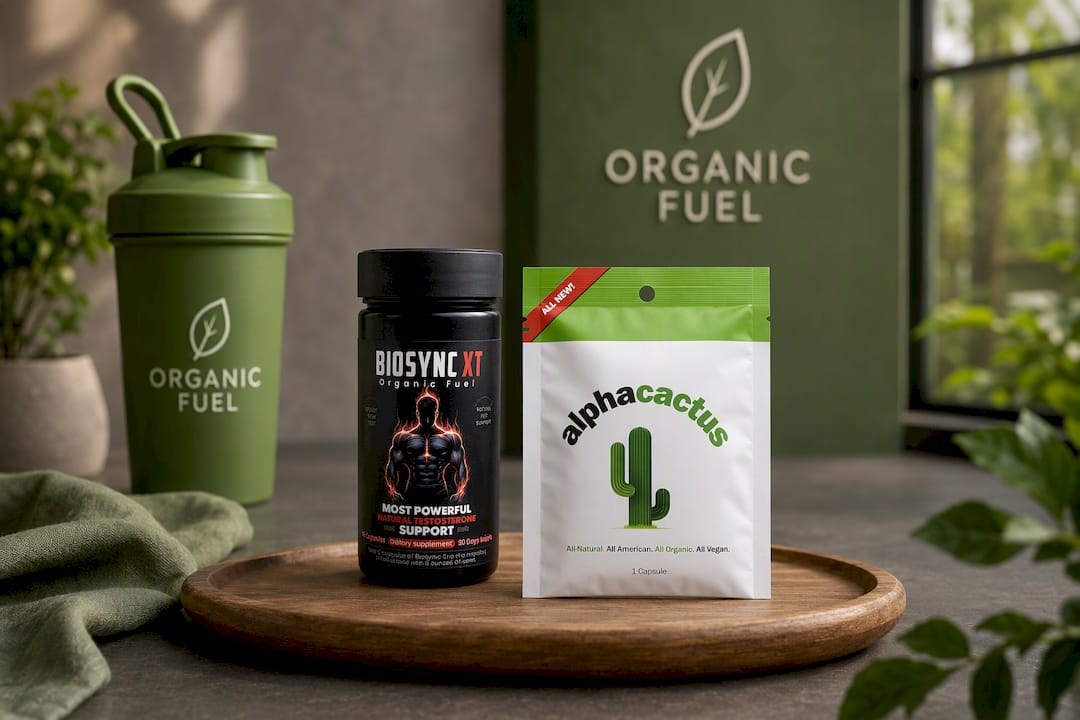
BioSync-XT Natural Testosterone Support & Booster uses an organic herbal formula aimed at supporting natural testosterone levels. Alpha Cactus is designed to support stamina and drive, using plant-based ingredients. Both products are described as lab-tested and made without artificial preservatives.
Before you buy, check the Supplement Facts panel and ingredient details on the product page, and look for the specific forms and doses used. You can browse the full product collection to compare options side by side.
Sources
- Evaluation of Organically Versus Synthetically Derived Multivitamin and Mineral Supplementation on Circulatory Concentration in Healthy Humans (2026)
- Vitamin E - Health Professional Fact Sheet (NIH ODS)
- Natural vs. Synthetic Vitamins | Britannica
- FDA: Botanical Drug Development Guidance and inspection notes
FAQ
Should Supplements Be Organic?
Not necessarily. Organic certification governs farming practices, not chemical form or dose, and a randomized trial found organic and synthetic multivitamin formulas produced comparable short-term changes in blood nutrient levels. Choose based on the specific form and evidence for your goal, then decide whether organic sourcing matters to you for other reasons like farming practices or phytochemical content.
How Do You Tell if Your Supplements Are Synthetic?
Check the exact wording on the Supplement Facts panel: terms like “dl-alpha-tocopherol” indicate a synthetic vitamin E, while “d-alpha-tocopherol” indicates the natural form, per NIH guidance. For other nutrients, look at the ingredient sourcing statement or contact the manufacturer directly, since “natural” claims aren’t strictly regulated on most labels.
Is Natural Always Better Than Synthetic?
No. Natural vitamin E outperforms the synthetic version by weight, but some synthetic folate forms are more bioavailable than food folate under certain conditions, according to NIH’s folate fact sheet. When a manufactured nutrient matches a natural molecule’s structure exactly, the body typically responds to that structure regardless of origin.
How Much Does Organicufuel’s BioSync-XT Cost?
Current pricing for BioSync-XT is available directly on its product page, along with the full Supplement Facts panel and ingredient details. Shipping protection is available for a flat $2.95 per order if you want added coverage.
What Should I Check Before Buying a Botanical Supplement?
Look for a standardization marker showing the percentage of the named active compound, plus evidence of contaminant testing for heavy metals and microbial content. The FDA has flagged botanicals as a category where identity and strength testing is especially important, since plant-based ingredients are harder to verify than single synthesized compounds.

Comments (0)
There are no comments for this article. Be the first one to leave a message!