

Low testosterone and erectile dysfunction are not the same condition, and treating them as interchangeable leads to wasted money on the wrong fix. Low T mainly drags down libido; ED is usually a plumbing and wiring problem tied to blood flow and nerves. If you’re symptomatic, get a morning total testosterone test and start an ED workup focused on vascular risk factors. Consider testosterone replacement therapy only if labs confirm hypogonadism, especially when low sex drive is part of the picture.
TL;DR:
- A testosterone level below 300 ng/dL must be accompanied by symptoms like low libido or fatigue to justify treatment; lab results alone are insufficient.
- Erectile dysfunction often results from vascular or nerve issues unrelated to testosterone levels, and common causes include diabetes, obesity, and cardiovascular disease.
- Testosterone replacement therapy reliably improves libido but has inconsistent effects on erectile function, which remains primarily a vascular issue.
- Proper diagnosis involves morning blood tests repeated on separate days, along with assessments of free testosterone, SHBG, LH, prolactin, and vascular health factors.
- Lifestyle changes such as weight loss and physical activity can significantly improve both low testosterone and erectile function, sometimes more than hormone replacement.
Table of Contents
- Low T vs. ED: How Doctors Actually Define Each One
- Why Testosterone Drives Desire More Than It Drives Erections
- What the Research Actually Shows About the Low T and ED Overlap
- What Your Doctor Should Check Before Diagnosing Anything
- Treatment Options: What Actually Works for Each Problem
- Where Natural Supplements Fit Into This Picture
- Questions to Bring to Your Next Doctor’s Visit
- The Honest Take on Fixing This the Right Way
- Try Organicufuel’s Natural Support Options
- Sources
- FAQ
Low T vs. ED: How Doctors Actually Define Each One
Confusing these two conditions starts with skipping the actual diagnostic criteria. The American Urological Association defines testosterone deficiency as a total testosterone reading below 300 ng/dL, and that number alone isn’t enough. It has to come paired with symptoms like low libido, fatigue, or mood changes. A man with a testosterone level of 280 ng/dL and zero symptoms doesn’t meet the clinical bar for treatment, no matter what an online calculator says.
Erectile dysfunction has its own separate definition: a persistent inability to get or hold an erection firm enough for intercourse. It’s not one bad night after too much wine at a wedding. Prevalence climbs steeply with age, and by a man’s 60s and 70s, some degree of ED becomes common rather than the exception, largely because vascular and neurologic risk factors accumulate over decades.
The overlap trips people up because both conditions share vague, overlapping symptoms on paper. That’s exactly why a lab value in isolation tells you almost nothing useful.
- A low testosterone reading without symptoms is not a diagnosis.
- ED without a testosterone test is an incomplete workup, especially in men over 40.
- Both conditions need symptoms correlated with objective findings before any treatment plan makes sense.
Why Testosterone Drives Desire More Than It Drives Erections
Testosterone’s biggest job in sexual health happens in the brain, not the penis. It fuels the neural circuits behind desire, motivation, and sexual interest. When testosterone drops, the first thing most men notice is a fading appetite for sex, not necessarily trouble once things get started.
Erections, on the other hand, are mostly a vascular and neurologic event. Blood needs to flow into the penile tissue and stay there, which depends on healthy endothelial function and adequate nitric oxide signaling, the same chemical pathway that keeps arteries throughout the body flexible. Testosterone plays a supporting role here, but it’s a minor one compared to the vascular machinery doing the actual work. A foundational review by Rajfer laid out this distinction decades ago, and it still holds up.
That’s why a man with rock-normal testosterone can still develop ED if he’s dealing with:
- Type 2 diabetes, which damages the small blood vessels and nerves involved in erections.
- Obesity, which drives inflammation and reduces nitric oxide availability.
- Cardiovascular disease, since ED is frequently an early warning sign of arterial narrowing elsewhere in the body.
Pro Tip: If your erections have gotten worse but your interest in sex hasn’t changed at all, that pattern points toward a vascular issue, not a hormone issue. Mention that distinction to your doctor directly.
What the Research Actually Shows About the Low T and ED Overlap
Roughly 35% of men with erectile dysfunction also have low testosterone, but that coexistence is not proof that low T is causing the ED. Two conditions showing up in the same man at the same rate often just means they share risk factors, like age, obesity, and metabolic syndrome, not that one is causing the other.
About one in three men with ED also tests low on testosterone, yet testosterone replacement resolves the erectile problem in only some of those cases.
Testosterone replacement therapy reliably restores libido in men with confirmed deficiency. Its effect on erectile function itself is far less consistent. Clinical guidance summarized in the StatPearls review on erectile dysfunction notes that PDE5 inhibitors remain the first-line ED treatment for most men, while testosterone therapy functions more reliably as a libido fix than an erection fix.
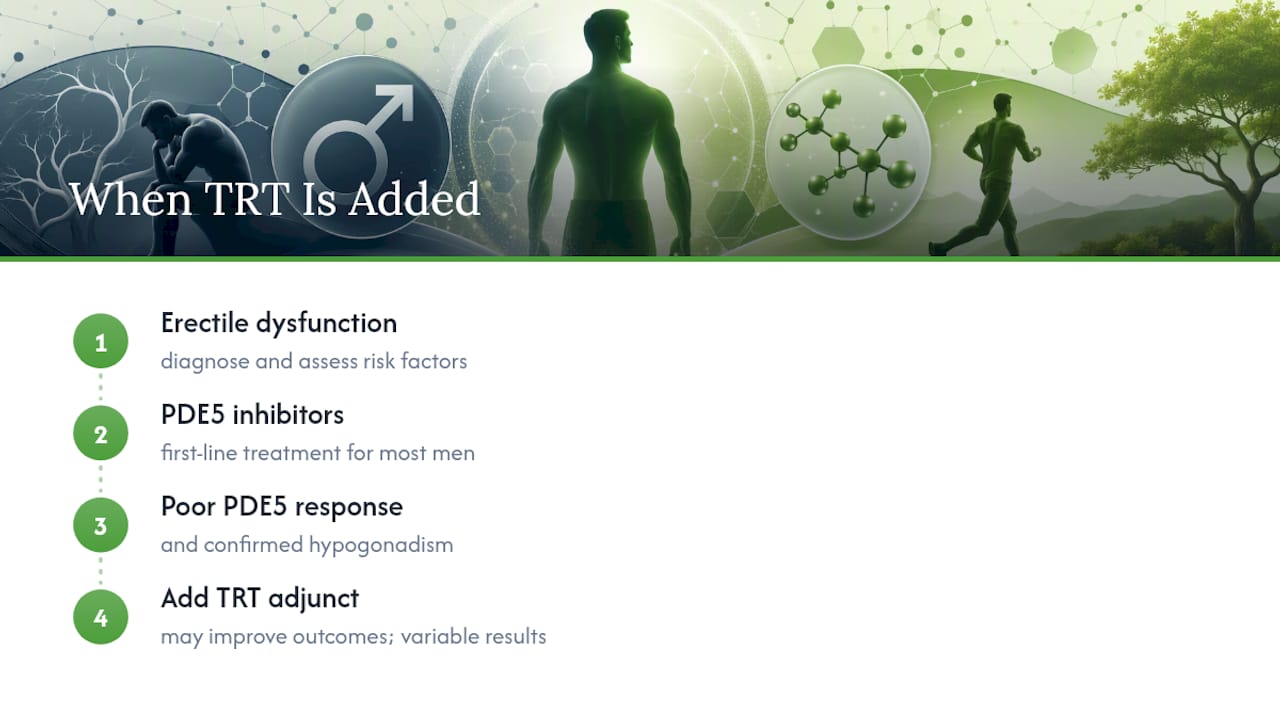
Where TRT earns a real role is in men who’ve already tried PDE5 inhibitors and gotten a poor response. Research on combined therapy shows that adding testosterone to the treatment plan can improve outcomes for some men with confirmed hypogonadism, though results vary from person to person. It’s an adjunct, not a replacement, and it works best when the biochemistry actually backs it up.
What Your Doctor Should Check Before Diagnosing Anything
A single blood draw at 3 p.m. tells you almost nothing. Testosterone follows a daily rhythm, peaking in the morning, so an accurate workup depends on timing and repetition just as much as the number itself.
- Order a morning total testosterone test, ideally between 7 and 10 a.m., and repeat it on a separate day if the first result comes back low.
- Check free testosterone and SHBG when total testosterone sits in a borderline range, since binding proteins can distort the total number.
- Add LH and prolactin if testosterone is confirmed low, which helps distinguish a testicular problem from a pituitary one.
- Screen for diabetes, cholesterol, and blood pressure, since these conditions damage the same vascular pathways responsible for erections.
- Review current medications, because blood pressure drugs, antidepressants, and opioids are common, underrecognized contributors to ED.
- Take a focused sexual history, including whether spontaneous nighttime or morning erections still happen, which helps separate a hormonal problem from a vascular one.
If labs confirm low testosterone with a pituitary or testicular cause, or if ED doesn’t respond to standard treatment, that is the point to bring in urology or endocrinology rather than continuing to guess in primary care.
Treatment Options: What Actually Works for Each Problem
PDE5 inhibitors like sildenafil and tadalafil remain the first-line treatment for ED, with strong overall success rates across most causes. They’re not universal, though. Men taking nitrate medications for heart disease cannot safely combine them with PDE5 inhibitors due to a dangerous blood pressure interaction. Timing also matters. Sildenafil works best on an empty stomach, while tadalafil has a longer window that gives more flexibility.
Lifestyle changes deserve more attention than they get. Weight loss and increased physical activity improve both testosterone levels and erectile function, sometimes outperforming hormone therapy alone in men whose low T stems from obesity or metabolic syndrome. This form of secondary hypogonadism responds to fixing the underlying metabolic problem, not just replacing the hormone.
TRT makes sense in three specific scenarios:
- Confirmed hypogonadism (below 300 ng/dL) paired with clear symptoms like low libido or fatigue.
- ED that hasn’t responded well to PDE5 inhibitors, where TRT is added as a supporting therapy.
- Severe biochemical hypogonadism where multiple lab draws confirm the diagnosis, not a single borderline result.
Pro Tip: If you’re only chasing better erections and your libido has been fine, TRT is probably the wrong first move. Save it for cases where desire has also taken a hit.
Even in the right candidates, expect a modest and variable benefit on erectile function specifically, not a guaranteed fix.
Where Natural Supplements Fit Into This Picture
The company builds its formulas around organic herbal ingredients tested in US labs, and every product ships backed by a money-back guarantee. That matters here because supplements occupy a different lane than prescription medication, and Organicufuel is upfront about where that lane starts and ends.
None of these products are FDA-approved treatments for erectile dysfunction or hypogonadism. What they’re designed to do is support the metabolic and vitality factors that influence libido and general sexual wellness, which fits squarely into the lifestyle-and-support side of this conversation rather than the clinical-diagnosis side.
- BioSync-XT Natural Testosterone Support & Booster targets natural testosterone support for men dealing with fatigue, low drive, or general vitality decline.
- Alpha Cactus is positioned for libido and sexual performance support as a natural alternative to synthetic ED products, useful for men looking to support performance without a prescription.
- Ageless For Men addresses broader vitality and aging-related energy decline rather than a specific diagnosis.
Anyone on prescription medication, especially nitrates or blood pressure drugs, should talk to a doctor before adding any new supplement. That conversation takes five minutes and avoids a genuinely dangerous interaction.
Questions to Bring to Your Next Doctor’s Visit
Walking into an appointment with the right questions saves time and gets you better answers. Ask your doctor to run a morning total testosterone test rather than accepting a random afternoon draw, and ask directly whether a PDE5 inhibitor is appropriate given your cardiac history and current medications.
- Ask specifically about nitrate interactions if you take anything for blood pressure or chest pain, since this combination can be dangerous.
- Ask how long to wait before reassessing treatment. PDE5 inhibitors typically show results within a few doses, while TRT benefits on libido often take four to six weeks and longer for any erectile improvement.
- Watch for red flags that need urgent care, not a follow-up appointment: chest pain during sexual activity, sudden erectile loss paired with other neurologic symptoms like numbness or slurred speech, or an erection lasting more than four hours, a medical emergency known as priapism.
The Honest Take on Fixing This the Right Way
The biggest misconception we see is men assuming a testosterone shot will fix an erection problem that’s really about blood flow. It usually won’t, and chasing that fix delays the vascular and metabolic work that actually moves the needle. Lifestyle change isn’t a consolation prize here. It’s frequently the more effective lever, especially when obesity or blood sugar issues are in play.
TRT is a legitimate tool in the right hands, but it belongs in a shared decision with a doctor who’s actually run the labs. Organicufuel builds supplements to support that broader effort safely, not to replace it.
— Organic
Try Organicufuel’s Natural Support Options
If your workup points toward low libido or general vitality decline rather than a strictly vascular ED problem, a targeted natural supplement can be a reasonable adjunct to the lifestyle and medical steps outlined above. Organicufuel formulates its products from organic herbal ingredients, tests them in US labs, and backs every purchase with a 100% money-back guarantee, which matters when you’re trying something new for a sensitive health issue.
Some products are built for men focused on libido and performance support, while others target natural testosterone and vitality for men dealing with fatigue or low drive. These supplements may be available as one-time purchases or through subscriptions for ongoing support. If you’re on prescription medication, particularly anything for blood pressure or heart disease, talk to your doctor before adding either one to your routine.
Ready to see which option fits your situation? Check out Alpha Cactus or explore the full Organicufuel product lineup to compare options before you decide.
Sources
The clinical claims in this article draw from established urology and endocrinology guidelines rather than general wellness advice.
- AUA testosterone deficiency guideline
- Study reporting coexistence of low T and ED
- Erectile Dysfunction - StatPearls/NCBI Bookshelf
This article is general information, not a substitute for advice from a qualified doctor. Consult a qualified healthcare professional about your own circumstances before acting on anything here.
FAQ
Can masturbation cause low testosterone?
No. Masturbation and ejaculation frequency don’t cause long-term drops in testosterone. Any short-term hormone fluctuation after ejaculation is temporary and unrelated to clinical hypogonadism, which is diagnosed through morning blood testing and persistent symptoms.
Can a man with low testosterone get hard?
Yes, in most cases. Erections depend primarily on vascular and neurologic function, so a man with low testosterone can often still achieve an erection, even though his desire for sex may be reduced.
Will Viagra work if I have low testosterone?
Often, yes. PDE5 inhibitors like Viagra target the vascular mechanism behind erections and work independently of testosterone levels in many men, which is why they remain the first-line ED treatment regardless of hormone status.
How does a man act when he has low testosterone?
Common signs include reduced sex drive, persistent fatigue, low mood or irritability, and difficulty building muscle despite regular exercise. These symptoms, combined with a confirmed lab result under 300 ng/dL, are what clinicians use to diagnose testosterone deficiency rather than any single behavior alone.

Comments (0)
There are no comments for this article. Be the first one to leave a message!