
Dietary supplements are regulated in the United States, but not the way most people assume. Federal law treats them as a category of food rather than medicine, which means the FDA does not pre-approve them before they hit store shelves. The FDA oversees manufacturing and labeling, and the FTC polices advertising claims, but manufacturers carry the primary burden of proving their products are safe before selling them. Regulators mostly step in after something goes wrong.
TL;DR:
- Most supplements enter the market without prior FDA review, with manufacturers responsible for safety and the FDA acting mainly after sale.
- New dietary ingredients introduced after October 15, 1994, require an NDI notification, which is a disclosure, not a product approval.
- The FDA enforces manufacturing quality through facility inspections and testing, but it has limited resources to monitor the millions of products launched yearly.
- Labels must include specific information and disclaimers, but claims about health benefits are tightly regulated, with disease-treatment claims prohibited without approval.
- Checking FDA’s recall database, requesting a certificate of analysis, and consulting healthcare providers offer better safety measures than seeking “FDA approval” labels that do not exist for supplements.
Table of Contents
- How The Law Defines And Frames Supplement Regulation
- What The FDA Actually Does And Where Its Reach Ends
- Manufacturing Rules: What CGMPs Actually Require
- Labeling And Claims: What’s Allowed On The Bottle
- How Problems Get Caught: Monitoring, Reports, And Recalls
- Practical Steps: Checking A Supplement Before You Buy It
- Where Organic Fuel Fits Into This Regulatory Picture
- The Real Gap In How People Think About Supplement Safety
- Get Supplements Built Around Real Manufacturing Standards
- Sources
- FAQ
How The Law Defines And Frames Supplement Regulation
The Dietary Supplement Health and Education Act of 1994, known as DSHEA, is the law that created the entire framework we live with today. It amended the Federal Food, Drug, and Cosmetic Act to carve dietary supplements out as their own legal category, distinct from both conventional food and prescription drugs. Under DSHEA, a “dietary supplement” is a product taken by mouth that contains a vitamin, mineral, herb, amino acid, or similar ingredient meant to add to the diet, not replace a meal or treat a disease.
The date October 15, 1994, matters more than most shoppers realize. Any ingredient sold in supplement form before that date is treated as having an established history of use, so it gets a presumption of safety without further review. Anything introduced after that date counts as a New Dietary Ingredient, or NDI, and the manufacturer has to notify the FDA before marketing it.
That notification, though, is not the same thing as approval. It is a filing where the company lays out its own safety rationale, and the FDA can object if the evidence looks thin, but silence from the agency doesn’t mean a green light.
The bigger structural difference between supplements and drugs comes down to who has to prove what, and when:
- Drugs: the manufacturer must prove safety and effectiveness to the FDA before the product can be sold.
- Supplements: the manufacturer is responsible for safety, but there’s generally no premarket review; the FDA acts mainly after a product is already on the market.
- New ingredients: require an NDI notification at least 75 days before marketing, but that’s a disclosure, not a government sign-off.
That inverted burden of proof is the single biggest thing people misunderstand about supplement regulation laws.
What The FDA Actually Does And Where Its Reach Ends
The FDA does not run premarket approval for supplements the way it does for drugs, and that single fact explains most of the confusion around this topic. A prescription drug has to clear years of clinical trials and an FDA review before a pharmacy can stock it. A new protein powder or testosterone support blend generally does not.
That doesn’t mean the FDA is hands off. Its oversight runs through several channels:
- Facility registration and inspections. Manufacturers must register their facilities with the FDA, and inspectors can show up to check manufacturing practices and recordkeeping.
- NDI review. When a company files a New Dietary Ingredient notification, agency scientists evaluate the safety data submitted.
- Market surveillance. The FDA monitors advertising, product testing results, and consumer complaints for red flags.
- Warning letters and recalls. When it finds a supplement that’s adulterated, mislabeled, or spiked with an undisclosed drug ingredient, it can demand a recall or force a company to stop selling it.
The practical limit is scale. Thousands of new supplement products enter the market every year, often with no notice to the agency at all. Dr. Cara Welch, who oversees FDA’s supplement program, has pointed out that because so many products launch without any FDA notification, the agency has to prioritize its limited inspection and enforcement resources toward the products most likely to cause real harm. That’s why the agency has pushed for a mandatory product-listing requirement, so it can actually see what’s on the market instead of finding out about a dangerous product only after people get hurt.
Pro Tip: If a supplement claims to work as fast as a prescription drug, especially in categories like weight loss or sexual performance, that speed is often a warning sign of an undisclosed pharmaceutical ingredient, not a marketing highlight.
Manufacturing Rules: What CGMPs Actually Require
Current Good Manufacturing Practices, or CGMPs, are the quality-control backbone of supplement regulation, and they apply to every company selling products in the U.S. market. These rules exist specifically because the FDA doesn’t review products before they launch. If nobody is checking the recipe in advance, the process that makes the recipe has to be checked instead.
CGMPs require manufacturers to maintain several layers of documentation and testing:
- A master manufacturing record detailing exactly how each product is made, batch by batch.
- Identity testing confirming that an ingredient listed on the label is actually the ingredient in the bottle, not a cheaper substitute.
- Quality control checks throughout production to catch contamination, mislabeling, or dosing errors before shipping.
- Recordkeeping that the FDA can audit during an inspection.
The FDA enforces CGMPs through facility inspections and its own product sample testing, and companies that fail can face warning letters, product seizures, or a shutdown of a manufacturing line.
Here’s where consumer language gets murky. When a label says a product is “tested,” that typically refers to CGMP-mandated identity and quality testing, not a clinical trial proving the product treats a condition. Those are two very different kinds of testing, and the word “tested” alone doesn’t tell you which one you’re getting.
Pro Tip: Ask a manufacturer directly for a certificate of analysis (COA) on a specific batch. A company confident in its CGMP compliance will usually hand one over without hesitation; a company that stalls is telling you something.
Labeling And Claims: What’s Allowed On The Bottle
Every legally sold supplement has to carry a specific set of label elements, and skipping any of them is itself a violation. The required pieces include:
- An identity statement naming the product as a “dietary supplement.”
- A Supplement Facts panel listing every dietary ingredient and the amount per serving.
- A full ingredient list, including inactive ingredients like fillers and binders.
- The manufacturer or distributor’s name and address.
The claims section of the label is where the legal lines get sharpest. A company can make a structure/function claim, something like “supports healthy testosterone levels” or “promotes energy,” as long as it carries the disclaimer that the statement hasn’t been evaluated by the FDA and the product isn’t intended to diagnose, treat, cure, or prevent any disease. What a company cannot legally claim, without becoming an unapproved drug in the FDA’s eyes, is that a supplement treats erectile dysfunction, cures low testosterone, or reverses a diagnosed medical condition.
This is also where a second agency enters the picture. The FTC monitors advertising for deceptive or unsubstantiated claims, separate from the FDA’s labeling authority, and the two agencies coordinate on enforcement when a company’s marketing crosses the line from support language into disease-treatment territory.
How Problems Get Caught: Monitoring, Reports, And Recalls
Postmarket surveillance is where most real enforcement happens, since premarket review barely exists for this category. Manufacturers are legally required to report serious adverse events, meaning hospitalizations, disabilities, or deaths linked to their product, to the FDA. Consumers can also file reports directly through the agency’s MedWatch system if they experience a reaction they suspect is tied to a supplement.
Once a signal appears, whether from a manufacturer report, a consumer complaint, or a routine inspection, the FDA typically works through a sequence:
- Investigate. Agency staff review the complaint, test product samples, and check manufacturing records.
- Notify. If a real risk is confirmed, the FDA issues a warning letter or public safety communication.
- Enforce. Depending on severity, this can mean a voluntary recall, a mandatory recall order, product seizure, or an import alert blocking future shipments.
One pattern shows up repeatedly in FDA enforcement history: products marketed for weight loss, bodybuilding, or sexual enhancement get spiked with undeclared pharmaceutical ingredients, like unapproved erectile dysfunction drugs or banned stimulants, and get recalled once testing catches it. Academic reviews of the DSHEA framework have noted that this postmarket, complaint-driven model leaves real gaps between when a tainted product ships and when it gets pulled.
Practical Steps: Checking A Supplement Before You Buy It
You have more tools available than most shoppers realize, and using them takes a few minutes.
- Search the FDA’s recall and safety alert database before buying, especially in categories like weight loss, bodybuilding, or sexual enhancement, where tainted products show up most often.
- Look up whether an ingredient has an NDI notification on file if it’s unfamiliar or newly popular.
- Treat third-party testing seals as a useful signal, not proof of effectiveness. They confirm the bottle contains what the label says, not that the product works as advertised.
- Ask the manufacturer for a certificate of analysis and check whether facility claims can be verified independently.
- Talk to your doctor or pharmacist about interactions, especially if you take prescription medication. Federal oversight can’t screen a product against your personal health history, only a clinician can do that.
Pro Tip: Keep a photo of the Supplement Facts panel before you start a new product. If you ever need to report a reaction, having the exact ingredient list and lot number on hand speeds up the process considerably. For a deeper look at evaluating herbal products specifically, see our breakdown on herbal enhancement pill safety.
Where Organic Fuel Fits Into This Regulatory Picture
Everything above explains why the burden falls on manufacturers, not federal regulators, to prove a supplement is safe before it ships. This company builds its process around that reality rather than around the label claims regulators can’t verify in advance.
Every formula undergoes U.S. lab testing, and manufacturing follows the CGMP standards described earlier, including facility registration and batch-level quality checks. That’s not a substitute for FDA approval, since no supplement gets that, but it’s the kind of documented, auditable process CGMPs are designed to require.
The product lineup reflects that approach across different needs:
- BioSync-XT targets natural testosterone support with ingredient transparency on its Supplement Facts panel.
- Alpha Cactus focuses on natural performance support, formulated as an alternative for men wary of synthetic options.
- Ageless For Men and the Bad Boy Bundle round out the men’s vitality lineup, while WAP FOR HER ONLY! addresses energy and drive for women.
Readers who want to see the testing process directly can review the labs and testing information or reach customer support for a specific certificate of analysis.
The Real Gap In How People Think About Supplement Safety
The biggest misunderstanding in this whole topic isn’t about the FDA at all. It’s about the phrase “FDA-approved.” People hear “regulated” and assume it means “vetted,” the way a new prescription drug gets vetted. It doesn’t. DSHEA built a system where the agency’s role is closer to a referee that steps in after a foul than an inspector who checks every player before the game starts.
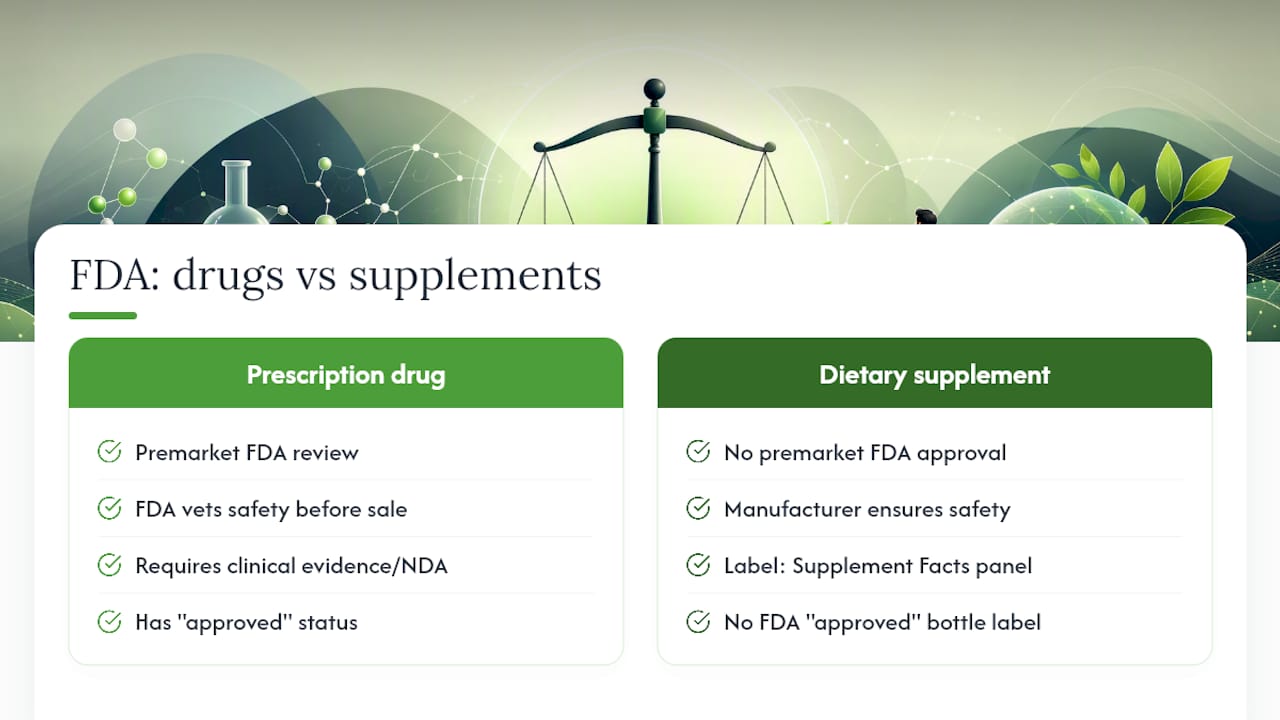
That gap between perception and reality is where most bad purchasing decisions happen. Shoppers see a bottle on a shelf and assume someone in Washington already checked it. Nobody did, not in the way they imagine.
The conventional advice, “look for FDA approval,” is actually useless advice, because that label will never legally exist on a supplement bottle. The advice that actually holds up is narrower and more actionable: check the Supplement Facts panel, look up the manufacturer’s recall history, ask for a certificate of analysis, and talk to your doctor about interactions. Those four habits do more for your safety than any search for a stamp of approval that was never coming.
— Organic
Get Supplements Built Around Real Manufacturing Standards
Organicufuel makes the case simple: instead of guessing whether a synthetic-heavy competitor’s claims hold up, you’re choosing formulas built from organic herbal ingredients, lab tested in the U.S., and backed by a 100% money-back guarantee if a product doesn’t work for you.

That guarantee matters precisely because of everything covered above. No federal agency is going to vouch for a supplement’s effectiveness before you buy it, so the responsibility for standing behind the product falls on the company selling it. Organicufuel’s catalog, from BioSync-XT for testosterone support to Alpha Cactus for natural performance, is built for people who want an alternative to synthetic options without giving up on real formulation transparency.
If you’re ready to see the ingredient breakdown and lab testing behind a specific product, visit Organic Fuel and browse the current lineup, or check the labs page first if you want the testing details before you decide.
Sources
FAQ
Why doesn’t the FDA approve vitamins and supplements before they’re sold?
DSHEA classifies supplements as a category of food, not drugs, so Congress designed the law around manufacturer responsibility and postmarket oversight rather than premarket FDA approval.
How can I tell if a supplement is safe to use?
Check the FDA’s recall database for the brand, review the Supplement Facts panel for full ingredient disclosure, and ask the manufacturer for a certificate of analysis if you want batch-level testing proof.
Is there a single “most trustworthy” supplement company?
No single company holds official certification as the most trustworthy, since the FDA doesn’t rank or endorse brands; look instead for companies that publish lab testing, follow CGMPs, and offer clear guarantees, which is the standard Organicufuel builds its process around.
Are supplements sold at large retail chains FDA regulated?
Yes. Every dietary supplement sold in the U.S., regardless of retailer, falls under the same FDA labeling and manufacturing rules described in DSHEA; being sold at a major chain doesn’t mean a product received any additional government review.
What’s the difference between a structure/function claim and a disease claim on a label?
A structure/function claim, like “supports energy levels,” is legally allowed with a standard disclaimer, while a disease claim, like “treats erectile dysfunction,” would classify the product as an unapproved drug.

Comments (0)
There are no comments for this article. Be the first one to leave a message!