
No, dietary supplements are not FDA-approved before they reach U.S. consumers. Under the Dietary Supplement Health and Education Act (DSHEA) of 1994, the FDA has no legal mechanism to review a supplement’s safety or effectiveness before it’s sold. Manufacturers carry that responsibility themselves, and the agency only steps in after a product is already on shelves.
TL;DR:
- Supplements are not reviewed or approved by the FDA before sale; the responsibility for safety lies with the manufacturer.
- A dietary ingredient not on the market before 1994 requires a safety notification, but FDA review does not equate to approval.
- Post-market enforcement relies on adverse reports, inspections, and laboratory tests, not pre-market safety evaluations.
- Labels can only make structure-function claims with a mandatory disclaimer; disease claims are illegal.
- Consumers should verify cGMP compliance, seek third-party testing, and consult healthcare professionals before purchasing supplements.
Table of Contents
- How DSHEA Shapes FDA Authority Over Supplements
- The One Premarket Step: New Dietary Ingredient Notifications
- What Happens After Supplements Reach the Market
- What Supplement Labels Are Legally Allowed to Say
- What cGMP Actually Guarantees, and What It Doesn’t
- A Practical Checklist for Buying Supplements Safely
- How Organicufuel Approaches Transparency Without Claiming FDA Approval
- Common Misconceptions About FDA Approval of Supplements
- What Third-Party Certifications Can and Can’t Tell You
- Red Flags That Signal an Unsafe or Fraudulent Supplement
- Editorial Guidance for Responsible Supplement Use
- Where to Learn More and Shop Organicufuel’s Product Line
- Sources
How DSHEA Shapes FDA Authority Over Supplements
DSHEA drew a hard legal line between drugs and dietary supplements. Drugs go through years of FDA-reviewed clinical trials before a single bottle reaches a pharmacy. Supplements don’t. The law defines them as products meant to supplement the diet, things like vitamins, minerals, herbs, amino acids, and enzymes, and it puts the manufacturer, not the government, in charge of proving safety.
That distinction has real teeth. According to FDA guidance on dietary supplements, companies generally don’t submit safety evidence to the FDA before marketing a product, with one narrow exception covered below.
Here’s what DSHEA actually requires of manufacturers:
- Verify the product is safe before it ships
- Use accurate, truthful labeling with no false claims
- Follow federal manufacturing standards
- Correct or remove products if problems surface after launch
The government doesn’t inspect the recipe before it goes to market. It inspects the kitchen after the fact.
The One Premarket Step: New Dietary Ingredient Notifications
There’s a narrow exception to the “no premarket review” rule, and it’s the one most people confuse with approval. If a company wants to sell a dietary ingredient that wasn’t already on the U.S. market before October 15, 1994, it has to file a New Dietary Ingredient (NDI) notification with the FDA at least 75 days before selling it.
An NDI notification includes:
- A description of the ingredient and how it will be used
- The manufacturer’s evidence supporting reasonable safety expectations
- Proposed labeling and dosage information
The FDA reviews the filing and can raise safety objections. But even a notification that clears review isn’t a stamp of approval. As the NIH Office of Dietary Supplements points out, NDI filings are technical safety submissions based on the company’s own evidence, not an independent FDA endorsement of the ingredient.
What Happens After Supplements Reach the Market
Once a supplement is on shelves, the FDA shifts into a different role entirely. It monitors, inspects, and reacts rather than approves. Dr. Cara Welch, who directs the FDA’s Office of Dietary Supplement Programs, has described this as a post-market model built out of necessity: the agency oversees more than 100,000 supplement products with a fraction of the resources it dedicates to drug review.
That means enforcement is triggered, not routine. Typical triggers include:
- Adverse event reports submitted by consumers, doctors, or manufacturers
- Facility inspections that turn up sanitation or quality failures
- Laboratory testing that finds contamination, mislabeled ingredients, or undeclared drug compounds
- Import screening that flags foreign-made products entering the U.S. supply chain
When the FDA finds a product is adulterated or misbranded, it can force a recall, issue a warning letter, or pursue seizure. But it’s reacting to a problem someone already reported or a sample someone already tested, not catching it before the product ever ships.
What Supplement Labels Are Legally Allowed to Say
Supplement labels can make what’s called a structure-function claim, a statement about how an ingredient supports normal body function. “Supports healthy energy levels” or “promotes muscle recovery” fall into that category, and they’re legal as long as the label carries a specific disclaimer.
Federal rules require that disclaimer to state the claim has not been evaluated by the FDA and that the product isn’t intended to diagnose, treat, cure, or prevent any disease, according to FDA consumer guidance. That single sentence is doing a lot of legal work. It’s the line between a legitimate wellness claim and an illegal drug claim.
A few things to watch for on any label:
- Structure-function claims are allowed; disease claims (“cures diabetes,” “treats depression”) are not
- The mandatory disclaimer should appear near the claim, usually in a small text box
- The Federal Trade Commission, not the FDA, polices misleading advertising, so a claim can violate FTC rules even if the label itself is technically compliant
What cGMP Actually Guarantees, and What It Doesn’t
Current Good Manufacturing Practices, or cGMP, are federal rules covering how supplements are produced, tested, and packaged. They exist to make sure what’s on the label matches what’s in the bottle, according to FDA’s dietary supplement regulations. That covers identity, purity, strength, and composition.
What cGMP compliance does not mean is FDA approval. A facility can be fully cGMP-compliant and still sell a product the FDA has never reviewed for effectiveness. Compliance tells you the manufacturing process is controlled. It says nothing about whether the ingredients actually do what the label implies.
Ways to verify a manufacturer’s testing claims:
- Ask directly for a Certificate of Analysis (COA) tied to the specific batch you’re buying
- Look for third-party lab verification separate from the manufacturer’s in-house testing
- Check whether the company discloses its manufacturing facility’s registration status
Pro Tip: If a company won’t produce a COA on request, treat that as a red flag. Legitimate manufacturers that test their products are generally happy to show you the results.
A Practical Checklist for Buying Supplements Safely
Since the FDA isn’t vetting products before you buy them, the evaluation work falls on you. It’s not complicated, but it takes a few extra minutes most shoppers skip.
- Read the full label, including the supplement facts panel and the required FDA disclaimer
- Confirm cGMP manufacturing and check whether the company discloses lab testing or a COA
- Search the FDA’s recall database for the product or brand before buying
- Talk to a doctor first if you’re pregnant, nursing, managing a chronic condition, or taking prescription medication that could interact with the supplement
If something goes wrong after you’ve taken a product, report it through FDA MedWatch or the HHS reporting system. Include the product name, lot number, symptoms, and timing. Those reports are exactly what triggers the post-market enforcement described above, so filing one isn’t just venting. It’s data the FDA actually uses.
How Organicufuel Approaches Transparency Without Claiming FDA Approval
Organicufuel doesn’t claim FDA approval for any product, because no legitimate supplement brand can. What Organicufuel does instead is build the kind of transparency this article recommends looking for. Some products are formulated and tested in U.S. labs, manufactured in GMP-registered facilities, and backed by a money-back guarantee.
None of that is a substitute for FDA review. It’s the manufacturer side of the safety equation DSHEA assigns to companies, done the way the law expects it to be done. Readers evaluating any supplement, not just Organicufuel’s, should look for this same combination: lab testing, GMP registration, and a company willing to stand behind its product.
Common Misconceptions About FDA Approval of Supplements
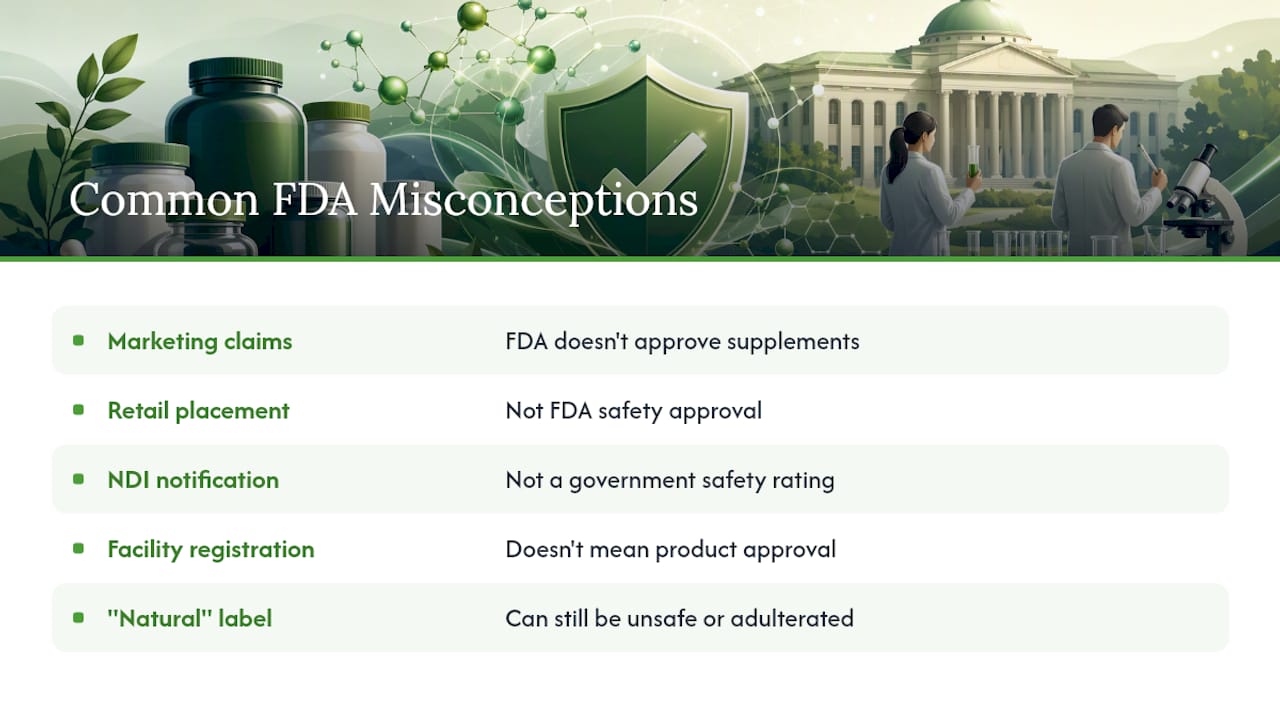
The biggest misconception is baked into the marketing language itself. Phrases like “FDA approved,” “FDA cleared,” or “clinically approved” get slapped on supplement bottles constantly, and none of them are legally accurate. The FDA doesn’t approve or clear dietary supplements in any capacity, and a manufacturer using that language is either confused about the rules or hoping you are.
A related myth: people assume that because a product is sold in a major retail chain or pharmacy, it must have passed some federal safety check. It hasn’t. Retail placement reflects a store’s own vendor standards, not FDA sign-off.
Another common mix-up involves the NDI notification process. Consumers who’ve heard about it sometimes assume filing one means the ingredient got a government safety rating. It doesn’t. An NDI notification is the manufacturer submitting its own safety evidence for FDA review, and the FDA can object to it, but a lack of objection isn’t equivalent to certification.
There’s also confusion around FDA facility registration. Supplement companies register their manufacturing facilities with the FDA, which is a legal requirement, but that registration number on a label doesn’t mean the FDA inspected that specific product or approved its formula. It means the facility exists in a federal database, nothing more.
Finally, many shoppers assume “natural” implies “regulated” or “safe by default.” Natural ingredients can still interact dangerously with medications, cause allergic reactions, or be adulterated with undeclared substances, exactly the kind of problem the FDA’s post-market enforcement exists to catch after the fact.
What Third-Party Certifications Can and Can’t Tell You
Since the FDA doesn’t test supplements before sale, several independent organizations have stepped into that gap, offering certification marks that verify specific claims about a product. Certifications typically confirm that a product contains what the label says, doesn’t contain undisclosed contaminants above certain thresholds, and was manufactured under audited quality conditions.
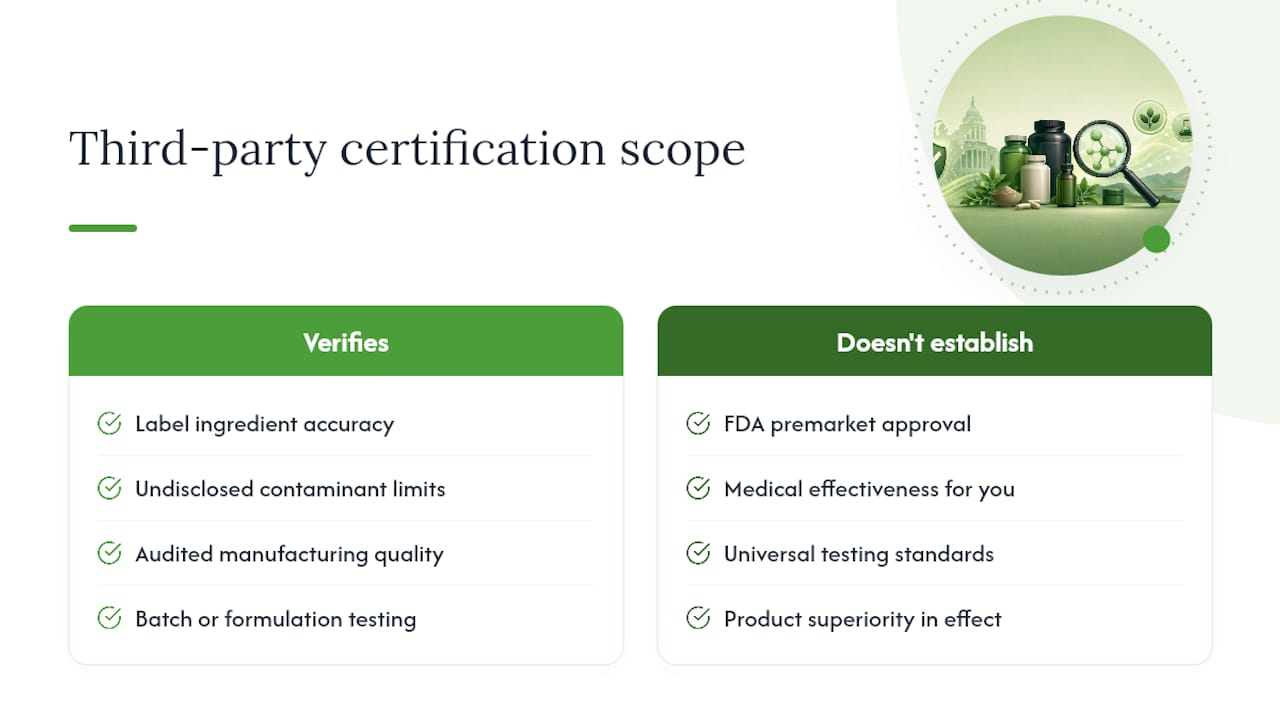
That’s genuinely useful information, and it’s worth seeking out when you’re comparing similar products. A certification mark from a reputable testing organization tells you someone independent looked at that specific batch or formulation and verified label accuracy.
But certification has real limits. It confirms manufacturing quality and label accuracy, not medical effectiveness. A certified product can still fail to deliver the benefit implied by its marketing, because certification bodies test for contamination and content accuracy, not whether the ingredient actually works for the stated purpose in your body.
Certification also isn’t universal or standardized the way a nutrition facts panel is. Different certifying organizations test for different things, use different thresholds, and charge manufacturers different fees for the service. A product without any certification mark isn’t automatically unsafe, and a certified product isn’t automatically superior in effectiveness. It just means one more layer of independent verification happened somewhere in the supply chain, on top of, not instead of, the manufacturer’s own responsibility under DSHEA.
Red Flags That Signal an Unsafe or Fraudulent Supplement
Certain warning signs show up again and again in supplements that later get recalled or flagged by the FDA. Learning to spot them takes less time than reading a full label.
Watch for miracle language first. Claims promising rapid, dramatic results, “lose 10 pounds in a week,” “instant results,” “works better than prescription drugs,” are a strong signal of a product cutting corners, because legitimate structure-function claims tend to be modest and hedged, not explosive.
Be skeptical of products marketed for sexual enhancement, weight loss, or bodybuilding sold outside mainstream retail channels. These three categories account for a disproportionate share of FDA warnings for undeclared pharmaceutical ingredients, often prescription drug compounds mixed in without disclosure to fake a stronger effect.
Missing or vague labeling is another tell. A legitimate product lists a specific manufacturer name, address, and the supplement facts panel required by law. If a listing shows only a vague “distributed by” line with no verifiable business address, that’s worth pausing over.
Check pricing against the category. A product priced far below comparable options in its category sometimes reflects a genuine deal, but sometimes reflects cut manufacturing corners or fake ingredient sourcing.
Finally, search the product name alongside the word “recall” before buying, and check whether the brand has any FDA warning letters on record. A five-minute search catches a meaningful share of problem products before they ever reach your cart.
Editorial Guidance for Responsible Supplement Use
The takeaway here isn’t complicated: nobody is checking supplements for you before they hit the shelf, so the checking has to happen on your end. That’s not a reason for alarm, it’s a reason to ask better questions before you buy. Request a COA. Check for GMP registration. Talk to your doctor if you’re on medication or managing a health condition. Organicufuel builds its own products around that same standard, because it’s the standard that actually protects people, regardless of which brand’s name is on the label.
— Organic
Where to Learn More and Shop Organicufuel’s Product Line
Organicufuel is the alternative to guessing which supplement brand actually tests what it sells. Instead of chasing bogus “FDA approved” claims you now know don’t exist, look for the practices that actually matter: U.S. lab testing, GMP-registered manufacturing, and a money-back guarantee that puts the company’s own money behind its product.
The Organicufuel catalog includes targeted formulas like Alpha Cactus and BioSync-XT Natural Testosterone Support & Booster, along with options such as Ageless For Men, WAP FOR HER ONLY!, the Bad Boy Bundle, and the Holiday Fire Deal 4-in-1 Premium Collection for anyone stacking multiple goals at once. Every product page links back to the Organicufuel labs page, where you can see the testing process behind each formula. If you’re managing a health condition or taking prescription medication, talk to your doctor before adding any new supplement to your routine. Check out the full product catalog to see which formula fits what you’re working toward.
This article is general information, not a substitute for advice from a qualified doctor. Consult a qualified healthcare professional about your own circumstances before acting on anything here.


Comments (0)
There are no comments for this article. Be the first one to leave a message!